Showing posts with label sakura. Show all posts
Tuesday, June 26, 2012
蕨餅: Wannabe Mochi
I have no idea what it is exactly, but it is not mochi and yet I know that is in the naming of this Japanese summer dish. 蕨餅 is technically called warabi mochi and yet, every time I hear it I could swear they call it Wanna-be Mochi (or that is could easily be interpreted that way).
This is not mochi as you might think of it. Mochi is rice that is pounded again and again so thoroughly that is is effectively mush re-solidified again. Ok that was a very un-eloquent way to put it...Mochi is rice that is indeed pounded very thoroughly, though they might also have machines that are able to perfect this technique in lieu of human hammering, and as pounded the rice becomes very sticky and naturally will mush and stick together forming a spherical like mound of dough-looking substance. It is then pulled apart and made into these sticky bite-sized dough-like balls and served to be dipped in a number of fixings, such as sesame powered, soy sauce, ginger soy sauce, sometimes innard fixings of red bean or sesame, and many others, but really I can just stop with the sesame powder, it is by far the most popular that I have seen and for this post, the only one that matters.
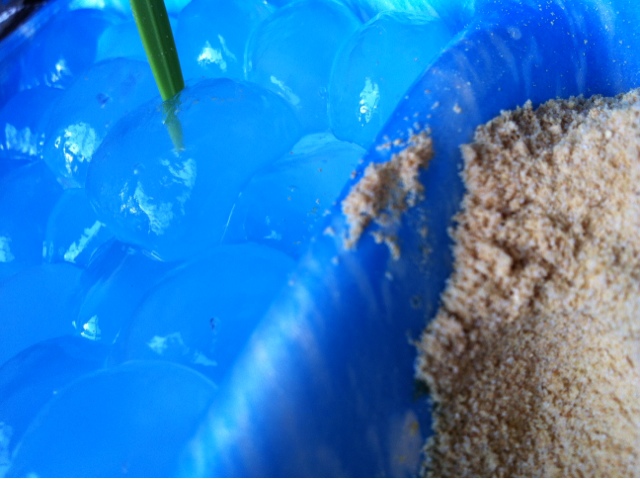
But again as stated, wanna-be mochi is not mochi. It is more so as my name states it. It is not made of rice but a transparent gelatinous substance. It is often clear, green or pink. The clear should be normal flavored and the green is green tea, and the pink might be sakura, but if you ask me those have no natural flavorings. I suspect that wanna-be mochi is made of some sort of agar or gelatin, but then again I cannot read the Japanese in the ingredients and cannot accurately tell you this is the way it is. They are the same shape, the bite-sized little balls, as mochi and are just as stick as it. They have a sticky jello-like feeling to them but more solid than jello, as you stick a toothpick like object in them to pull them apart to eat them. If you do the same to jello and try to eat it with toothpick prodding, then you have far more patience than I for all the jello you will be able to obtain in a single bite...If you eat them plain, there is again the jello texture and hints of flavoring but really there is not much to it. For their flavoring you are supposed to roll them around in sesame powder, much like you would with plain mochi, and then stick them with the little pick and pop them into your mouth.
This mochi can be served cool or room temperature and is a special summer delight for Japanese people. The texture and ingredients of the mochi give it a naturally cooler sensation and therefore it is seen as refreshing in the face of the splendid summer heat.
Tuesday, April 17, 2012
Sakura Season
Here in Japan we have four seasons!
I don't know how many times I have heard this said, but it must be approaching a flabjillion. For whatever reason Japanese people, and Koreans for that matter, don't believe like anywhere else in the world has 4 seasons. That they are the only ones with that exact latitude that is requires for the meteorologic system to grant them the all divining power of 4 seasons.
Well enough of that. Someone recently informed me (after hearing this little rant and telling them that in fact my home in America too has 4 seasons) that Japan has Sakura Season. Well I just had no response to that.
Sakura Season (note: not a real season) is a gorgeous time of year when trees turn white with flowers. Sakura trees do not leaf first; therefore the trees appear purely white with the flower. The appearance of sakura, also known as cherry blossoms, marks the beginning of spring for Japan. As you may have read in many of my other posts, this is also a new beginning for Japanese people. Sound familiar? It seems Japanese people have many chances 'new beginnings' in the first few months of the year. This one marks the start of a new school year, as well as a time for when most people will start a new job, or when the benefits of insurance/ vacation time for a job/ contract agreements typically renew. It has nothing to do with the sakura flowers, or mayhaps it does and was determines several hundred years ago, it mostly involves the coming of spring and new life.
In fact sakura were not so popular at one time. It was the pink blossoms of the plum trees that were the most significant tree-flower that people used to sit under and write their haikus. However people like Hideyoshi changed the favoritism and brought a must greater significance to the sakura flower after he himself declared his preference for it and had many installed for his personal viewing. Sakura then became preferred not only due to the favoritism of an important figure but also because the weather is much warmer when the sakura are blooming making it more desirable to sit under and have a picnic.
Today you can find many people sitting under them on a sunny Saturday when they are in bloom. Due to the nature of the season and the fact that a bunch of new employees just began their terms at their new companies, it is the new lackys' job to get up at 5 in the morning to reserve a good viewing spot for a company picnic. Many people do this in fact. With their blue picnic tarps in hand they get up quite early in the morning to find the best viewing location and set up camp. They might be there all day and well into the night too, as many places have lighting to display the cherry blossoms with a scenic night display.
Sakura Season is an important and well anticipated part of the Japanese culture. People from all over the world flock to Japan during this time. On the new channels they have announcements declaring the blooming percentage as if it was a rain forecast. 'Today there is a 30% chance of sakura' Just so that people know when the best time to set up their little camps is. Different areas of course have different blooming times; Kyoto would of course bloom before Tokyo due to the slightly warmer weather. And of course the placement and sunlight a tree receives also determines the blooming time and period. I saw one cherry blossom tree bloom and entire month before all the rest. But sadly the experience is fleeting. Sakura only last for approximately ten days or so before they begin their elegant little dance to the ground. Which is again beautiful. It is due to the nature of the sakura that haikus are made of their beautiful yet fleeting existence.
I don't know how many times I have heard this said, but it must be approaching a flabjillion. For whatever reason Japanese people, and Koreans for that matter, don't believe like anywhere else in the world has 4 seasons. That they are the only ones with that exact latitude that is requires for the meteorologic system to grant them the all divining power of 4 seasons.
Well enough of that. Someone recently informed me (after hearing this little rant and telling them that in fact my home in America too has 4 seasons) that Japan has Sakura Season. Well I just had no response to that.
Sakura Season (note: not a real season) is a gorgeous time of year when trees turn white with flowers. Sakura trees do not leaf first; therefore the trees appear purely white with the flower. The appearance of sakura, also known as cherry blossoms, marks the beginning of spring for Japan. As you may have read in many of my other posts, this is also a new beginning for Japanese people. Sound familiar? It seems Japanese people have many chances 'new beginnings' in the first few months of the year. This one marks the start of a new school year, as well as a time for when most people will start a new job, or when the benefits of insurance/ vacation time for a job/ contract agreements typically renew. It has nothing to do with the sakura flowers, or mayhaps it does and was determines several hundred years ago, it mostly involves the coming of spring and new life.
In fact sakura were not so popular at one time. It was the pink blossoms of the plum trees that were the most significant tree-flower that people used to sit under and write their haikus. However people like Hideyoshi changed the favoritism and brought a must greater significance to the sakura flower after he himself declared his preference for it and had many installed for his personal viewing. Sakura then became preferred not only due to the favoritism of an important figure but also because the weather is much warmer when the sakura are blooming making it more desirable to sit under and have a picnic.
Today you can find many people sitting under them on a sunny Saturday when they are in bloom. Due to the nature of the season and the fact that a bunch of new employees just began their terms at their new companies, it is the new lackys' job to get up at 5 in the morning to reserve a good viewing spot for a company picnic. Many people do this in fact. With their blue picnic tarps in hand they get up quite early in the morning to find the best viewing location and set up camp. They might be there all day and well into the night too, as many places have lighting to display the cherry blossoms with a scenic night display.
Sakura Season is an important and well anticipated part of the Japanese culture. People from all over the world flock to Japan during this time. On the new channels they have announcements declaring the blooming percentage as if it was a rain forecast. 'Today there is a 30% chance of sakura' Just so that people know when the best time to set up their little camps is. Different areas of course have different blooming times; Kyoto would of course bloom before Tokyo due to the slightly warmer weather. And of course the placement and sunlight a tree receives also determines the blooming time and period. I saw one cherry blossom tree bloom and entire month before all the rest. But sadly the experience is fleeting. Sakura only last for approximately ten days or so before they begin their elegant little dance to the ground. Which is again beautiful. It is due to the nature of the sakura that haikus are made of their beautiful yet fleeting existence.
without you--
how vast
the cherry blossom grove
Subscribe to:
Posts (Atom)

