Showing posts with label Edo. Show all posts

Thursday, October 18, 2012

A Pain of a パン

Pan is taken from the French  Portuguese word for bread, pao. It is commonly thought to be taken from the French word pain(NOT to be pronounced like the English word, 'pain'), which is actually takes influence from the Portuguese word. But you see, Japan learned of this delicious sort of food directly from the Portuguese themselves. The Portuguese are the original influence that opened up Japan for international exporting, and also for western influence. Not to be mistaken for the 'black ships' which brought about the end of the Edo period and opened up Japan, the Portuguese landed in Nagasaki in the 15th and 16th centuries and got a modest, but growing trade scene going. They introduced things like Christianity, medicine, and technology, and of course, bread to Japan, all of which took to different sorts of followings. But of course after some time, Japan became a shut in again and persecuted the Christians and closed its borders. However, in Japan you will find many other things that French and English and Portuguese words that have been Japanified, and this is a popular one. Japan seems to have a small habit of taking the foreign words for things for which they have no word, and adopting them into their own culture; in the process, giving the word a bit of a Japanese embellishment, hence things like ramune versus 'lemonade', or toreina for 'trainers' (meaning sweats).

Bread is possibly THE most important snack food in Japan. Especially in Kyoto. There are boulangeries and patisseries everywhere. But more effectively, bread can be found at the 7-11's and convenience stores, which I might add are way more true to their name and actually convenient, than in America. There is a whole series and selection of bread. Sugary, savory, green tea flavored, creamy, rolls, croissants. Just so much bread.


But the bread that is probably most worth a mention, and is something that can perhaps only be found in Japan. It is called メロンパン or melon bread. This bread is typically round is shape with a criss-crossing of markings across the top and is on the slightly large side as far as dollar breads go in Japan. Sometimes it is covered in sugar, and others it has a greenish dried icing look to it, and other still it is filled with custard or cream. I am not so sure about the melon flavoring...perhaps there is a slight hint to it; but lets be serious you would be eating this bread not for its melonyness, but for the most delicious sugar rush you can get for a dollar at a convenience store while still maintaining your dignity.


Another popular and very traditional styled bread is あんパン or anpan. Anpan is red bean bread. Yeah beans. You might be a little turned off from this bread at the moment, but they are sweet. Yeah, I couldn't really imagine sweet beans either before I came here. I kept imagining throwing brown sugar into some beenie weenies. I bet you might be thinking that too. And that face you are making right now? Probably close to the one I made. But it is actually very sweet, and not all that weird, or bean-ie tasting. This bread is bread and normal looking on the outside, with the red bean sweetness on the inside.

It became such a popular sensation, that they named a cartooned super hero after the bread. In the Japanese anime, Anpanman, the hero has the head of an anpan. Which when damaged, or say, eaten, gets baked anew. The anime became so popular it has been on air for more than 3 decades!

Thursday, July 26, 2012

Eel Day

Eel, called unagi in Japanese, is an incredibly popular cuisine in Japan. So popular, that there is even a day named after it. Eel Day. Pretty original right? Ok well it is more like Doyo Ushinohi....but otherwise known as Eel Day.

Japans affinity for eel comes not from its deliciousness really, but mostly in part due to the fact that there was so many of them at one time. And as with most things it was not originally a gourmet dish. It was too common and too fattening and cooked much like you would cook and ayu fish. In other words, boney and not incredibly sophisticated. Since then, the cooking method has been refined and it has been made more desirable for all people to enjoy.

One of the things I found most interesting about this day is that Ushi-no-hi actually means Day of the Ox. And last time I checked, eel is certainly not ox. Actually Japanese people being as superstitious as they are,  believe that eating anything starting with a 'u' on ushi no hi is acceptable and, of course, brings them luck in the following year. Thus with eel being a commonly found article and with the added fact of the new delicious techniques, made eel quite the popular choice.
Though in present day, the majority of Japans freshwater eel is actually imported from the United States, driving up the price of eel, making not as common as it once was, but still just as desirable.

Also interesting is the way that the eel is prepared. It is cut open from the spine. Seppuku, as you might know, is a pretty infamous final act for samurais. In light of this final affair preformed by samurai of cutting open ones stomach in an act of suicide, the shop owners, not wanting to insult anyone (politeness is forever ingrained) nor detract from the honorable end-all for their samurai clientele, decided to cut open the eels from the spine and not the belly. This is also the way they will open shrimp and some fish as well.
From there the eel is grilled and painted with a sweetened sauce. And finally eaten atop of rice called unagi-don. This dish is can often be found in a bento, but even more so atop of sushi. You can also find it grilled on skewers right next to ayu.


This day changes from year to year, but this year it falls on July 27th 2012. It is supposed to be eaten on the hottest day of the year to give the person more nutrition and stamina to get through the day and not melt.


Thursday, February 2, 2012

Happy New Year - Again!!

Japanese people no longer celebrate the Chinese New Year.

Once before the World War, Japanese people celebrated this custom along with the Chinese and Koreans. Enter American traditions and the holiday was set on the back burner, with more importance shown upon the new year that is set by the Georgian calendar. Japan officially stopped using the Chinese calendar in 1873; long before they stopped celebrating this as as a holiday. I believe this is because Japanese just love their holidays. There are still many holidays in Japan that began in the Edo period and are thus celebrated with the moon phases, or Tsuki-okure, but many more are now being celebrated with the Georgian calendar. Others still, are in the spirit of the lunar calendar but celebrated with the Georgian calendar, like Tanabata which is held on the 7th day of the 7th month according to the lunar calendar, but is now held on July 7th.
Interestingly is that Japanese people still very much follow the Chinese zodiac. These too are vibrantly celebrated and displayed on January first. In the smaller villages and towns in Japan, you might still find some celebrators of the Chinese New Year which hold their customs to the lunar new year day. But you will find more revelers if you look in the local China Towns. There are some decent sized districts in Yokohama as well as Kobe that spritz their area up and put on a show. I had the pleasure of going to the Kobe lunar new year festival.
There you can see speeches, performances, try wonderful Chinese New Year delicacies, and most importantly, the dances. There are two specific dances involving tigers and a Dragon. These elaborate dances utilize the force of many people who are used to support the dragon. The tiger costume is a much smaller operation with just a few people (2-3). The tiger costume is not propped up as the Dragon is and it has full functionality of its facial movements.

 In addition to the dances, I would always recommend a taste of the street food. These vendors sell anything from croquets to pork buns and dumplings, which is a must have as per Chinese New Year tradition. It is said to bring you wealth and prosperity in the new year, but then what doesn't?


 A video of the Kobe Dragon Dance:

Tuesday, January 10, 2012

Drink. Smoke. Party

Let us now enter adulthood.
This year on January 9th all people who are or will turn 20 between the days of April 1st of 2011 and April 1st of 2012 officially become an adult. This is like turning 18 and 21 in the same day for us Americans. As of this year they are, now allowed to smoke, drink, and vote.
The celebration is called Seijin no hi and is held on the second Monday of January. These new adults often go to the local government offices where the ceremonies are held. At these ceremonies speeches and presents are given to the new members of society. It is celebrated with women being dressed up in what is likely the most elaborate kimono, called furisode, they have worn thus far and this hair intricately done up. Men also will wear kimonos and hakama; though more recently modern men's Western-style suits have been preferred ( I wonder if it's warmer?)

Previously in the Edo period the Coming of age ceremony was held for different age groups for men and women: age 15 for men and 13 for women. In the Edo period they would celebrate this day for men by cutting their bangs. Feature in the first picture below, and they will cut it off, or shave it back, to have a samurai styled hair (second picture). 


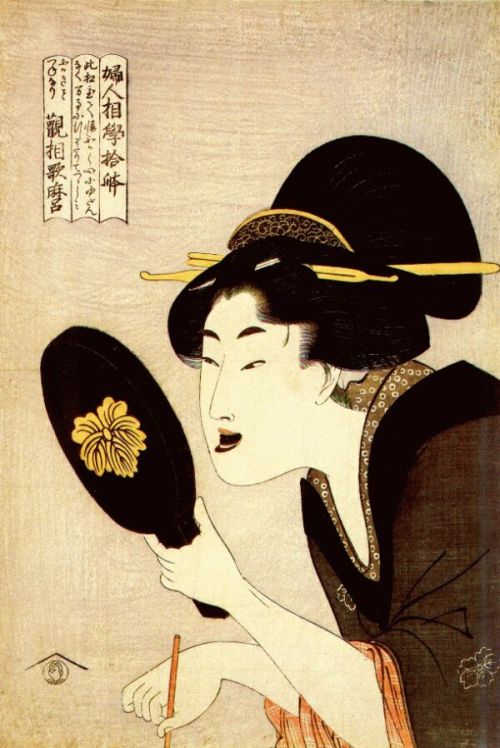
On this day 13 year old Edo period women would in turn dye their teeth black in celebration of adulthood. 

It wasn't until 1876 that the government decided to change the age of adulthood to age 20 for both men and women, likely due to the onslaught of westernization.