Showing posts with label Japan. Show all posts

Thursday, September 13, 2012

Dr. Doctor

Doctors in Japan are extremely different from doctors in America of Korea. 

Let me start with Korea. First of all, in Korea I had to get accustom to saying 'hospital' every time I meant clinic. For them there are no clinics, only hospitals. And when I say hospital, I do not mean the kind with beds. Apparently it is customary to say you go to the 'hospital' whenever you go to the doctor, even if it is just a clinic. And who works in hospitals? doctors. Therefore clearly all doctors work in hospitals. However there are true hospitals as we know them. With the beds and the surgeries and the broken bones. It is at a much larger place, that looks just like your normal one in America.
Moving on, in Korea all doctors are required to learn English, making speaking it for them pretty much no problem. The reason for this is that there are so many English publications for scientific articles that are also important to doctors. Well that is one of the reasons. But there are many. To stay contemporary in terms of administration procedures, equipment, and practices (at least with the English speaking world) are all also very good reasons. Either way, if you have to see a doctor in Korea, chances are that he will speak English a lot better than most. I can personally attest to this seeing as I lived in a tiny little area of roughly 10,000 people (in my country. not my city) and both the doctors spoke wonderful English. One of which I nearly saw monthly. Paragliding is not a sport for the weak. 
Their offices were small and would occasionally be a part of some other building. The one I frequented was in a building that had apartments on the top floor, a travel agency on the third, the doctor on the second and finally the pharmacy. Another thing all doctors had in common was office placement in very near proximity to a pharmacy. I am talking like right outside. His doctor office for the most part was extremely small. And I would like to think there was more than one office, but I only ever saw the one and did not really see much space for another. Therefore it was this one doctor who saw everyone! Talk about a lot of work!
I saw him for muscle aches, ear aches, colds, fevers. Pretty much everything except my eyes and teeth. And he could relay pretty much any and all necessary information to me in English. Additionally he methods were very...western. I am not sure how to say this best, but they were very different from Japan, and very similar to America. He would poke, prod and probe, he would ask if this hurts, and stick things in my ears. In other words, it was a bit invasive, but not overly so, just to a 'normal' amount. He would also go a step beyond American doctors, at least where my ears were concerned (I am very prone to earaches) and would do me the favor of administering a one time dose of the medication on the spot for some instantaneous relief. A total miracle worker.
The medication. Oh the meds. Yes I was probably never perscribed less than three different pills whenever I saw the doctor. And these pills...they would always be very colorful and in different shapes. I swear to you once I had a yellow star pill. But I would always be feeling better the next day. Even if I feel like I might have been over prescribed. And as a result, I would not be taking the pills anymore with in 3-4 days. Oh! and additionally and very helpfully, the pills would always be packaged together for the day that you take it. It was a really nice and neat way of doing it. Like all 5 pills (or however many) would be in their own plastic little package you just rip open and swallow with water. For some reason I found this incredibly convenient. Also the pharmacy was incredibly fast. I never had to wait more than 5 minutes and they would often have a 'gift' for me. Like a hot vitamin drink in the winter (these are pretty popular and come in glass bottles and you can get them at most drug and convenience stores), or packets of tea or gum. That is one thing I really liked about Korea. Their little 'services' that is what they call these little gifts. They do this as a way to earn your favor to ensure your continued patronage, and it is not just pharmacies, but butchers, grocers, boutiques and more.

In Japan it may possibly be the case that all doctors must learn English, but I would never know it. Sure some of the doctors I visit speak a bit of English. Enough to tell me to take the pills two times a day. Nearly all their medical vocabulary might also be in English, or perhaps it is that they learn all the medical vocabulary specifically in English. Bacteria names and things like 'bronchitis' or 'sputum' I don't see in the text books I teach my kids at least. Most doctors will know these things. They even write in English. I am not kidding, they have a fantastic doctor scrawl in their medical records writings. I can't even read it, but I can promise you that it is not Japanese. They will know enough to convey bits of diagnosis and perhaps tell you what you have, but perhaps not how best to take care of it. I think it is because they will write down the key words in their reports, but not exactly connect them together with verbs and propositions and particles and such, which dramatically effects their speaking ability. I was sorely disappointed when I went to the doctor looking for a prescription for my sore throat, and he told me to gargle with salt water...only he did not know how to say 'gargle' or 'salt' (but he did know the word for 'pepper'). This situation did lead to a very amusing demonstration of them preforming the task in front of me so that I would properly understand. However this doctor also told me that sleeping with my mouth open would fix me. -___-
Doctors here are way less invasive. I went to one doctor for a pain in my heel (that I have had since February and it is now September). He looked at my heel and took an x-ray and said to lay off it a bit. No poking, prodding or anything. Did not bother to see where it hurt or really care about my explanation of the pins in my foot. All in all. A terrible doctor I would not want prescribing me anything. If you cannot see the root of the problem nor care to try, then you are not fit to call yourself a physician. Many doctors are like this. They will listen to your explanation. Not touch you at all. Do the least invasion thing (I swear I take x-rays for every little thing!) and give you possibly the worst diagnosis I have ever heard. If my doctor in the United States hadn't moved my foot around for himself he would never know that the tendon was too weak to support physical exercise. If the same thing happened here I am terrified to think of what the outcome would have been. 
Their prescriptions take pretty much forever at the pharmacy. And you get little packages, much like opening a box of Claritin and seeing the individually packaged pills inside, covered by this little foil wrapping. You would think with the time it takes at the pharmacy and with 8 people working there and only 3 people waiting that they must be individually wrapping the pills themselves with the time it takes to get them. I mean at least the people at the CVS pharmacy look busy when you approach them with your prescription and therefore you are much more accepting of their 20 minute wait. But then they have a drive through, and call-ins and people who pick them up at a certain time and then other people who are wandering around the store, but are in reality waiting on their prescription. In Japan there is no store to wander. There is only a white room with seats and if you are lucky a few magazines. And the waiting. Sometimes there is even a T.V. 
Let me talk about their offices. The offices here are more like real hospitals. Not clinics. They are larger and I am certain that each of the ones I have been to have beds in the back for when they administer shots or have patients bedridden for a time. There is still normally only one doctor presiding over things, or at least one at a time. At some hospitals, they have a rotating staff. 
These 'hospitals' are the ones that function more like the clinics we know, but have the inward appearance of hospitals and not clinics. Meaning that there is no consultation room and you get taken directly to the doctor and you get to see all the equipment everywhere. There is a waiting area and then you go beyond a sliding door when your number or name is called and go to face the doc. If you need an x-ray or your blood taken, you go to the separate rooms or floors for that. To me this feels like an American hospital and not a clinic, perhaps because of its size. Though there are true hospitals here as well, with over night patients and surgeries. Sometimes they are of the same building but on the upper floors, other times they at a nearby facility. 

And the last infuriating thing about hospitals, is that they are NOT open all night. Their hours are typically sometime in the morning, with a 4 or 6 hour break during the middle of the day and then open again in the evening perhaps starting around 5 or 6pm and ending around 8 or 9pm. This is largely due to the after work crowd. You see Japanese people are workaholics and don't want to miss their regular work time to go to the hospital, and therefore have the option of going after work. I almost wonder if there was some issue with Japanese workers getting sick and not going to the doctor due to its hours and therefore getting everyone else sick with an end result of doctors everywhere changing their hours for both business and for the benefit of coworkers everywhere. Just a theory. But I digress. Say that you had a mishap late at night, once such that you needed stitches for. Stitches have to occur within the first six hours of the wound (after that, I am not even sure what would happen). But at night the hospitals are closed. I lie. ONE is open. ONE in the entire area for cases such as this. But that one might be an hour away. I am not sure how this works, if it one per every 50,000 citizen  and 2 for every 100,000 or if it is one for 50 square kilometers, or what. But I know there is a very limited number open and once when I was sick in Shikoku, the nearest hospital open was over an hour away and I was in the center of the city. In America, if you have ever been to a hospital at night, you will see nearly every seat taken in the emergency room. Some just have sick children and for others it might be the only time they have off to see a doctor, either way, the seats are filled. Now perhaps Japan offsets this crowd because they have their clinics open in the evenings for these types of people to come by, and therefore they don't have to worry about keeping hospitals open all night. 
And for only one hospital to be open at night... I don't want to think about it and what terrible thing might happen and to have to worry about which hospital it was that was open (as those rotate from week to week). What if there was a fire with victims that were terribly burned and they had to travel AN HOUR to go to a hospital to be treated! There are reasons there are emergency rooms in America. There are reasons they are always open at every hospital. There are cases that need to be treated immediately without needing to worry about open hospitals and forever long journeys. 

Tuesday, August 21, 2012

Borrowed Cars

An extremely interesting option for those who do not have a car, borrowing a car. This is like a car rental service minus all the people. 

This is a really nifty feature of Japan society. Since the majority of people do not have cars as there is simply no space to have a car (most houses do not come with garages or anywhere to park your car), and the fact that owning a car can get pretty expensive, with the parking fees (if you do not have a personal parking lot, you must pay some company for the use of their garage to permanently store your car when it is not in use) and the parking fees (when you go somewhere) and the insurance for the car, and the fuel it eats. You get the picture. It all adds up. So unless you are pretty well off, you most likely don't have a car. But that does not mean you don't have to not have a drivers license. You can still get one of these without registering the car for which you need it. Therefore this little invention of Times Plus, basically a rental car, can be extremely handy for people who need to get somewhere out of the way of buses and trains (or possibly you just have a lot of baggage that can't properly be handled on a train or bus). 
From a designated spot, and for a certain fee you get to rent out this car for a an undesignated amount of time. You pay a pretty low initial fee something like 2 or 3 hundred yen (I am not sure the exact amount here) to be able to use this car. Of course you must have a drivers license, with which at some computer you will register your use of the vehicle before you can use it. Clearly this is for their own security purposes, so if any damage comes to the car, your identity is on file. Now what is to stop you from stealing someones drivers license and identity... your good heart? I don't exactly know. But I do know that the computer at which you register has a camera so that if any inaccuracies or identity thefts occur, it can be easily checked. 
After you check out the car you also must pay by the hour as per use. I can't tell you the fee for that simply because I have never done it (I also don't have a Japanese license). And if you need more gas you have to pay for that too. You also have to pay for the parking of anywhere you park, and in Japan, parking is hardly ever free. 
When you are done with the car, you simply return it from whence it came paying for the hours for which it was absent from its parking spot. Nice and simple right?


Tuesday, July 17, 2012

Suicide by Force

This is determinedly a very unhappy post, but it does show you a lot of insight into some really harsh Japanese culture.

A seemingly mundane event for Japan happened last October in Otsu (pretty near Kyoto), that was just a minor ripple in the pond until recently when investigations uncovered the schoolyard brutality that began making much larger waves.

A junior high school student, a boy of 13 years, committed suicide last year by jumping off a 14 story tall building. Seeing as suicides happen in Japan every day, by train, by hanging, by jumping, cutting, pills etc. It didn't seem too incredibly out of the ordinary. Sadly. It took almost an entire year for them to really dig their claws in and turn this evidence to light, that it was really no normal event. 
I am not talking about murder, no, I am talking about such forceful bullying that suicide seems to be the only logical conclusion for young teens. This story touches a bit close to home for me, seeing as it really happened so close to my own home and I, myself, teach a bunch of junior high schools students, everyone of  which I care about. 
In this particular incident, a group of 4 boys mercilessly bullied this poor student into submission. You might be thinking oh he should just suck it up, we all got punched a few times, it is part of growing up. That may be...but did you have to eat dead animals? Were you forced to practice suicide so that your peers might find you absent from school in the following days in hopes that you finally did off yourself? The group of boys forced the poor lad to do numerous things for them starting with the beatings, the mild money extortion (they actually weaseled out his PIN information and would withdraw money from his account) and shoplifting and escalating to public humiliation of derobing him and scribbling on his face, and finally forcing him to eat dead bees, frogs, and birds and practice his own finale. They made him practice jumping so that he would not be so scared as to do it if that was the way he chose, as well as to tie his own noose and see how it felt with his head snug inside it. Additionally, and perhaps the most psychologically tormenting, was the mock funeral that they held for him, making him play a part. 
Nearly everybody knew about it. Only who wants to stand away from the laughing group? Who wants to be the outsider that lets know it is going too far? Such heard mentality. 
Just before he died, he messaged his tormentors proclaiming his act and they replied with encouragements.

And the worst part?

I know you are thinking how could this possibly get any worse. 
EVERYONE tried to sweep it under the carpet.
The police received advanced complaints MULTIPLE times about the bullying. But each and every time, they turned away the father of the child saying that their hands were tied and there was no proof and it was hard to claim. It was reported to the teachers as well as the school who did no more than say 'Keep it to a minimum'. The boy went to them even for advice. For help. For mentoring. For avoidance. But they turned a blind eye. They did nothing. They did not watch over him as a teacher should. As he was forced to do these acts during lunch break, where I can attest, a teacher has to be in the classrooms at all times. 
And then after the fact?
The school tried to cover it up. At first they claimed there was no bullying what so ever. And then after an initial investigation they claimed that it was only mild instigations.  The school removed all the reports of the bullying and any new evidence reported went unclaimed to the board of education. They actually went as far as to claim that 'no new reports of bullying had been submitted.' They were trying to keep the incident in the family and trying to make it seem less worse than it really was. The reason? Money. Why else? If they school goes public with information, no one will want to go there. The teachers will be out of work, and not only that, they will find it difficult to find new jobs once they are known as the 'Teachers who Stood-by', new schools don't want mentors for their students if they are no mentors at all. A group collective decided to ignore these reports and now a renewed police investigations are looking into the school and case. 
What took the police so long? Why did they ignore the fathers claims of bullying?
One of the boys' grandfathers was a policeman. Not just any policeman, but a well respected one with influential power in a top position. Even retired he still had a bit of power and if it came out that his grandson was involved and how wretched of a person he must be to overlook the actions and mentoring of his own family to end up in such a situation, well it would just not look good. It is suspected that he used a lot of his remaining power to forestall investigations and make them seem less serious. 

Currently the mayor of Otsu has proclaimed that another investigation was going to be set underway promptly as the case has come more and more into light and after being bombarded with many angry parents and emails in regards to the bullying. 
The parents of the boy are suing the involved students and their families for incredibly large sums of money, but in my opinion not large enough. 
Two of the four families have already moved to Kyoto, trying to avoid the spot light that Otsu has become. 

And the worse worst part?
Just when you think it cant get any worse right. There will be no retribution. 
The boys?
Nothing will happen to them. There will be no jail time. There will be no trials. They might have to go to a detention facility and come back all freshly reprimanded but that will be it. Here there is a law that protect kids of the ages 14 and under. I would totally recommend the Japanese movie Confessions, which really shows you how the Japanese mentality regarding this law in respect to the students functions. It also is a movie that gives you some insight to the bullying that takes place in Junior High Schools in Japan(additionally it is a pretty good psychological suspense movie). 

Thursday, June 7, 2012

I miss you

Many people like to ask me what I miss the most being abroad.

Well as it turns out I miss a lot of things. I have been abroad for nearly two years now and I can say that living in Japan makes me miss America more. I think this is because E-mart allowed me easy access to many American foods and items when I was in Korea. Therefore a piece of home was always nearby. In Japan American food is much much more expensive. Even the base ingredients. Needless to say, I cook and eat out American style ( or any kind of Western style ...I won't even tell you how expensive it is to cook or go out for Mexican!) way less. Now I love Japanese food you will hear no qualms from me about most any dish, but sometimes there are things from the heartland that are near and dear and just hit the right spot from time and again. 
I think another thing that kind of frustrates me about Japan that I know I have mentioned before, is the prices. Gas is 140 yen per liter ( it just went down. during golden week it was 160 yen). Mangoes are 300-400 yen. Blueberries 600 yen. A sewing machine ...you won't find one for less than 100.00 usd over here. Oh! And bikes! you won't find one for less than 120.00 usd over here. Well not new anyway. If you are accustomed to living a certain lifestyle in America or even Korea, it will cost you much more in Japan. Road trips? Several hundred dollars. Even if you avoid the toll roads. A nice dinner meal twenty bucks for all the cooking ingredients at bargain prices. Even the hotels are more expensive than in America. Here they often have a little thing called love motels which are typically cheaper than a nice hotel though a large bit more shady. And those will often charge by the person (or by the hour if you prefer). Actually hotels charging by the person is a pretty normal thing in Japan. They do not charge by the room. So a 5000 yen hotel very quickly becomes a 10000 yen hotel when traveling with a companion. 
Let me back up. In Korea my experience was extremely different. I took buses every where and they were cheap. 15 dollars for a three hour ride or so. And then I would stay the night in a place called a jimjilbang ( a large bath house with sleeping areas) for about 5 dollars a night. Food in Korea? I never spent more than 10 dollars for the best meals ( I think meals are typically on the cheap side and they make more of their money off the alcohol most people want with the meals). These prices are certainly cheaper than American places where sleeping bath houses are just unheard of, but in comparison to Japan, it seems like robbery. 

If you are living in Japan or have lived (or living!) abroad anywhere for any length of time. Please leave me a comment on what you missed the most about your homeland when you were away. 

Thursday, May 31, 2012

Tat Tat Tat it up

Here is something that pertains exactly not at all to myself, and yet still manages to infuriate me.
Tattoos.

I am not going to say I am for or against them because personally I don't really care. But what I can't stand is the blatant racism towards people that have them. Recently in Japan, a man employed by the city of Osaka showed his tattoo to a child. What the tattoo was, they never said, but what entailed...After hearing of this story, the Osaka mayor demanded to know who on his force, employed by the government anywhere, in any position in Osaka, who had body ink. Now this already infringes upon the rights of people. And to take it a step further the Osaka city mayor, Toru Hashimoto, just said they may as well quit now. It is currently implied that he is looking fire anyone with a tattoo, but of course there is a certain legal battle. How will he get his workers to survey as to whether they have tattoos or not? He is holding promotion above their heads. He states that anyone who fails to answer the survey will be withheld from all promotion possibilities.
Toru Hashimoto is probably the most active politician in Japan and does do some decent things for Osaka, and then apparently some radical things: tattoos, ending relations with the red cross which provides much of the disaster relief to many victims, such as for Fukushima last March. And additionally he is an advocate of dismantling the Tokyo government. He feels it holds too much power and that to dismantle it and start afresh would be in its best interest as it can't but last another 3-5 year (quote).

So what is next?
They have now put forth a motion where any teachers in the employment of Osaka government will have to answer if they have tattoos or not. Remember this does not affect me or my job. I am tattoo free. But the blatant criminalization for freedom of expression is so overwhelming that one cannot help but to be infuriated with the closed-mindedness of the Osaka government. The movement for teacher is luckily facing a lot of opposition from the board for good reason and is in an unpassing stalemate currently.

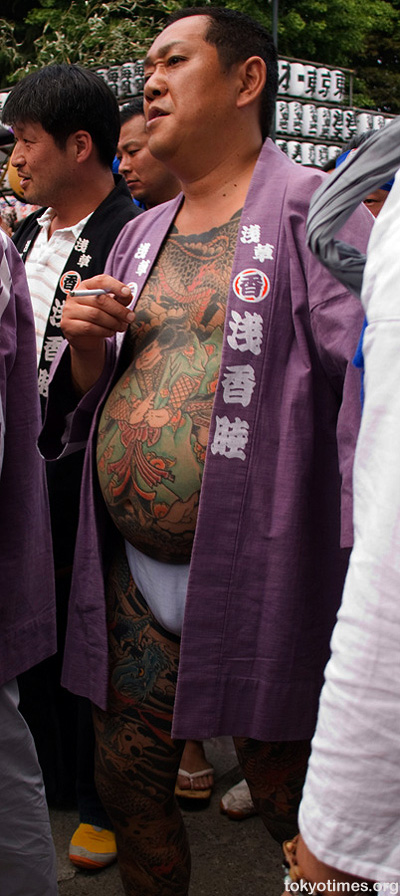
Tattoos have long been a source of stereotypes and even fear in Japan, as they have long been related to the yakuza, the gang population in Japan. I can't tell you much about gang related tattoos other than that apparently they exist. The situation is probably highly similar to tattoos in the American gang scenarios. Regardless, the yakuza inspire fear in much of the Japan population. And seeing tattoos only increases the knowledge of the person, the affiliation and that fear. And the best way to see tattoos? Get naked. No really. As people began to take notice of these tattoos at public bath houses and onsens, their clientele began to express their worries and take their patronage elsewhere. Action was taken, a rarity for Japan. The public naked places put a ban on anyone entering with tattoos. This means regular Joe with a MOM tattoo can't go either. Why? Because they had to make it fair. They cannot just ban the yakuza that is illegal and infringing upon rights, so they had to make it everybody to be politically correct. At least they got that bit right.


The above is an example of some Japanese yakuza body art. There isn't necessarily one image they stick to but more over a style of images.

AN UPDATE!
So 6 people who admitted that they had tattoos on the survey were recently fired from their positions.

Tuesday, May 8, 2012

Fax me

Another technology related post for Japan.

Japan relies heavily on fax machines to this date. Seem crazy? Yeah it is a bit, while most of the world has moved on the scanning and emailing things (or merely just emailing them), they seem to be a bit hung up on these devices. Japan invested heavily in them just before the internet was birthed and as a result refuses to give up on them. Instead they continue to upgrade them and modify them so that you now don't even need to scan anything in to send a fax. You can create the fax on a touch screen that has recently become a part of the new designs. Know what that sounds like? Email. Due to the fax machines resilience to things like modern innovations and its own expiring uses, you will be able to find them at any company and the majority of homes as well. It is not too uncommon to hear that someone will fax you something late at night as opposed to emailing.
The primary reason that the fax machine became a tool of Japan-wide use was because kanji was easier to write than to hand type on a computer. As computers were a fairly recent invention at the time, I suspect that there was no efficient way to input the kanji characters when typing and very likely the entirety of the kanji collection might not have even been added yet. Since then it has become much easier to type in kanji; however, like a stain on your favorite shirt, the fax machines' prevalence is a thing that still has yet to meet its tossing.
As such I receive scheduling documents that could easily be draw up in excel and sent via email, via a fax that is in turned scanned in and sent to me via email instead.

Thursday, May 3, 2012

I am the 1%

Actually I am the less than one percent.

That is how many of us white kids are in Japan. The total foreigner tally of Japan marks up to a good 2.5 billion but then you have to subtract all the Korean Pachinko owners and their families and also the Chinese businessmen stealing Japanese tech and retired manpower. Also the Brazilians who for some weird reason took Japan by storm a few years back and have been good friends ever since. And there you have the rest of us; the Indians and their restaurants, the Filipinos and their Japanese obsessions, and the White people and their English. Turns out that 100,000 for all of these nationalities and almost any other, is a pretty charitable number.
Japan's population is a whopping 127.5 million people, that is ever decreasing as their birthrate is in decline. Japan is a wonderful place for tourism, but it turns out that it might just not be the place for foreigners to settle down and spend a few years for life. Well it is for the English teachers, but for many other professions, it just might not be the place.
Living here I have on ever met one other employed foreigner who did not work for anything other than the English language. He was from France, Lyon, and worked at Uniqlo and was the better part of trilingual. He was studying at a university in Kyoto and had a part time job to help him get by. There are actually plenty of foreigners who actually go to school here. I love right next to a university that has perhaps 50 foreigners going there. And if you have read anything else I have written, you would know that I live in a really small city that has not that much to offer (and thus the students don't actually live here, they live in more lively areas and just come to school here everyday). But I consider myself very lucky for this passing foreigner recognition. There are many out in the inaka that don't have these opportunities and are faced with much fewer encounters to even utilize their English in a natural conversation. At least I have the opportunity.
The few foreigners that I know of who have jobs other than English-related careers are people I have never really met. They are or were the CEO's of large company's, or a supposed statistic of businessmen who have been position here on a contract for a few years, located in large places like Tokyo. The CEO's of which I speak are actually no longer. It turns out it is very difficult to change the way Japanese people might think leading to some having to step down from the positions. The only one I know in a current position of major recognition, is the CEO of Nissan, Carlos Ghosn.
The major reason for the minority of foreigners in Japan is probably due to the high cost of living here and the inability to purchase the comforts of home. For example, or for redundancy since I know that everyone who has ever been to Japan has mentioned this, fruits are an extreme sore point as the prices in Japan are skyrocketed 500yen (perhaps 6 USD) for strawberries. Year round. I mean unless they are damaged. Actually during Christmas, strawberries prices are inflated to 900yen due to the Christmas cakes and everybody needing to make one. Another super good example. For anyone who knows the game Skyrim, the price of the game here in Japan is 7180yen, the price back home is 49.99USD - or less depending on where you buy it! Another ridiculous example. Fans. The normal electric kind you plug in and enjoy in the summer heat. I was walking around a department store and saw a perhaps meter and a half tall with 40cm rotating blade or so and it looked very normal. It was also 12,000yen. Over a hundred dollars. Ovens here are not sold for less than 10000 yen (cheap is about 30000yen and they go over 100000yen) and are about the size of a normal kitchen microwave. Actually I mistook them microwaves at first. As they are electric and not gas (or at least not that I have seen yet).
So there is definitely a huge tourism draw to the country with their ancient shrines and temples and numerous historic sites, but the limited job market and the ridiculous cost of living make it a fairly uninhabitable environment for most foreigners to stay too long. Thus making me a very small percent indeed.
And a side note, imagine the percentage of and African or African-American people here trying to make a living. We consider them a minority in America, but it seems to me that we, Americans as a population, have no idea what minority means until we live in an environment where we are such a small percent that there can be a day or even a week that goes by where we do not see anyone who we can have a chat with (in our natural tongue of course). Though that of course depends on where you live and how out going you are.

Tuesday, May 1, 2012

Pet Shop of Surprises

I can't resist a good pet shop.

In general pet shops in Japan and America are the same. They have you usual puppies and kitties and insanely high prices. I have not actually found a breeder here yet or anyone selling animals in general. It seems like once you buy it, you are stuck with it...even if you don't want it. I think that might be one of the more interesting things to me. When I first got here I searched up and down for a bird or dog that someone was selling (getting rid of) and needed a new home. However they were not to be found. Japanese people either really love their pets or they just don't give up. It is a touch inspiring.
But back to the pet stores! You can find pretty much the same things as an American store with a few exepctions. Those exceptions being meerkats, owls, and monkeys. But yup! Pretty similar.
I must admit, when I first saw the meerkat I thought to myself what an oddly restless and unbeautiful dog. It was no dog. It was right next to the dogs. And in a dogs kennel. And evidently people buy them and want to have them, as in three weeks time it was sold. The monkeys are small I-fit-inside-your-hat type of monkeys. And are adorable and a bit reserved. For whatever reason I did not find it incredibly odd they were there. Well, I mean they were no longer odd after I found the meerkat. Lastly, when visiting and playing with the birds as I always do, I came upon a very large barn owl cooped up in a darkened cage that really seemed way too small for it. Now this was surprising. I thought you had to have licenses or something to own one? Perhaps you still do and need to present it upon purchase. The owl was beautiful and it seemed to have been there a while as it was immune to all the noise and hubbub that filtered in from the busy street. It could be that pet owls became a popular item after the Harry Potter movies. I can't say.
In addition to the few featured unusual pets, the pet stores differ in that they are exceedingly expensive. A Shiba Inu dog can set you back nearly 200000yen. The older they get the cheaper they are as people prefer them to be very young at the time of purchase. And thus you can buy one for 98000 or so yen. Other dogs are less in demand or perhaps they are just in surplus and are typically cheaper, but not by much. I actually did not look at how much it would be to own an owl or a meerkat. But I promise to do so upon my next visit.


Thursday, April 26, 2012

Weight loss: By Trial and Error

I am a girl.
Oh man glad I got that off my chest. Surprise I know. But like many girls, I was forever concerned about my weight. I have tried a great good number of methods to slim down and keep it to a minimum while staying healthy.

Running for one. I have had a beautifully broken ankle in the past which to this day limits exercise options, largely due to the surgery it has since incurred. So I limited myself to gym exercise, primarily on the elliptical. I would go crazy with gym exercise for periods of time with mild success. Of course as a student it is difficult to keep a regular schedule with the onslaught of tests, papers, and projects all bombarding you for your space and time. Thus regularity with the schedule was difficult for time other than the summer. This clearly did not work out so well for me. I would only make progress for a short time and then regress. All in all I really only ever lost water weight doing this. I can say this however, I did lose a lot of fat during this time, but gained it back in muscle. So I was looking trimmer than before after I started doing this.

Another things I tried was weight loss pills. Oh I have tried many. And I was even met with success for one of them. However as the warnings say, you should not be doing them for a long time or it could cause some more serious health side effects. That aside, do you really know what you are ingesting when you take these? These have been no long term medical studies. How could there be? These have only cropped up in recent years. These puppies could very easily lead to organ failure or blood thinning. Therefore I cannot recommend this to anyone who wants to seriously permanently and healthily lose weight. I only took these for short periods of time during the bikini season, if you will. I additionally cannot recommend these because of the 4 or 5 variations I have tried, only one has worked. Perhaps you have to be very strict with the measures with which you take these ( the time of day and amount of exercise you get), but for the price they cost and the results I have had, it is just not worth it.

Dieting. Ohhh dieting. Everyone always telling you to eat right and eat less. Well they are right to a degree. Americans, which I am, eat a heaping lot more than they should. I think the best weight loss regime that I have had in my college years has been dieting. Granted it was also not so fun and a bit saddening. I mostly ate salads and ate very moderately to little. I probably lost a good 20 pounds doing this for perhaps 6 months. However then I regained a social life and the happiness that came with that, going out, eating nice meals, dessert parties... and much of it returned.

Now for what worked for me

Moving.

I moved to Korea a year and a half ago and then to Japan since then. Before I moved to Korea, I weighed in at 162 pounds ( HOLY CRAP)...ok not so much. I had a lot of muscle on me from my sporting days, of which I had many. I was a bit overweight but not terribly and I at this point I was comfortable with myself, as it was perhaps the largely the most consistent weight I have had since high school. Only I looked better and more trim since then, as I was eating better and had a bit more muscle on display than fat.
But FYI for Asian standards, this is very overweight. But they are also structurally very different with a lot less muscle ( I feel as though I could very easily take any Korean woman on).
Moving to Korea made a huge difference though. In both my dietary and exercise regimes. Of course I ate more rice, debunking any Atkins diet for me. I ate loads more vegetables and fish as well. In addition I was walking 4 kilometers a day. That is a little over 2 miles (for Americans). With this constant assuage of a constant healthy diet and physical exercise, as well as extremely active weekend activities I began to lose weight. I didn't notice at first. It wasn't until I was in a jimjilbang ( a Korean bathhouse) that I noticed my face was looking slimmer. After my year in Korea I weighed a grand total of 17 pounds less.
Feeling great I moved to Japan and gave up juices, ( do you have any idea how man sugars those have?!) and putting sugar in my coffee. As I was already accustomed to not drinking soda ( another American guilty pleasure), my sugar intake dived. Additionally my walk to work was farther, increasing my previous routine to about 8 kilometers a day. Thus, after living here for 5 months, I have lost another 5 pounds. Making my grand total thus far to be a loss of 22 pounds and I weigh in at 62 kilos (about 140ish pounds). I can definitely say that I look way better and because of that feel awesome.

Therefore my final advice on losing weight is to move to Asia.

And because everyone likes to see before and after pics (and bikini pics as well here is an after pic...now let me find a before one...)

Tuesday, April 24, 2012

The difference between Kimchi and Sushi

So most of you might know I have spent a year in Korea and well a bit of time in Japan so far. But even with my short time here I have noticed some extreme differences. Now there is abosulutely no way I can catagorize all the differences in just one post. Thus, since the place where I have spent the most time thus far in both the countries is at school, I will talk about some of the differences I see here at school in this post.

So first off, the place where I definitely spend most of my time at school, the office!
In Korea, I had my own office that I shared with my English teaching cohorts. In my case, there was one other native English teacher at my school, and a Korean teacher and then there was Kate. Kate was our very special...helper. She did not have a teaching certificate so was technically not allowed to teach, but she made sure our classes ran smoothly and no student got too out of hand. We probably drove her crazy. There is a reason there is not a Kate at every school.
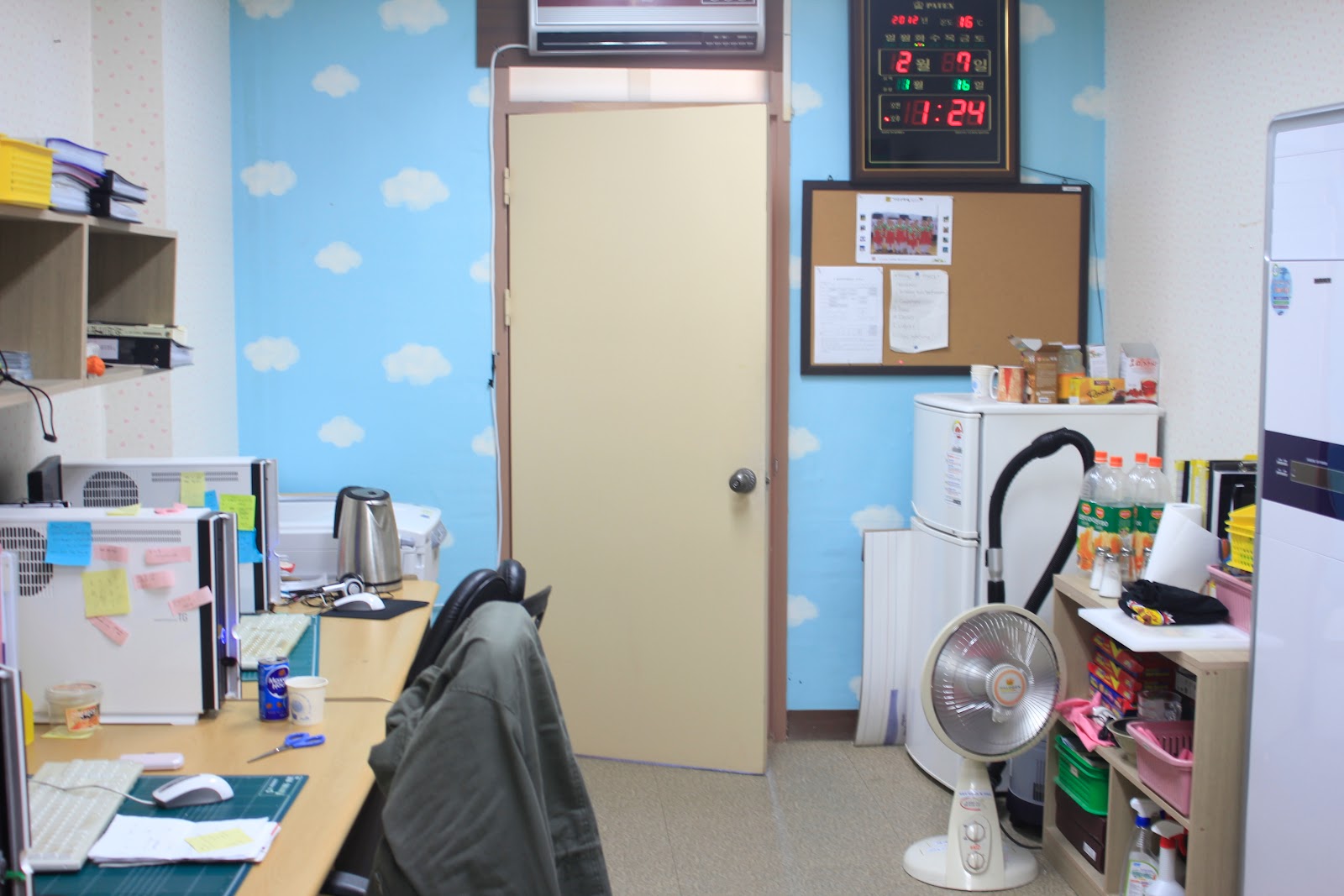
Our office was a small little thing that really barely fit all of our desks. Additionally we had a full army of our very own machines in that room; including multiple heaters, an ac unit,  2 printers, 4 speedy slender desktop computers, a huge copy machine, fans, and craft supplies. Somehow it and us all fit. However it was OUR office. With no one else.
It was also very clean as we cleaned it ever Wednesday (or Friday depending on the semester).
While in the office there were practically no blocked sites and when desk warming in the winter in the absence of students facebook and megaupload movies were a constant feature on our computer screens. I once even caught more than one coworker playing Starcraft. No surprise there I suppose.
Now let me say a word on everyone else's office. Their offices were practically their classrooms. They had all their tech gear for teaching a class and their desk furnished with their computer in one corner of the classroom. This is much how I remember it being in America when I was little. There were a few admins who had their own office and then a few of the interning personnel who had a desk in the vice principals room which also served as a large meeting room. This room is where everyone would gather for coffee in the morning and where everyone would come at the end of the day for a bit of respite. It was a large room with a large circular table. In the winter and summer, what staff remained at the school would set up temporary offices here rather than in the solitude of their rooms. It was a super friendly environment.


My desk and office in Japan is no less friendly, possibly even more so as all the teachers share one room. Teachers who are home room teachers also have a desk in this room, but are more frequently absent from it. The head of the room is presided over by the school leader. A person who addresses the masses, er teachers, and deals with their concerns. Beside him sits the vice principal and an adjoining door connects the principals office to the teachers room.
The room itself is relatively free of large machinery,for its size, save for several printers strategically places about the room either for printing in color printing, and copying, or just a black and white printer. Every desk varies in size and shape and has drawers of varying degree as well. Every teacher is furnished with a desk and a laptop. Anyone know knows me has heard me talk about these laptops. They are approximately 6-8 centimeters thick, weigh like 6 kilos, are slower than frozen slugs in the dead of winter, frequently lose internet connection and are over all better used as boat anchors. If you are wondering exactly what make and model it is, its something like a model-T Fujitsu, which seems to be the sponsored brand for Japanese schools.
These computers were certainly less friendly to me than the Korean computers I was accustomed to, as they have a similar but slightly different keyboard than western computers. Sure you can type just fine, but whenever you want to add punctuation or think you know where that plus sign or at mark are, think again! Additionally it is fairly easy to change languages on these computers and a bit more difficult to change back. There are exactly 4 keys on my key board that will change my words from English to either romanji ( yes it is different), katakana, kanji or hiragana. AND THEN as if that wasn't enough, you can either keep the western keyboard orientation when you switch...or you can switch to the hiragana keyboard which requires me to hunt all over the keyboard for the right character. I have recently figured out the exact combination of two keys that I need to hit in order to return to my sort of normalcy (its alt and the key beside the 1), since it is impossible to revert back on the computer interface... though I suspect my computer being especially special in this case. Often these schools will have visiting teachers or teachers who only come in once a week for whom they will also have a desk and computer.
In a separate adjoining room in the back we have all of our machinery capable of printing more pages in a minute than the Occupy protesters present right now in New York. It also works to my advantage that is is the dead of night there as I write this. Next to that room and still attached to the main room is our admin office...I am not really certain what these people do...
The rooms themselves aren't really all that clean. In fact I have never seen anyone pick up a broom in my office. My desk is by default one of the cleanest for the simple reason that in comparison to the other desks, there is nothing on it. Today a guy two desks down from me had an avalanche of papers. His desk, or lack thereof, is definitely one of the most impressive I have ever seen. The office being dirty is a little on the strange side for me, as in Japanese schools there is a special time after lunch that is reserved for cleaning and all the students must take to broom and cloth to wipe the room clean.

A few of the other differences include the structure of the building itself. My Korean school was very small with only one class per grade; however this can be attributed to my living in a very small town. It was a one building school, with 3 floors and about 15 classrooms for various purposes. An addition of a cafeteria and an afterthought of building a fancy English center over head were a later attachment to the school adjoined to the main building with a sheltered wooden walkway.
Whereas in Japan my school is huge 4 stories and 3 separate buildings with around 50 classrooms. It has a swimming pool and a huge field ( this is a junior high school with a swimming pool but the junior high school in Korea did not have one). The fields at both my elementary and junior high schools are hands down bigger than that of my Korean school, but again this can be attributed to my living in the Korean boonies.
But with all its luxury it is no match for the technology of Korean classrooms. Sure my schools in Japan are furnished with lovely smartboard televisions and 4 meter long chalk boards.
But in my Korean school, I had a blue screen, a projector for physical objects, a projector, and a 60 inch touch screen television at my disposal. Not to even mention that in their regular classrooms, my students each had a tablet netbook that they would use for their lessons. The trade off for all of this electric magic was having itty bitty white boards that flanked the T.V. and could not do much for whiteboard teaching. Meaning, I had to always have an elaborate powerpoint at the ready. The other trade off was that our rooms had no windows. I am not really sure why that is since there was an obvious plan for windows from the outside, they were blocked off from the inside.

Photos!
In Korea:


Japan!
JHS
Elementary School


a new elementary school:

Tuesday, April 17, 2012

Sakura Season

Here in Japan we have four seasons!

I don't know how many times I have heard this said, but it must be approaching a flabjillion. For whatever reason Japanese people, and Koreans for that matter, don't believe like anywhere else in the world has 4 seasons. That they are the only ones with that exact latitude that is requires for the meteorologic system to grant them the all divining power of 4 seasons.
Well enough of that. Someone recently informed me (after hearing this little rant and telling them that in fact my home in America too has 4 seasons) that Japan has Sakura Season. Well I just had no response to that.

Sakura Season (note: not a real season) is a gorgeous time of year when trees turn white with flowers. Sakura trees do not leaf first; therefore the trees appear purely white with the flower. The appearance of sakura, also known as cherry blossoms, marks the beginning of spring for Japan. As you may have read in many of my other posts, this is also a new beginning for Japanese people. Sound familiar? It seems Japanese people have many chances 'new beginnings' in the first few months of the year. This one marks the start of a new school year, as well as a time for when most people will start a new job, or when the benefits of insurance/ vacation time for a job/ contract agreements typically renew. It has nothing to do with the sakura flowers, or mayhaps it does and was determines several hundred years ago, it mostly involves the coming of spring and new life.

In fact sakura were not so popular at one time. It was the pink blossoms of the plum trees that were the most significant tree-flower that people used to sit under and write their haikus. However people like Hideyoshi changed the favoritism and brought a must greater significance to the sakura flower after he himself declared his preference for it and had many installed for his personal viewing. Sakura then became preferred not only due to the favoritism of an important figure but also because the weather is much warmer when the sakura are blooming making it more desirable to sit under and have a picnic.
Today you can find many people sitting under them on a sunny Saturday when they are in bloom. Due to the nature of the season and the fact that a bunch of new employees just began their terms at their new companies, it is the new lackys' job to get up at 5 in the morning to reserve a good viewing spot for a company picnic. Many people do this in fact. With their blue picnic tarps in hand they get up quite early in the morning to find the best viewing location and set up camp. They might be there all day and well into the night too, as many places have lighting to display the cherry blossoms with a scenic night display.

Sakura Season is an important and well anticipated part of the Japanese culture. People from all over the world flock to Japan during this time. On the new channels they have announcements declaring the blooming percentage as if it was a rain forecast. 'Today there is a 30% chance of sakura' Just so that people know when the best time to set up their little camps is. Different areas of course have different blooming times; Kyoto would of course bloom before Tokyo due to the slightly warmer weather. And of course the placement and sunlight a tree receives also determines the blooming time and period. I saw one cherry blossom tree bloom and entire month before all the rest. But sadly the experience is fleeting. Sakura only last for approximately ten days or so before they begin their elegant little dance to the ground. Which is again beautiful. It is due to the nature of the sakura that haikus are made of their beautiful yet fleeting existence.
without you--
how vast
the cherry blossom grove

kimi nakute makoto ni tadai no kodachi kana (1817)


Tuesday, April 10, 2012

Say Cheese!


There is a remarkably popular invention called the "purikura". Otherwise known as the Print Club (puri meaning print and kura meaning club, thus print club).

In America, I always saw these as a charming little addition to any T.V. drama special. Don't know what I mean? Just look at a good lot of the girly dramas, particularly the older ones when the fad was more popular, but even new one such as Pretty Little Liars (no, I don't watch this) feature the overused cliches of photo booths. This fascination with photo booths is primarily focused in bigger cities such as New York and Los Angeles, as they are bigger cultural melting pots with a much more hip type of crowd. They are also of course found in Asia. All over it in fact. But mostly in the idol and photography obsessed areas of Korea and Japan.
Now being an actual living being that is not on a T.V. set, I never actually saw one of these things in America. I am going out on a limb assuming they can be found in popular city centers.
I was first introduced to it in Korea. Where they have little shops devoted to it. And I do mean little, I think my neighbor has a bigger walk-in closet than these shops. In it I found the stickers of happy smiling patrons all around, counters, ceilings, windows, booths. That's right. These pics are more than meets the eye, they can be stickers too. Being new to this whole experience, I don't actually recall much of my first experience. Just that I have the itty bitty smiling faces on photo film as proof of it. It was rather overwhelming. Smile! Pose! Snap! Next! Snap! Snap! Snap!
The boom of these purikura photos hit its peak about 10 years back. Wherein you would have to stand in line to take your pictures. For this reason the machine developers instated time limits when selecting features in order to meet their supply and demand and of course make money. In some areas you can still find a line outside these booths on a tipsy summer night with some girl friends in the city.  But for the most part the fad has faded a bit. This does not prevent my students from having their textbooks covered in the little stickers.


The booth exterior, the booth interior, and the outcome ( after fun-time in the editing room of course).