Showing posts with label food. Show all posts

Tuesday, July 16, 2013

Foodies of Japan

Japan is full of foodies. Pretty much everyone is a foodie here.

Every time someone goes somewhere special, even if it is the next town over, you will get food. These little rice cracker omiyages or a sweet cookie flavored in that cities famed orange flavoring. As you might know here, every city is 'famous' for something. And many cities just so happen to be famed for exceedingly similar if not identical things.

But beyond the little food culture presents, everyone here is forever taking photos of their food. You will always know a Japanese tourist in any country if they are the ones taking about 20 pictures of their dinner plates while it grows cold. Turning it different angles trying to get the light and the shutter frame exactly perfect to best accent their delicious dish. And then they might even proceed to whip out their phone to take a few more to upload them to facebook or mixi or whatever other social network they are using.

And then. Then there are the mangoes that cost 20-30 dollars per mango. Or the melons, the cantaloupes that are upwards of 50 dollars or some even nearing 100. Just for a single, solitary, individual, normal sized melon. These melons and mangoes are thought to be perfectly shaped and perfectly colored and the perfect gift. I cannot attest to the taste of them and I almost wonder if anyone actually eats them or just has them rotting on display as a look what perfect amazing melons I have (jokes intended). I also have never seen anyone buy them, which begs the question, what does the store do when the melons and mangoes start to go soft and over ripen? Do they just get placed with the other fruits? Do they go on discount? Perhaps this is all just an elaborate scheme to garner more money by the grocery stores who just switch out the melons with a more ripe one with no one the wiser, because honestly, who really looks and measures how perfectly their melon is shaped? I can say this for the stores though, these delectable are exceptionally carefully packaged and preserved with the best efforts, placed in silk lining and cradled in foam and then packaged up neatly in a nice little box. So maybe you are just buying into the appearance? Wouldn't be the first time anyone bought into appearances (one night stands, wives, material goods, plastic surgery) But who would ever want to buy into this beyond me. Additionally, when all gift wrapped up, no one will really know how much it is worth, unless they are a shapely-melon connoisseur. So my idea would be to by a nice, normal looking melon and wrap it up neatly and make people think that you spent that much on them and then bathe in their worship for your perfect choosing of melon-ness. Honestly, if you are going to spend 50 dollars buying me fruit, I am going to be expecting like a me-sized portion of bananas. Which would be undoubtedly awesome. Especially if it looked like me.

These special fruits in Japan are bought and given obviously on special occasions, perhaps to a retiring boss or to an employee who recently received a promotion, or maybe in the event of a wedding. I can't help but think of this as a way to throw money around and flaunt it. I have so much money I don't know what to do with myself, so let me buy this outrageously priced melon to flaunt it a bit. And oddly, people don't have that much money here. By far and large ( way over 50%) of the money held in Japan is by the elderly who have retired.


Korea actually has something similar to this, but with a much more reasonably priced tag. Korea will sell you boxes of spam or fruit or what have you all neatly packaged for perhaps a third or a fifth of the price. These gift boxes are much more common in their culture and are given on any number of occasions. House warming, recent holiday, home coming, new baby, hair cut. Well you get the point. But these things will normally at most cost you 30 dollars for an extremely nice set of what have you. Also their gift goods have a much wider variety: dishes, towels, spam (a crowd favorite), grapes, even toothpastes (that was a weird one to get!).

I can understand the little rice crackers from every city and prefecture, I can almost understand the food pictures, but this...This is a truly outrageous and bizarre food culture of Japan.


Tuesday, February 5, 2013

Zenzai

One of my favorite winter treats is zenzai.

It is a really simple sweet soup dessert. It pretty much consists mostly of a liquidy red bean soup. I know I know...red bean yeah yeah gross. Normally I am not the biggest fan either, they are actually just a bit too sweet for me. But for some reason this soup is less sweet than the bread. So as I was saying, it pretty much only consists of this liquid red bean stuff and some mochi. Really simple right? Of course you have to warm up and cook the mochi first before you add it to the soup, but over all, not a big deal.
And the BEST part about it? It is really REALLY easy to make. You can simply buy dried mochi and a can of the red bean stuff. You have to give the mochi its texture back, so you cook it a little in some water giving it its moisture and possibly then microwave or pan fry it for quickness if you prefer. And then you heat up the red bean canned deliciousness, add the mochi and BAM. done. fantasticness....I want some...

There are actually two different forms of zenzai that I have encountered and one is more watery and one is a thicker soup where the beans are more frequent and crushed and the watery one, the beans are left more whole. Both are really delicious.

You can actually eat this in the summer as well. I am pretty sure China first trademarked that (as well as the whole zenzai food tradition). You simply put the red bean paste over ice and add some sweetened condensed milk for some nice summer flavor, and any other suitable flavoring. They eat this pretty much all over Asia from what I can tell. China, Korea, Japan, and I honestly would swear I had something all too similar to the summer variation when I was traveling SE Asia as well.


Thursday, September 27, 2012

The Tofu Man

I am not sure if this man exists everywhere, or if I am just super lucky.
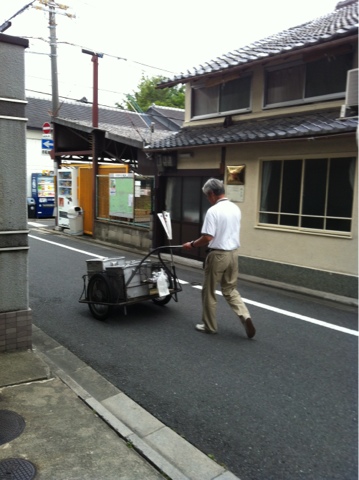
Anyways the tofu man is a man with a large two-wheeled aluminum wheelbarrow and a horn that sounds like a 1920's retired fire engine alarm. WEEEEEEE woooooo, the forceful sucking of air in and its exhausted release back out, like an old man on a respirator. You may or may not get the picture.
This man goes up and down a dozen streets and side streets throughout the day blowing the little horn. As you might have guessed he sells tofu to the denizens of Kyoto. This tofu is very likely homemade by the Man himself or possibly his wife. I cannot actually attest to the quality of the tofu and its tofiness, as I have never actually wanted tofu whenever he came by. He pretty much only comes by during daylight hours, around midday, but he will continue until dusk. And he will sell his tofu rain or shine. I have seen this man all decked out in rain gear with a covering for his wagon as well. I assume snow as well, but as it has yet to really snow and stick in Kyoto...
Honestly the way he walks selling tofu rather quite reminds me of the ice cream man in America. Touring the streets for sweltering children looking for respite, or in this case it is Japanese housewives planning their dinners.

Tuesday, July 31, 2012

Gion Matsuri

One of the three biggest festivals you can happen to see in Japan.

This one takes place in Kyoto and specifically, if the name hasn't given it away already, the Gion district. 

This is not an event that you run through quickly and get it all done. Rather it strolls right through your city and makes sure you know its there. It is a month long procedure starting at the beginning of July, but the most notable events begin around July 10th. At this time you will often hear the Gion Matsuri music being played in the arcades and along the street and shopping areas. There is a parade welcoming the mikoshi which effectively works as a further build-up (further since this is the second parade for the month in honor of this matsuri). It is this day that the mikoshi are cleansed in the Kamogawa and the commencement of the building of dozens carts called yamahoko. There are special places all over the city with granite blocks inserted into the street where the yamahoko are build upon when the time comes. 
The yamahoko are provided by special communities where they originate from (often called yama something) and if you are a member of one of these communities you have the unfortunate tax of providing for these gargantuan carts. There is a special community tax for their up keep, but in addition there are also sponsors for some lucky carts as a bit of a financial break. The instructions for these crazy carts are passed down from generation to generation without ever being written. Yeah that's right. They build these 10 meter plus structures completely from memory and just watching when they were children. Needless to say the building team is pretty exclusive.
These carts are finished in three days time on the 13, but with some particular carts (like the koi one), some finishing touches are added the day of the large Gion matsuri parade. The night of the 14th is called yoiyoiyoiyama, which pretty much translates to 'The Eve of the Eve of the Eve of Gion Matsuri'. Pretty ridiculous right? Well these people like their festivals. And as you might have guessed, the next night is the ever of the eve and then the 16th is the eve of Gion Matsuri. And you might even say this event is bigger than the actual day of the event due to the turn out of people. Gion Matsuri is held on the 17th of July every year. Rain or shine. Weekday or weekend. 
Hence if the 17th is on a Wednesday, you might expect a lot of people will not take off of work to see the parade around the city, but rather admire the yamahoko and food stalls and thousands of people the night before. It is a very large event that closes down the busiest part of town. People flood in from literally countries away. All of the hotels are sometimes booked a year in advanced for this celebration. There are game and activity stalls in the streets and people selling their merchandise and food. Lots and lots of food. 
On the morning of the 17th around 10am, the yamahoko begin their march around the city. Starting with one specific cart every year with an impressive katana on the top of it. Held on a bamboo pole perhaps 5 meters about the cart itself, this blade is used to cut the ribbon commencing the festival.

The day of the matsuri, the three gods of Yasaka shrine at the end of Shijo street and the Gion district are transported to a new temporary 'home' in the middle of Shijo street via the mikoshi that were earlier cleansed. The reasoning for the carts is that those are used to cleanse the streets in preparation for the gods arrival. The night of the 17th is when the mikoshi action takes place. You see at the shrine there must be complete darkness, no lights, no cameras, cellphones, nothing. Just total darkness for the gods to go into the mikoshi. A ritual is preformed and they are on their way. In 10 days time, on the 24th of July, they are paraded around the city once more via their mikoshi and are sent back to the shrine. This event gathers a lot of watchers, but not as many as before. There is also a significant lack of food stalls ( perhaps 4 or 5 to every hundred of the night of the 17th). 
On the 28th, these mikoshi are again cleansed and packed away for storage. 


Thursday, July 26, 2012

Eel Day

Eel, called unagi in Japanese, is an incredibly popular cuisine in Japan. So popular, that there is even a day named after it. Eel Day. Pretty original right? Ok well it is more like Doyo Ushinohi....but otherwise known as Eel Day.

Japans affinity for eel comes not from its deliciousness really, but mostly in part due to the fact that there was so many of them at one time. And as with most things it was not originally a gourmet dish. It was too common and too fattening and cooked much like you would cook and ayu fish. In other words, boney and not incredibly sophisticated. Since then, the cooking method has been refined and it has been made more desirable for all people to enjoy.

One of the things I found most interesting about this day is that Ushi-no-hi actually means Day of the Ox. And last time I checked, eel is certainly not ox. Actually Japanese people being as superstitious as they are,  believe that eating anything starting with a 'u' on ushi no hi is acceptable and, of course, brings them luck in the following year. Thus with eel being a commonly found article and with the added fact of the new delicious techniques, made eel quite the popular choice.
Though in present day, the majority of Japans freshwater eel is actually imported from the United States, driving up the price of eel, making not as common as it once was, but still just as desirable.

Also interesting is the way that the eel is prepared. It is cut open from the spine. Seppuku, as you might know, is a pretty infamous final act for samurais. In light of this final affair preformed by samurai of cutting open ones stomach in an act of suicide, the shop owners, not wanting to insult anyone (politeness is forever ingrained) nor detract from the honorable end-all for their samurai clientele, decided to cut open the eels from the spine and not the belly. This is also the way they will open shrimp and some fish as well.
From there the eel is grilled and painted with a sweetened sauce. And finally eaten atop of rice called unagi-don. This dish is can often be found in a bento, but even more so atop of sushi. You can also find it grilled on skewers right next to ayu.


This day changes from year to year, but this year it falls on July 27th 2012. It is supposed to be eaten on the hottest day of the year to give the person more nutrition and stamina to get through the day and not melt.


Tuesday, June 12, 2012

Can I take your order?

One of the things I first loved about Japan, was their plastic food.

Outside of a great many restaurants you will find their menu. In food format. In Japan there is a whole industry on the construction and life-likeness of plastic food. The food of course displays what the menu is for the restaurant and for someone who spoke and read exactly no Japanese save for sumimasen, these visual menus were the perfect way to see what a restaurant had. You might find a good amount of the menus of places are written in stylized kanji and will need someone to order for you. It seems that, save for very well populated and well positioned restaurants, a good amount of menus have a sincere absence of visual aid to help you decide what you would like to order. Making these little outdoor look-alikes a nice blessing.
Plastic food seems to last forever. Honestly one restaurant where I live I swear probably installed their display in the 70's and hasn't opened it since. Granted there are newer and better models of the same thing that are now in production. Models that look nearly real. Of course models still need a good dusting now and again to maintain their life-like qualities or the food will sincerely begin to look a bit drab.
Occasionally there will be real models of the food outside. If there is a special that day or a slight change in the menu or what not. But be advised not to eat it. I am sure they will look at you very strangely for that indeed. Also it will probably be cold.

Can't speak Japanese? Not a problem. When I first visited Japan and went to restaurants alone, I would take a picture on my phone of whatever I desired to eat and show the waiter/waitress/or cook. And oh they loved it. I was such a funny little gaijin to them.


Thursday, June 7, 2012

I miss you

Many people like to ask me what I miss the most being abroad.

Well as it turns out I miss a lot of things. I have been abroad for nearly two years now and I can say that living in Japan makes me miss America more. I think this is because E-mart allowed me easy access to many American foods and items when I was in Korea. Therefore a piece of home was always nearby. In Japan American food is much much more expensive. Even the base ingredients. Needless to say, I cook and eat out American style ( or any kind of Western style ...I won't even tell you how expensive it is to cook or go out for Mexican!) way less. Now I love Japanese food you will hear no qualms from me about most any dish, but sometimes there are things from the heartland that are near and dear and just hit the right spot from time and again. 
I think another thing that kind of frustrates me about Japan that I know I have mentioned before, is the prices. Gas is 140 yen per liter ( it just went down. during golden week it was 160 yen). Mangoes are 300-400 yen. Blueberries 600 yen. A sewing machine ...you won't find one for less than 100.00 usd over here. Oh! And bikes! you won't find one for less than 120.00 usd over here. Well not new anyway. If you are accustomed to living a certain lifestyle in America or even Korea, it will cost you much more in Japan. Road trips? Several hundred dollars. Even if you avoid the toll roads. A nice dinner meal twenty bucks for all the cooking ingredients at bargain prices. Even the hotels are more expensive than in America. Here they often have a little thing called love motels which are typically cheaper than a nice hotel though a large bit more shady. And those will often charge by the person (or by the hour if you prefer). Actually hotels charging by the person is a pretty normal thing in Japan. They do not charge by the room. So a 5000 yen hotel very quickly becomes a 10000 yen hotel when traveling with a companion. 
Let me back up. In Korea my experience was extremely different. I took buses every where and they were cheap. 15 dollars for a three hour ride or so. And then I would stay the night in a place called a jimjilbang ( a large bath house with sleeping areas) for about 5 dollars a night. Food in Korea? I never spent more than 10 dollars for the best meals ( I think meals are typically on the cheap side and they make more of their money off the alcohol most people want with the meals). These prices are certainly cheaper than American places where sleeping bath houses are just unheard of, but in comparison to Japan, it seems like robbery. 

If you are living in Japan or have lived (or living!) abroad anywhere for any length of time. Please leave me a comment on what you missed the most about your homeland when you were away. 

Thursday, May 10, 2012

Things on a Train

In many cultures there are things that you should and should not do on a train.
In America, it is perfectly acceptable to eat on a train. There are even snack cars for it. But in Taiwan or Singapore don't dream of it. It is a fine-able offense.

There are similar rules in Japan as well. But the only super important one that will also apply to any bus you take is to not talk on your phone. There is only one car that will say not to use your phone. In fact it tells you to completely power it off. This is because that car is specifically for people with pacemakers. In the other cars phones are allowed and I am not even sure you could have any hope of preventing their usage, but you are not really allowed to talk on them. On the few occasions I have actually seen it happen (I think I have seen it 3 times in the 9 months I have been here), no one will stare you down...well not usually. If there is a particularly disgruntled old maid then perhaps you are in no such luck. Rather more often it is the opposite: people go out of their way to avoid looking at you and make displeased noises and faces.
So rule number one. Don't talk on your phone on the rail or buses, but using it is perfectly fine.


The next one is not really a rule per se but more of a cultural aspect. I have noticed you don't really eat or drink on trains or buses...Though night buses seem to be a bit more of an exception. The cultural part of this quirk comes from how Japanese people don't eat and walk. They believe that you must be sitting (almost anywhere) to eat for it to be acceptable. They also believe that you should enjoy your food (part of the reason why you should sit) and to partake in it leisurely so as to enjoy the flavors to the fullest. Remember this is a country that is very thankful for their food. When searching for a place to eat outside of an establishment a few places seem to be more acceptable than most; a park bench vs. in the alley at the backdoor to some establishment crouching on the ground. I am sure you get the picture. Well I think because when you are on a train you are actually sitting I think it must be occasionally acceptable. However the behavior isn't frequented likely because it makes the interior dirty or possibly because it is eating while transporting again. Granted walking and eating is a lot more physical than train riding and eating, they are both methods of commuting which is one of the only common grounds I can find between the two. If you do decide to eat or drink on a train...Well first of all drinking is just more acceptable over all. Especially in the summer. But if you decide to eat, people really do tend to look. It is not the stare down for talking on a phone kind of look it is more like a 'what's she eating? is it good?' kind of look.
With that here is rule number two: Don't frequent eating and drinking on trains.

And here is one last final things I have noticed.
Make up. Girls really love to put their make up on on trains. I mean the young ones going out for a night or a day. It is a fairly common event really, but you really get stared down for it. Also I can't imagine it being an easy take. All stations have bathrooms and I just think it would be significantly easier to do it while stationary and without having to juggle a mirror and all your cosmetics. The reason they get stared down is because they are seen as cheap by much of the Japanese population. A pro if you will. She may just be a normal girl going out for the night with some friends and didn't want her parents to see her with her new face on before she left (you know since most Japanese people do really live with their parents). But in Japan's eyes any classy kind of girl would not need to put make up on on a train and should go somewhere none public to adorn herself. Additionally Japan seems to really prefer a natural look for most women seeing make up, especially in excessive amounts, as severely cheap or trashy.

Tuesday, March 20, 2012

Japan's Pricetag

What the What?! Do I really need $5000.00 to move to Japan!?

No. You need more than that.


Ideally you should really move to Japan with at least 500,000¥.

At this point most people are like what the heck?! I am moving there to make money, not to spend all of it! Well, it's a trade off. It's crappy I know, but you need money to start a new life somewhere, anywhere.


Don't want to buy in?
If you don't want these money worries, my advice is to move to Korea. The EPIK program is nice and generous and pays for your flights (they pay a set fee so if you get a cheap flight, you really tend to make money - I think my flight was $480.00 and they reimbursed me somewhere around a grand). In addition they house you for free and give you three free meals a day during training. I apologize, I can't seem to remember if they pay you for the training or not... But they DO they pay you exactly a month from when you start. They also provide you with free housing and furnishing for your entire time in Korea. Sometimes, as in cases like mine, they even pay for your bills; that is because the place I stayed in was so cheap that they had to find a way to use the rest of my budget for housing. However, if you place costs more than the housing budget, then you may end up paying a little bit extra a month. I am talking like a hundred dollars or less.


So what do I need all these monies for?

The biggest thing you need money for is your apartment. It costs a nice handsome price for something that could equal a New Yorker's closet space. Why does it cost so much? Japanese apartments have a lot of hidden fees and such. You have to pay for things like key money, insurance and a few months rent ( just in case).


So now I have a place what about the rest of the money?
You need it to furnish your place. Some places and contracts, especially ones with Leopalace, will have furnishings including: a TV, bed frame, TV stand, table, microwave, fridge, and washing machine. Please note that if you want to go with your own place you have to buy all these things. If that is the case, you can find pretty sweet deals at the local recycle shop. But overall, the majority of these appliances can be pretty expensive in Japan. With that being said I still bought my toaster oven at a recycle shop for 1,500¥.

Furnishings check.
Now you need food and dishes and a futon! That last one is extremely important. Yes, if you work for Interac they will offer you a nice deal on bedding, including a pillow, kake and shiki futon (the one you sleep on and the comforter), as well as all the accompanying casings. But if you are picky about bedding, then get your own! I got a nice shiki futon from Muji and Ikea has cheap down comforters that are also very nice and plush. Between those two stores, you should have everything you need for sleeping and eating in your apartment. Beware though, some placements have the misfortune of being nowhere near an Ikea (not being near a Muji...don't be preposterous), if that is the case Konan (コナン) is a wonderful alternative.

Apartment check. Furnishings check. Everything else check.
Now what?
After that, and perhaps most importantly, you need a phone. You are require to have one so that your company can contact you in a pinch. Sure, you can get a pay as you go one, but if you are planning on staying in Japan longer, I personally really recommend getting something with a bit more snazz. Japanese smart phones have truly unlimited data, also you can use them to pay your bills by simply walking in a store (however, I think this may be an android only service), or use them for a nifty app that tells you exactly when trains arrive and the fastest route from point A to B (Jorudan). Overall they are just really useful.
Can't I just use my old phone?
Short answer. NO. You can absolutely not use your old phone. Also Japanese stores do not sell only the SIM cards either. So quit asking. I swear that is like the first thing that people fresh off the boat ask. Can I buy a cheapo phone and switch the SIM card? Still a neg. The SIM card you buy has to match the functions of your phone (ie: data plans). This leaves you with two choices, go cheap or go all the way. Personally, I have an iPhone. They had a deal for Japanese citizens that made it free when they purchased it. NOT being a Japanese citizen I paid 46,000¥ for it. However, my monthly rate is cheaper.


OK so now for a break down of your start up costs:

Apartment Total: 198200¥
  • Key Money (non-refundable deposit): 50,500 ¥
  • Key Exchange Fee: 3,150 ¥
  • Fire Insurance (good for 2 years): 20,000 ¥
  • Data Entry Fee: 2,100 ¥
  • Rent for August (Partial): 12,410 ¥
  • Rent for September : 55,020 ¥
  • Rent for October : 55,020 ¥

Furnishings at recycle shop prices! 57,000 ¥
  • Toaster oven 1,500¥
  • Microwave 5,000¥
  • Rice cooker 3,500¥
  • Fridge 8,000¥
  • Washing machine 12,000¥
  • Bed 8,000 ¥
    (find online or at sayonara sales) 
  • TV 10,000¥
    (for whatever reason even the analog ones are still expensive!)
  • Kotatsu 9,000 ¥
    (including table and kotatsu futon)
    (new its pretty hard to fund used) 

Apartment oddities 30,600
  • Dishes 6,300¥
    (pots, pans, utensils, plates, bowls, mixing bowls, spatula, ladle, chopsticks)
  • Futon x2 10,000¥
  • Sheets 3,000¥
  • Towels 1,200¥
  • Bathroom supplies 800¥
    (toilet paper, scrubber...)
  • Shower supplies2,600 ¥
    (shower rack, shampoo, conditioner, tooth brush, tooth paste, soap...)
  • Kitchen supplies 800¥
    (trash cans, soap, sponge...)
  • Cleaning Supplies 1,500 ¥ 
  • Closet stuff 1,400 ¥
    (coat hangers/organizers)
  • Shelving 500 ¥ per
  • Fan 2,500 ¥

Phone (varies)
  • iPhone 46,000 ¥ 
  • pay as you go4,000 ¥ 

What do you do with all the left over money? 
Eat. 
Pay bills. 
Transportation. 
These are all things you need to consider as well. Since you are not going to get paid for possibly 2 months. But you get paid for training? Yes this is true...However this will come with your first pay check. For most that pay check comes the month after they start working. Hypothetically, say you start working in April. You will not get paid until the end of May. Therefore, if you come over in March for training, you need to make sure you have enough money to cover food expenses (which are higher) until you get paid. Personally I go through about a 10,000¥ a week. I cook all of my meals. You can of course pay much less. Also since you pay for three months of your apartment, you clearly don't have to worry about paying that, say for three months, but you do need to worry about paying for the gas, electric, and water bills for each month. In addition to those bills, you will also get your phone bill too. And on top of that, there is your insurance that you need to pay every month. 
And I know some of you right now might be saying 'but they said I will get paid for transportation'. And you will. But it is a reimbursement. You get reimbursed the exact amount that you spend for transportation. AFTER you spend it. So you need to have enough to make it to your first pay check and then they will reimburse you for all the money that you previously spent on transportation. Also, they say up to 20,000¥ they will typically not go too far over it, and on the flipside they will only pay you for how much it costs you to get to your schools and get home from them (so no funny business!). If that means it is only 6,000¥ then they only reimburse you for 6,000¥. 

Since Japan is just so expensive, please do not fool yourself into thinking that once you obtain 500,000¥ that that is the end all and you are set to go off to Japan. Please notice I did not cover a single before-cost in this blog. This is largely because I did not come from America, or the U.K. or any place that could be useful to you. I came from Korea. And as such my process was very different from your own. But for curious readers I highly recommend checking out The Rising Daikon's breakdown of the monetary units required for that. 


NOW! 
With all that being said, and for people still freaking out about Japan's pricetag, companies, like Interac, will often give you a cash advance and can help you out a bit (which you pay off bit by bit via your paycheck in an amount that you find convenient). Other companies, like JET, will pay for your plane ticket over, as well as part of your housing. Additionally, you can choose things like cheap housing, only eatting things from the dollar store, minimizing your furnishing (you don't need that toaster), sleeping on the floor (Japanese style!), which are all valid and available options to a penny pincher looking for adventure. But my advice, make the most of your time here...whatever that means...Just live and don't regret it!

Thursday, October 27, 2011

ごちそうさまでした!

or Gochisosama-deshita!

This is something that is often said after a meal as a way of saying "Thank you for the delicious food"!
It is the opposite of the more widely known いただきますor " itadakimasu!" Which is said at the beginning of a meal.

So one of the questions I often get is what about lunch? What do you eat/do for lunch?

Well actually it depends on which school I am located that day. My JHS does not have a school lunch that all the kids get. Everyone more or less brings their own lunch. However there is a bento that the teachers can order. 


My JHS school desk with my ordered bento.
Please note: you do note keep the box.

A picture of today's bento and rice.

 Now these bento's may look delicious and sometimes that is quite the case; however I need to warn you that the order for these is placed at 9am and they are often here by 10 and they wait around cooling for the next two and a half hours, making the meal on the cooler side. This is actually normal. Many of the students wake up and prepare their meals early in the morning thus by the time they can eat them they have cooled; therefore this taste is acquired since childhood. Thus making the warmest thing during my meal often my tea...which I suppose it would be regardless.
On a side note, one addition that is quite common is a type of flavoring for the rice. Whether it is dried vegetables and eggs or a type of seed they put on it, I find that many of my coworkers enjoy flavoring their rice with something. I have it actually pictured in the first picture - it is the green packet.

However it is more common for the teachers to bring their own lunches, which I do as well so that my leftovers don't go to waste!


Elementary school lunch
This is more often served with silverware.
 Above is my elementary school lunch. These always consist of a main meat containing dish which seems to be often some kind of thick stew, a vegetable or fruit dish and a grain. Typically I most meals are accompanied by bread, but on an odd day I actually got rice as seen above. These meals are also accompanied by cold milk. Now the cold part is optional, my Interac mentors have told me the horror stories of having warm milk for lunch; therefore I count my blessings that it is cold.
Until lately I have been eating these meals in office, but have since my lunchtime presence has been demanded by my students for their eating entertainment.

One of the things that I sometimes get asked as well is if I can go to a convinience store to get something to eat. Well I think that it is for the most part considered not as polite to leave school, even during lunch time, unless it is for a genuine issue with something like the post office or bank that must take place during their business hours. Now that is not to say that is it not acceptable to eat convinience store food at work....it is ENTIRELY acceptable. Just buy it beforehand.

Here are a few more lunch time pictures to satisfy anyone's lingering curiosity.


For anyone who is curious as to the nutrition value of these meals, here is a bit of information for you.

These are the average values obtained in a study on the health content of the meals served at school two years ago.

Elementary school                    Junior High School

Calories: 628.1                       Calories: 781.7
Protein: 25g                           Protein: 30.7
Fat: 19.9g                               Fat: 23.6