Showing posts with label matsuri. Show all posts

Tuesday, July 31, 2012

Gion Matsuri

One of the three biggest festivals you can happen to see in Japan.

This one takes place in Kyoto and specifically, if the name hasn't given it away already, the Gion district. 

This is not an event that you run through quickly and get it all done. Rather it strolls right through your city and makes sure you know its there. It is a month long procedure starting at the beginning of July, but the most notable events begin around July 10th. At this time you will often hear the Gion Matsuri music being played in the arcades and along the street and shopping areas. There is a parade welcoming the mikoshi which effectively works as a further build-up (further since this is the second parade for the month in honor of this matsuri). It is this day that the mikoshi are cleansed in the Kamogawa and the commencement of the building of dozens carts called yamahoko. There are special places all over the city with granite blocks inserted into the street where the yamahoko are build upon when the time comes. 
The yamahoko are provided by special communities where they originate from (often called yama something) and if you are a member of one of these communities you have the unfortunate tax of providing for these gargantuan carts. There is a special community tax for their up keep, but in addition there are also sponsors for some lucky carts as a bit of a financial break. The instructions for these crazy carts are passed down from generation to generation without ever being written. Yeah that's right. They build these 10 meter plus structures completely from memory and just watching when they were children. Needless to say the building team is pretty exclusive.
These carts are finished in three days time on the 13, but with some particular carts (like the koi one), some finishing touches are added the day of the large Gion matsuri parade. The night of the 14th is called yoiyoiyoiyama, which pretty much translates to 'The Eve of the Eve of the Eve of Gion Matsuri'. Pretty ridiculous right? Well these people like their festivals. And as you might have guessed, the next night is the ever of the eve and then the 16th is the eve of Gion Matsuri. And you might even say this event is bigger than the actual day of the event due to the turn out of people. Gion Matsuri is held on the 17th of July every year. Rain or shine. Weekday or weekend. 
Hence if the 17th is on a Wednesday, you might expect a lot of people will not take off of work to see the parade around the city, but rather admire the yamahoko and food stalls and thousands of people the night before. It is a very large event that closes down the busiest part of town. People flood in from literally countries away. All of the hotels are sometimes booked a year in advanced for this celebration. There are game and activity stalls in the streets and people selling their merchandise and food. Lots and lots of food. 
On the morning of the 17th around 10am, the yamahoko begin their march around the city. Starting with one specific cart every year with an impressive katana on the top of it. Held on a bamboo pole perhaps 5 meters about the cart itself, this blade is used to cut the ribbon commencing the festival.

The day of the matsuri, the three gods of Yasaka shrine at the end of Shijo street and the Gion district are transported to a new temporary 'home' in the middle of Shijo street via the mikoshi that were earlier cleansed. The reasoning for the carts is that those are used to cleanse the streets in preparation for the gods arrival. The night of the 17th is when the mikoshi action takes place. You see at the shrine there must be complete darkness, no lights, no cameras, cellphones, nothing. Just total darkness for the gods to go into the mikoshi. A ritual is preformed and they are on their way. In 10 days time, on the 24th of July, they are paraded around the city once more via their mikoshi and are sent back to the shrine. This event gathers a lot of watchers, but not as many as before. There is also a significant lack of food stalls ( perhaps 4 or 5 to every hundred of the night of the 17th). 
On the 28th, these mikoshi are again cleansed and packed away for storage. 


Thursday, November 24, 2011

Matsuri! on a Boat!

Only there was no T. Pain on this boat.
In Arashiyama this past weekend there was a special matsuri going on. What makes this matsuri so different is that it takes place on boats! Traditionally, in all of the preceding matsuris I have seen, they have all taken the form of elaborate mikoshi with people carrying them around and making their way to the shrine.


So you might be thinking how on earth does one have a festival on a boat. Well about 13 different shrines from all over Kyoto prefecture sponsor a boat and they put on a performance, such as a dance or tea ceremony in front of the Tokgetsu bridge in Arashiyama. Supposedly there was even a Noh play on one of the boats. The boats move in a circular fashion around the lake to appease their large crowd on both banks.


Clad in elaborate costumes and elegant kimono's the entourage of the boats are as much as of the performance as the dancers. These people sit along the sides and rear of the boat as the performance takes center stage on the boat. Some of these people function as singers, singing traditional songs that are possibly for purification, and are often heard at their respective shrine; others would play various instruments such as the gong seen below. The performers donning the most elaborate costume and often a mask or an object with which they dance (a fan, a hat, these things?...).


The name of this matsuri happens to be Momoji Matsuri. For anyone who does not know, momiji is the term for the beautiful fall foliage that Japan is so known for. Unfortunately, this matsuri was planned a little too early and the leave have yet to fully turn therefore having a very slight but still present mottled effect of green and orange tinged leaves.


In addition to watching the matsuri from the riverside, you can also rent boats and tour around the lake. Even during the matsuri allowing you a very up close opportunity to view the festivities.

Tuesday, November 22, 2011

Aki Matsuri

 
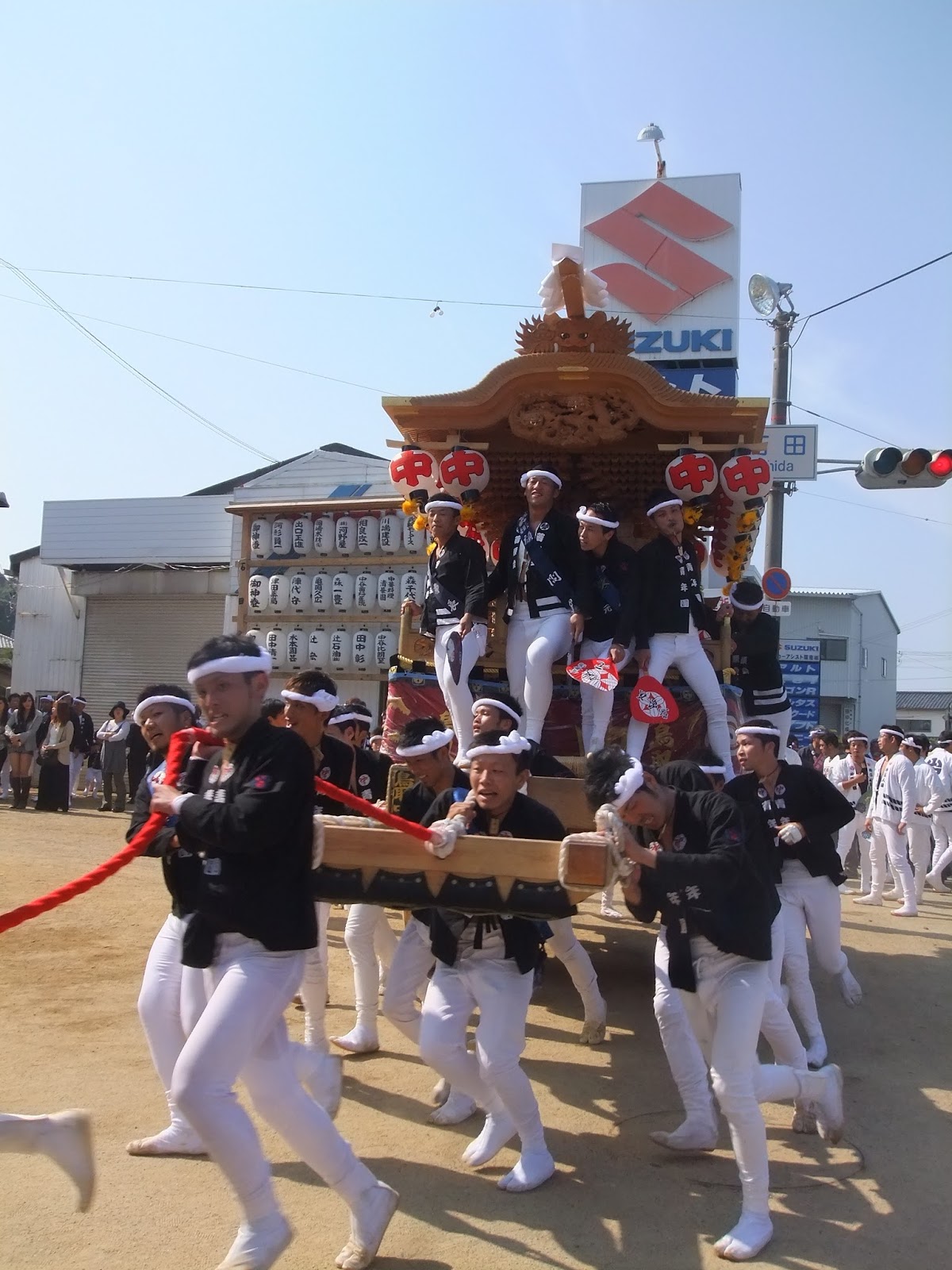
I think one of the most associated aspects of the word matsuri is all the food booths and game areas. But one of the greater more massive features of it, is the giant elaborate wooden carts that weigh 4 tons and are mobilized by the shear force of man. Here at the Wakayaman town of Aki, matsuri that is no different.

These wooden carts are called mikoshi and it is believed that the gods temporarily reside in them while they are transported around a city or to new shrines that will serve as their home. These are often seen as portable shrines and are sacred. Every year lots of money is used to furnish and decorate the mikoshi. Since they are so elaborate and so much time and thousands of dollars goes into making them, they get a lot of use out of them; they are used year to year, for possibly up to 20 years or until they acquire enough money to build a new one. You may wonder what happens to some of the decor that falls off in the stunts that they do, they simply pick up the pieces and glue them right back on for the next years festival.
Here in Wakayama you may notice a few rather similar aspects about the three mikoshi here, They all have a heavy golden rope that weighs a fair amount and costs just as much mantled around the cart, called shimenawa, as well as the folded spirit paper called shide.
Up on the cart are the leaders yelling encouragements and waving their fans.
During the matsuri these carts are carried by dozens of men and women, who are decked out in the uniform of their team. The leaders sport fans and towels and support the runners, yelling 'Soyra!' as a chant of encouragement. Occasionally seen at these festivals is the hitting of the runners with these fans. At first I thought this was friendly brutality, but later learned it is an act called 'charging'.
Here are boys and girls decked out in their teams uniform.
White pants, white cloth shoes and a type of (usually) black jacket with their team image.
Girls often do up their hair in cornrows for the event.

At this Wakayama matsuri, the three carts on display at the time run in a small, tight circle dragging the cart to the crowds enjoyment. After an uncertain amount of times or laps they break and ready themselves for the big important event of the festival. They have to drag their 4-5 ton cart up a set of 5 stairs into the shrine center. This is no easy task.They have their long line of runners ready themselves with half of them already up the stairs in order to get the leverage needed to propel the cart up them. It is the task of all three carts to accomplish this. What happens if they fail? Well I don't know!
Here is a picture of the shrine and the sand bags that 
they put before the first step to give them leverage on the way up.


Once up the slope the carts put on a sort of 'dance' if you will, rocking their cart back and forth with a person in the back pounding a rhythm on the drum. After each finally make it, they go out in a bang, producing their banners, popping streamers, and finally go into a sort of boisterous revelry. They drink sake, Japanese holy water, and proceed to anoint their mikoshi with the sake as well as the crowd. Then they proceed to gift the crowd with mochi, or rice cakes, which are thought to bring good luck in health if obtained.

Other notable areas around the celebration are the stalls. Food stalls. Game stalls. Sweet stalls. Fish stalls. All sorts of things can be found here. And rather go into detail describing them all I will just give you the photos for you to make of it what you will!