Does not actually happen in the springtime for Japanese people.
It is something that everybody actually does before the new year, right around Christmastime, or soon afrer. The big osoji (cleaning). Everything must be cleaned. It is pretty much a ritual habit or culture aspect of Japan. Houses, work places, gardens. Everything. And not just your weekly cleaning. I am talking about spring cleaning clean, but almost over and beyond. At least over and beyond any spring cleaning I have ever done. Take everything out and individually clean it and clean the room. Ceilings too. Before you put anything back inside.
I even cleaned under my built-in bathtub with fungal cleaner.
They do this to welcome the new year with a nice and fresh house. The more and more I study about Japan and its culture it is so interesting how repetitive they are with all of their customs and reasons, it seems they are oddly superstitious. They always try to start everything, houses, relations, semesters workplaces, anew as a way to purify it and to bring in good luck, longevity, and prosperity. To push out the demons of yesteryear and invite in the good spirits and freshness for the new year.
After everything has been cleaned, the decorations are put up, which often consist of mochi and oranges, as well as whatever the year's zodiac happens to be. Likely you will find those large bamboo pine decorations called kadomatsu in front of especially prestigious shops, hotels and other locations soon after as well. In homes, a bit more modest decorations are in place, in addition to their mochi and oranges, they also will typically have twists of straw rope they are a bit famous for, as well as their paper decorations. All of these things will again reinforce the themes of purity and prosperity in their homes and workplaces.

Showing posts with label New Year. Show all posts
Showing posts with label New Year. Show all posts
Thursday, January 3, 2013

Thursday, February 2, 2012
Happy New Year - Again!!
Japanese people no longer celebrate the Chinese New Year.
Once before the World War, Japanese people celebrated this custom along with the Chinese and Koreans. Enter American traditions and the holiday was set on the back burner, with more importance shown upon the new year that is set by the Georgian calendar. Japan officially stopped using the Chinese calendar in 1873; long before they stopped celebrating this as as a holiday. I believe this is because Japanese just love their holidays. There are still many holidays in Japan that began in the Edo period and are thus celebrated with the moon phases, or Tsuki-okure, but many more are now being celebrated with the Georgian calendar. Others still, are in the spirit of the lunar calendar but celebrated with the Georgian calendar, like Tanabata which is held on the 7th day of the 7th month according to the lunar calendar, but is now held on July 7th.
Interestingly is that Japanese people still very much follow the Chinese zodiac. These too are vibrantly celebrated and displayed on January first. In the smaller villages and towns in Japan, you might still find some celebrators of the Chinese New Year which hold their customs to the lunar new year day. But you will find more revelers if you look in the local China Towns. There are some decent sized districts in Yokohama as well as Kobe that spritz their area up and put on a show. I had the pleasure of going to the Kobe lunar new year festival.
There you can see speeches, performances, try wonderful Chinese New Year delicacies, and most importantly, the dances. There are two specific dances involving tigers and a Dragon. These elaborate dances utilize the force of many people who are used to support the dragon. The tiger costume is a much smaller operation with just a few people (2-3). The tiger costume is not propped up as the Dragon is and it has full functionality of its facial movements.


In addition to the dances, I would always recommend a taste of the street food. These vendors sell anything from croquets to pork buns and dumplings, which is a must have as per Chinese New Year tradition. It is said to bring you wealth and prosperity in the new year, but then what doesn't?


A video of the Kobe Dragon Dance:
Once before the World War, Japanese people celebrated this custom along with the Chinese and Koreans. Enter American traditions and the holiday was set on the back burner, with more importance shown upon the new year that is set by the Georgian calendar. Japan officially stopped using the Chinese calendar in 1873; long before they stopped celebrating this as as a holiday. I believe this is because Japanese just love their holidays. There are still many holidays in Japan that began in the Edo period and are thus celebrated with the moon phases, or Tsuki-okure, but many more are now being celebrated with the Georgian calendar. Others still, are in the spirit of the lunar calendar but celebrated with the Georgian calendar, like Tanabata which is held on the 7th day of the 7th month according to the lunar calendar, but is now held on July 7th.
Interestingly is that Japanese people still very much follow the Chinese zodiac. These too are vibrantly celebrated and displayed on January first. In the smaller villages and towns in Japan, you might still find some celebrators of the Chinese New Year which hold their customs to the lunar new year day. But you will find more revelers if you look in the local China Towns. There are some decent sized districts in Yokohama as well as Kobe that spritz their area up and put on a show. I had the pleasure of going to the Kobe lunar new year festival.
There you can see speeches, performances, try wonderful Chinese New Year delicacies, and most importantly, the dances. There are two specific dances involving tigers and a Dragon. These elaborate dances utilize the force of many people who are used to support the dragon. The tiger costume is a much smaller operation with just a few people (2-3). The tiger costume is not propped up as the Dragon is and it has full functionality of its facial movements.


In addition to the dances, I would always recommend a taste of the street food. These vendors sell anything from croquets to pork buns and dumplings, which is a must have as per Chinese New Year tradition. It is said to bring you wealth and prosperity in the new year, but then what doesn't?


A video of the Kobe Dragon Dance:
Thursday, January 26, 2012
Mochi
Mochi is rice.
Mochi pounding is a special thing and normally a festival type of event during the month of January. Mochi is considered to be representative of healthy and prosperity for the new year...as many things seem to be.
How you make rice into mochi is by pounding cooked rice vigorously until a sort of dough is made. Occasionally sugar is added to sweeten the mochi and water is used to help make it doughy and less sticky. You can't pound it so well when it sticks to the hammer. Once it is very doughy you take it and put it on a flour bed and pull pieces off to roll into balls.


How you make rice into mochi is by pounding cooked rice vigorously until a sort of dough is made. Occasionally sugar is added to sweeten the mochi and water is used to help make it doughy and less sticky. You can't pound it so well when it sticks to the hammer. Once it is very doughy you take it and put it on a flour bed and pull pieces off to roll into balls.


These balls are then dipped and garnished with various assortments of toppings. You can either make it so that it is sweet or a bit salty. The toppings here are soy and radish for the saltier flavorings, and a type of sweet rice powder, sweet potato and ??? sauce for the sweet flavors. (i never caught the name - ok I just couldn't recognize and remember it - of the mysterious sauce).


Here is a video that illustrates the mochi making process!
Thursday, January 12, 2012
Burn Baby Burn!
This weekend will be very bright and warm for those who are attending any shrines.
Dondo yaki (どんど焼き) is held around the 15th of January ( which might I add used to be the day that the Coming of Age ceremony was held on until the year 2000)and is typically on a Sunday . On this day people bring their New Years decorations such as their shimekazari to shrines to have them burned. At this time they will also burn any of the bad fortunes that are tied around the temple. Symbolically this is seen as breaking with the past and progressing with the new year. It is also seen to bring luck in the new year, as well as to send off toshigami. Toshigami are thought to be deities related to bringing in the new year or also spirits of ancestors passed. Some people have alters in their home where the toshigami reside until the New Year. For the remainder of the year they will adorn the alter with fresh fruits and such as presents for the toshigami.


Dondo yaki (どんど焼き) is held around the 15th of January ( which might I add used to be the day that the Coming of Age ceremony was held on until the year 2000)and is typically on a Sunday . On this day people bring their New Years decorations such as their shimekazari to shrines to have them burned. At this time they will also burn any of the bad fortunes that are tied around the temple. Symbolically this is seen as breaking with the past and progressing with the new year. It is also seen to bring luck in the new year, as well as to send off toshigami. Toshigami are thought to be deities related to bringing in the new year or also spirits of ancestors passed. Some people have alters in their home where the toshigami reside until the New Year. For the remainder of the year they will adorn the alter with fresh fruits and such as presents for the toshigami.

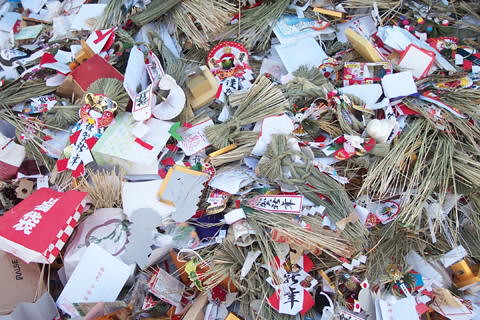


Often when the burning is in process mochi is given out like marshmellows for roasting. This idea behind this is to sweeten your mouth so that you only say sweet and nice things in the new year.

Tuesday, January 3, 2012
Happy New Year from Japan!
Happy shogatsu everyone!
New Years (正月) is a special time in Japan and the celebrations can last up to 10 days.
One of the special things about New Years in Japan is the sending of nengajo, or New Years cards. These are mailed from mid to late December so that they reach their destination on the right day: January 1st, of course. However, if a family member has died in the previous year, the decorations are removed from the home and cards are sent out to tell people not to send them any cards the following year. These cards are more like postcards than the hallmark cards you see in America and often feature the zodiac of the coming year (this coming year is dragon) along with well wishings of health and fortune
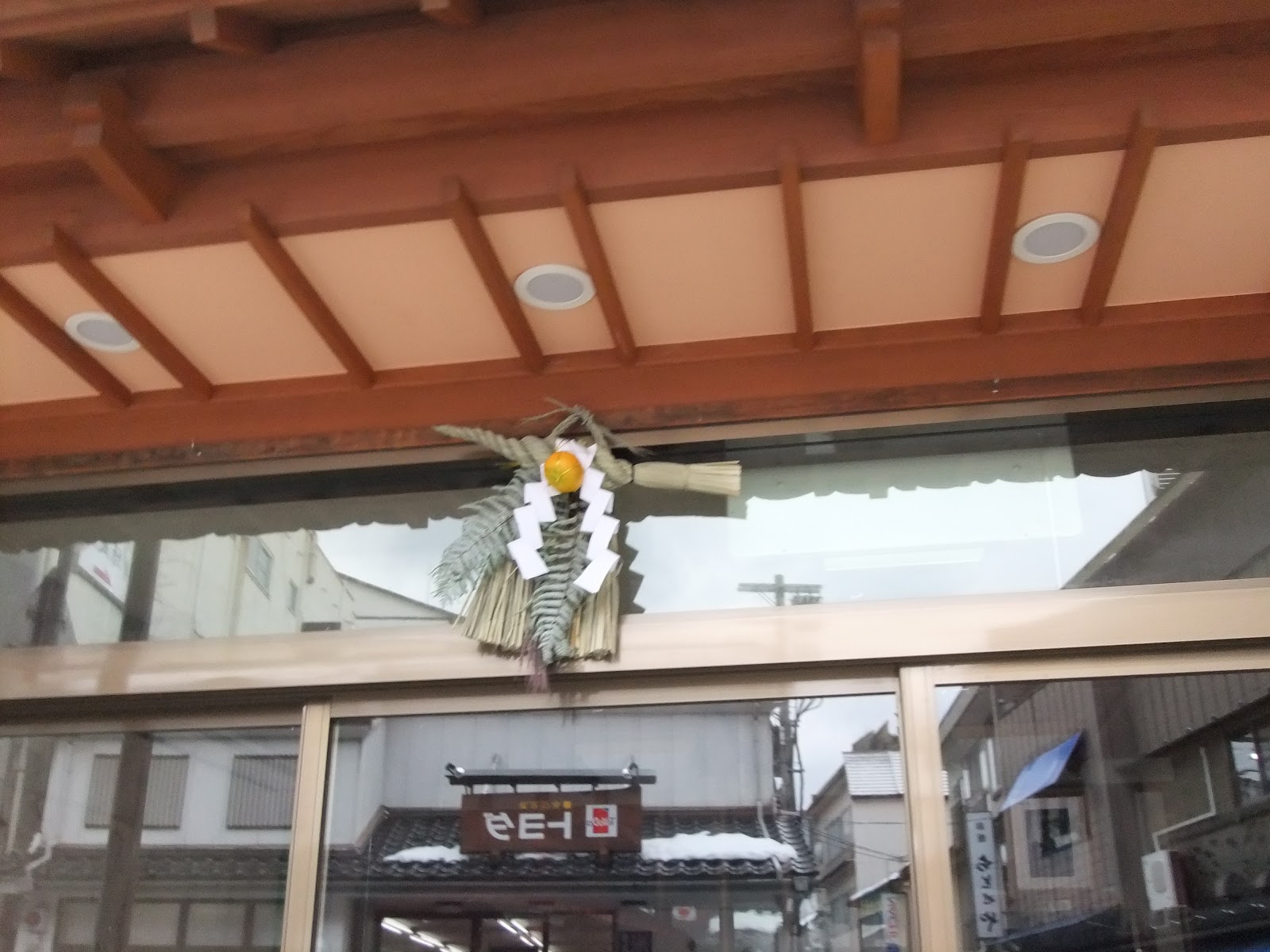
Another important feature of the majority of homes in the new year is a type of straw decoration that features a kind of leaf and a mandarin orange called shimekazari. These adornments are not only prevalent to houses but also temples and shrines as well as departments stores, which are typically more fashioned like kadomatsu.
January 1st is quite literally rung in on December 31st with the ringing of a bell 108 times to ward off the evil spirits at the local Buddhist temples. A particularly famous location to see this is at a temple in Kyoto called Chion-in. This day is called omisoka (New Years Eve) and the accompanying ritual is called osiouji, translated as "the big clean-up." This is also done in homes in the days preceding the New Year; homes are thoroughly cleaned and many things which are not often used or have grown old are thrown out. It is a long arduous process with which "spring cleaning" does not really compare. Once accomplished, shimekazari are often hung at the door frames of the clean homes. This is to represent purity and to ward off evil. Kadomatsu are also a representation of the New Year and are typically festive and ornate decorations of bamboo which are often seen at entrances to establishments to bring good fortune with the New Year.
Starting at midnight following these events, is perhaps any given shrine experiences its most popular day as people flock to it for hatsumode, to cleanse themselves as well as pray for the new year and receive their fortunes for the new year. Fortunes are obtained by either a random drawing of personal choice or via lotto numbers written on sticks that are received from a wooden barrel (you shake the barrel until a stick comes out and you show the stick and number written on it to a monk who then gives you your fortune).


New Years (正月) is a special time in Japan and the celebrations can last up to 10 days.
One of the special things about New Years in Japan is the sending of nengajo, or New Years cards. These are mailed from mid to late December so that they reach their destination on the right day: January 1st, of course. However, if a family member has died in the previous year, the decorations are removed from the home and cards are sent out to tell people not to send them any cards the following year. These cards are more like postcards than the hallmark cards you see in America and often feature the zodiac of the coming year (this coming year is dragon) along with well wishings of health and fortune
Another important feature of the majority of homes in the new year is a type of straw decoration that features a kind of leaf and a mandarin orange called shimekazari. These adornments are not only prevalent to houses but also temples and shrines as well as departments stores, which are typically more fashioned like kadomatsu.
 |
| shimekazari |
 |
| kadomatsu |
Starting at midnight following these events, is perhaps any given shrine experiences its most popular day as people flock to it for hatsumode, to cleanse themselves as well as pray for the new year and receive their fortunes for the new year. Fortunes are obtained by either a random drawing of personal choice or via lotto numbers written on sticks that are received from a wooden barrel (you shake the barrel until a stick comes out and you show the stick and number written on it to a monk who then gives you your fortune).
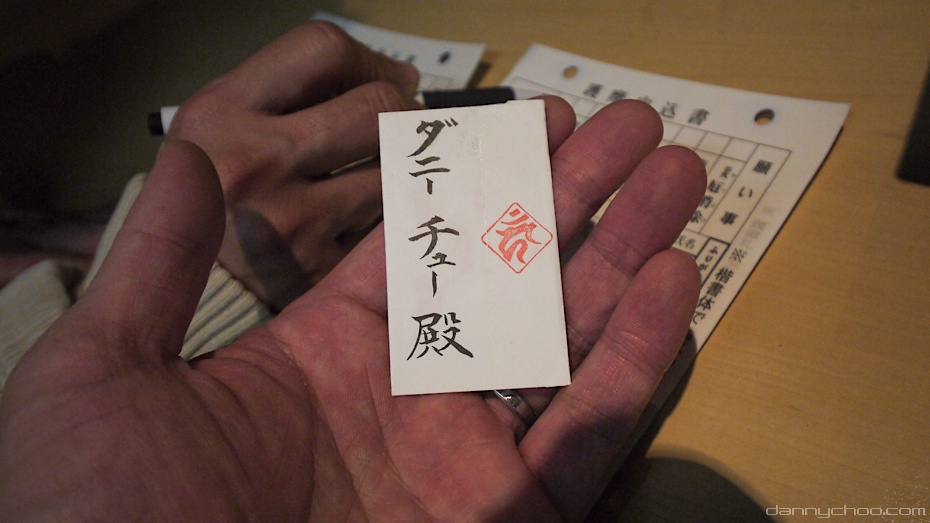


Ok So you either draw from the first box or use the barrels next to the man in the second picture to get your fortune in the third picture. This piece of paper unravels to tell you pretty much everything you want to know in the coming year: love life, house, money, lawyers, health, car stuff and there is more too!
However! if its bad then...

you leave it at the shrine to later be burned! So that you can get rid of your misfortune.
Another interesting activity at shrines is the casting off of arrows. Red and gold decorative arrows are purchased at this time during the year. The arrow is said to bring fortune. The following year at the same time you leave the arrow at the temple and purchase a new one.


Food is also a very important feature of the New Year and many custom dishes are prepared and eaten at this time to bring a variety of influences for the new year (such as health and prosperity... )
One of the things I was actually able to make and sample for myself, was a type of fish based soup that had lots of vegetable and root based ingredients called ozoni. Another was a mochi soup. My third year students at my JHS made a sweet red bean mochi soup that I found really delicious! Also common are New Years bentos, to welcome in the New Year with a large special meal. It typically contains a large variety of things and is quite a bit more expensive than any normal bento. Finally on the 7th day of the New Year (January 7th) a type of porridge called 7 herb porridge is eaten. This dish is called jinjitsu.


Lastly, this is a special holiday for children. They receive something called otoshidama, which loosely translates to gifts of money or presents that are usually given by the elderly to their grandchildren. This feature of the New Year is a bit reminiscent of the Chinese custom where on lunar new year they present children with a red envelope filled with a large sum of money.
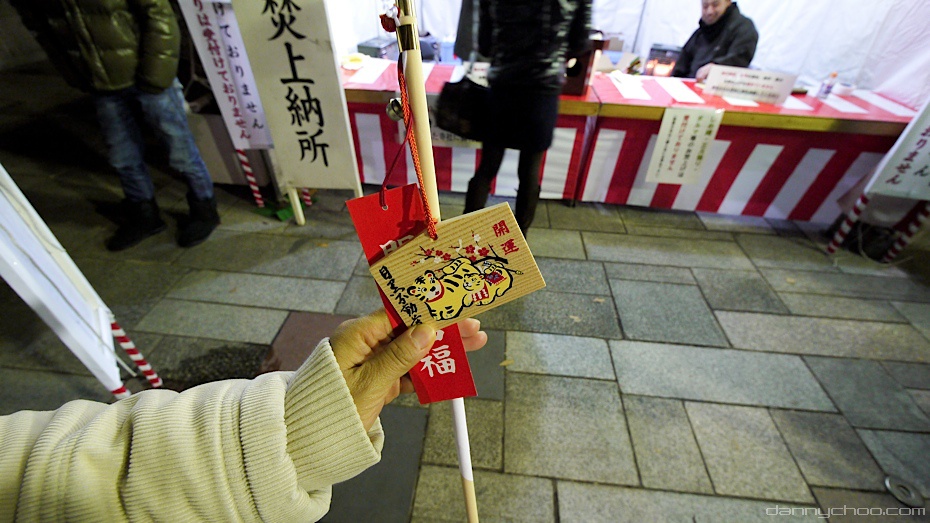


Above is the casting off of the old years arrow and the purchasing of a new one
 |
| Another New Years decoration to appease the deceased and other spirits |
Food is also a very important feature of the New Year and many custom dishes are prepared and eaten at this time to bring a variety of influences for the new year (such as health and prosperity... )
One of the things I was actually able to make and sample for myself, was a type of fish based soup that had lots of vegetable and root based ingredients called ozoni. Another was a mochi soup. My third year students at my JHS made a sweet red bean mochi soup that I found really delicious! Also common are New Years bentos, to welcome in the New Year with a large special meal. It typically contains a large variety of things and is quite a bit more expensive than any normal bento. Finally on the 7th day of the New Year (January 7th) a type of porridge called 7 herb porridge is eaten. This dish is called jinjitsu.
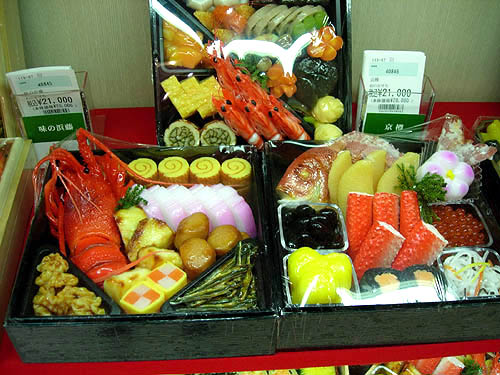

New Years bento, New Years soup, 7 herb porridge
Lastly, this is a special holiday for children. They receive something called otoshidama, which loosely translates to gifts of money or presents that are usually given by the elderly to their grandchildren. This feature of the New Year is a bit reminiscent of the Chinese custom where on lunar new year they present children with a red envelope filled with a large sum of money.


Subscribe to:
Posts (Atom)