Showing posts with label transportation. Show all posts

Thursday, January 10, 2013

Leaving on a Jet Plane

No.

I'm not.

As much as my parents wish it were true. It isn't.

This one is more about how to get to the airport.
You see there are several exceptionally cheap methods to get to the airport that people ought to be informed about. Or at least people in Kansai.

So the first and my current favorite option is the bus. The regular pay for taking the airport bus on over to Kansai International Airport, from hereon being referred to as KIX, is 2500 yen. This is a one way trip. However, the trip is a little less than an hour and a half and you don't have to worry about your baggage at all and the bus's seats will recline and there is a toilet. So when you are going home or traveling to some place with a long stay and extra baggage, probably the better option for you so you don't have to worry about transporting your baggage as much. The discount deal for this transportation method, is that if you are coming back to Kyoto (note, that price is specific to Kyoto - it is 1500 for Osaka I think and 2000 for Ibarakishi) is that the ticket will be 4000 yen. Yeah, a pretty steep price, but it is 1000 yen off. The deal is only valid for 14 days, so if your travels are more than 2 weeks, it is sort of not worth it, because you will just waste more money and have to buy a new one. Though on the other hand, the guy accepting tickets might not check the date if you are lucky...
The bus schedule and prices for anyone who is interested.


Another way to get to the airport, which I cannot actually boast to have taken though it is my vow for next time, is via train. Which will vary from 1150 to 1830 to 2390 depending on your preference. Pretty much an unreserved seat will cost you 1150 yen, which I am certain that you will be able to find, unless there is a massive hoard of people setting out on an adventure that day. The regular fare of 1830 will guarantee your seat on the train and probably even assign it to you, so when some aimless shmuck without a seat reservation sporting an unreserved seating ticket is sitting in your seat, you can have all that glory of thrusting your little numbered ticket in his unassuming face telling him to high tail it out of there and that the town aint big enough for the both of yous. Ok maybe not all that, but that can be how it might feel. And lastly, the expensive ticket is pretty much the nice car. I have no idea what makes it nicer. Perhaps cushier seats or maybe they have the capacity to lean back, or maybe they come with butlers to take your drink orders for little fruity umbrellaed drinks, nothing like a little pre-vacation wishing before your vacation eh? In any case, those tickets are said to be for green seats, which probably is meant for an entire car of green colored seats, as opposed to green and other variously colored seats intermixed throughout all cars of the train. Though personally, I am a bit lost with this payment system...I am one of those fine upstanding citizens that have the little train/metro money card where, as in most places that have excellent public transportation, I just scan it and walk on through the gates to the proper train. And then it charges me for my journey after I swipe it upon exiting the gates at my destination. However I am under the impression that this special airport train will have an attendant who will come by and make you pay for your ticket once you are seated. So my question would be do you pay twice if you are using my little transport card in addition to paying the money grubbing wench on the train? Well I suppose I shall see on my next venture. In either case, and probably the better of scenarios, you can always buy a ticket at the train station office, at least there, you can buy a unreserved seat if you so desired where I am sure the train wench would charge you for whatever seat you happened to be cushioned in.
This train takes you all of an hour and fifteen minutes to get to the airport, however I would like to point out that it will likely arrive sub-terrain with possibly a bit of walking to the departures and check-ins floors as opposed to the bus which dumps you off right in front of the check in counters. I will edit more of course after my next vacation. 
The only down side to the train is carting that luggage to the actual check in counters, oh and the fact that it only runs once an hour. The bus will run several times an hour and therefore there is always safety in numbers. But then of course, if you miss your train, you can always take the bus as a back up. After all they are located at the same place. 
Also worth a note, a double train fare is cheaper than the special deal for the round trip bus (which is probably why I am curious-and by that I mean confused- about the payment methods and transactions when using the train).
EDIT!
Ok an edit to this one. I found out last weekend it is 2990 to go to the airport from Kyoto via train if you do not change from the Haruka Express. It is only 1830 if you change trains in Osaka, which is also a lot slower I think...

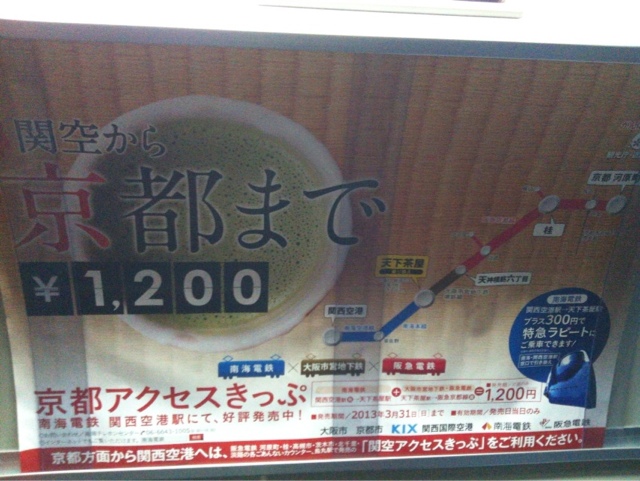
And finally the only other method I have actually taken before now, is the low cost slow train route to the airport. It takes probably more than two hours and you have to transfer like three times, but it is cheap. It costs 1200 yen from Kyoto to the airport, but there are different routes and prices for different areas in the Kansai region, which don't really seem to be well advertised, except for on the bus to and from the second LCC terminal of KIX airport. At least in the Kyoto region, you first start out taking the Hankyu lines heading toward Osaka and alighting at the Awaji station and exiting and transferring to the Nankai lines, from which you will disembark and transfer a final time to board the airport railroad trains. 
Due to the amount of transferring  this process is not recommended for those who have lots of bags. Pretty much used only by those few backpackers who have no money left from their travels in Japan. And people like me of course. 
Also worth a note, it is not really cost efficient to take this method of transportation to the airport and then return home on the bus if your trip will be within two weeks. 1200+2500=just not worth it and go buy a round trip bus ticket 300 yen is just not worth saving if you have to go through that much trouble with your bags. 
Ticket package and tickets for Hankyu and Nankai lines
awesome multilingual paper tail that no one reads


other deals for areas in Kansai

Tuesday, March 20, 2012

Japan's Pricetag

What the What?! Do I really need $5000.00 to move to Japan!?

No. You need more than that.


Ideally you should really move to Japan with at least 500,000¥.

At this point most people are like what the heck?! I am moving there to make money, not to spend all of it! Well, it's a trade off. It's crappy I know, but you need money to start a new life somewhere, anywhere.


Don't want to buy in?
If you don't want these money worries, my advice is to move to Korea. The EPIK program is nice and generous and pays for your flights (they pay a set fee so if you get a cheap flight, you really tend to make money - I think my flight was $480.00 and they reimbursed me somewhere around a grand). In addition they house you for free and give you three free meals a day during training. I apologize, I can't seem to remember if they pay you for the training or not... But they DO they pay you exactly a month from when you start. They also provide you with free housing and furnishing for your entire time in Korea. Sometimes, as in cases like mine, they even pay for your bills; that is because the place I stayed in was so cheap that they had to find a way to use the rest of my budget for housing. However, if you place costs more than the housing budget, then you may end up paying a little bit extra a month. I am talking like a hundred dollars or less.


So what do I need all these monies for?

The biggest thing you need money for is your apartment. It costs a nice handsome price for something that could equal a New Yorker's closet space. Why does it cost so much? Japanese apartments have a lot of hidden fees and such. You have to pay for things like key money, insurance and a few months rent ( just in case).


So now I have a place what about the rest of the money?
You need it to furnish your place. Some places and contracts, especially ones with Leopalace, will have furnishings including: a TV, bed frame, TV stand, table, microwave, fridge, and washing machine. Please note that if you want to go with your own place you have to buy all these things. If that is the case, you can find pretty sweet deals at the local recycle shop. But overall, the majority of these appliances can be pretty expensive in Japan. With that being said I still bought my toaster oven at a recycle shop for 1,500¥.

Furnishings check.
Now you need food and dishes and a futon! That last one is extremely important. Yes, if you work for Interac they will offer you a nice deal on bedding, including a pillow, kake and shiki futon (the one you sleep on and the comforter), as well as all the accompanying casings. But if you are picky about bedding, then get your own! I got a nice shiki futon from Muji and Ikea has cheap down comforters that are also very nice and plush. Between those two stores, you should have everything you need for sleeping and eating in your apartment. Beware though, some placements have the misfortune of being nowhere near an Ikea (not being near a Muji...don't be preposterous), if that is the case Konan (コナン) is a wonderful alternative.

Apartment check. Furnishings check. Everything else check.
Now what?
After that, and perhaps most importantly, you need a phone. You are require to have one so that your company can contact you in a pinch. Sure, you can get a pay as you go one, but if you are planning on staying in Japan longer, I personally really recommend getting something with a bit more snazz. Japanese smart phones have truly unlimited data, also you can use them to pay your bills by simply walking in a store (however, I think this may be an android only service), or use them for a nifty app that tells you exactly when trains arrive and the fastest route from point A to B (Jorudan). Overall they are just really useful.
Can't I just use my old phone?
Short answer. NO. You can absolutely not use your old phone. Also Japanese stores do not sell only the SIM cards either. So quit asking. I swear that is like the first thing that people fresh off the boat ask. Can I buy a cheapo phone and switch the SIM card? Still a neg. The SIM card you buy has to match the functions of your phone (ie: data plans). This leaves you with two choices, go cheap or go all the way. Personally, I have an iPhone. They had a deal for Japanese citizens that made it free when they purchased it. NOT being a Japanese citizen I paid 46,000¥ for it. However, my monthly rate is cheaper.


OK so now for a break down of your start up costs:

Apartment Total: 198200¥
  • Key Money (non-refundable deposit): 50,500 ¥
  • Key Exchange Fee: 3,150 ¥
  • Fire Insurance (good for 2 years): 20,000 ¥
  • Data Entry Fee: 2,100 ¥
  • Rent for August (Partial): 12,410 ¥
  • Rent for September : 55,020 ¥
  • Rent for October : 55,020 ¥

Furnishings at recycle shop prices! 57,000 ¥
  • Toaster oven 1,500¥
  • Microwave 5,000¥
  • Rice cooker 3,500¥
  • Fridge 8,000¥
  • Washing machine 12,000¥
  • Bed 8,000 ¥
    (find online or at sayonara sales) 
  • TV 10,000¥
    (for whatever reason even the analog ones are still expensive!)
  • Kotatsu 9,000 ¥
    (including table and kotatsu futon)
    (new its pretty hard to fund used) 

Apartment oddities 30,600
  • Dishes 6,300¥
    (pots, pans, utensils, plates, bowls, mixing bowls, spatula, ladle, chopsticks)
  • Futon x2 10,000¥
  • Sheets 3,000¥
  • Towels 1,200¥
  • Bathroom supplies 800¥
    (toilet paper, scrubber...)
  • Shower supplies2,600 ¥
    (shower rack, shampoo, conditioner, tooth brush, tooth paste, soap...)
  • Kitchen supplies 800¥
    (trash cans, soap, sponge...)
  • Cleaning Supplies 1,500 ¥ 
  • Closet stuff 1,400 ¥
    (coat hangers/organizers)
  • Shelving 500 ¥ per
  • Fan 2,500 ¥

Phone (varies)
  • iPhone 46,000 ¥ 
  • pay as you go4,000 ¥ 

What do you do with all the left over money? 
Eat. 
Pay bills. 
Transportation. 
These are all things you need to consider as well. Since you are not going to get paid for possibly 2 months. But you get paid for training? Yes this is true...However this will come with your first pay check. For most that pay check comes the month after they start working. Hypothetically, say you start working in April. You will not get paid until the end of May. Therefore, if you come over in March for training, you need to make sure you have enough money to cover food expenses (which are higher) until you get paid. Personally I go through about a 10,000¥ a week. I cook all of my meals. You can of course pay much less. Also since you pay for three months of your apartment, you clearly don't have to worry about paying that, say for three months, but you do need to worry about paying for the gas, electric, and water bills for each month. In addition to those bills, you will also get your phone bill too. And on top of that, there is your insurance that you need to pay every month. 
And I know some of you right now might be saying 'but they said I will get paid for transportation'. And you will. But it is a reimbursement. You get reimbursed the exact amount that you spend for transportation. AFTER you spend it. So you need to have enough to make it to your first pay check and then they will reimburse you for all the money that you previously spent on transportation. Also, they say up to 20,000¥ they will typically not go too far over it, and on the flipside they will only pay you for how much it costs you to get to your schools and get home from them (so no funny business!). If that means it is only 6,000¥ then they only reimburse you for 6,000¥. 

Since Japan is just so expensive, please do not fool yourself into thinking that once you obtain 500,000¥ that that is the end all and you are set to go off to Japan. Please notice I did not cover a single before-cost in this blog. This is largely because I did not come from America, or the U.K. or any place that could be useful to you. I came from Korea. And as such my process was very different from your own. But for curious readers I highly recommend checking out The Rising Daikon's breakdown of the monetary units required for that. 


NOW! 
With all that being said, and for people still freaking out about Japan's pricetag, companies, like Interac, will often give you a cash advance and can help you out a bit (which you pay off bit by bit via your paycheck in an amount that you find convenient). Other companies, like JET, will pay for your plane ticket over, as well as part of your housing. Additionally, you can choose things like cheap housing, only eatting things from the dollar store, minimizing your furnishing (you don't need that toaster), sleeping on the floor (Japanese style!), which are all valid and available options to a penny pincher looking for adventure. But my advice, make the most of your time here...whatever that means...Just live and don't regret it!

Monday, October 17, 2011

Life as a Gaijin

I am a foreigner.

And according to one of my second grade students I am from Foreign. To him, Foreign is a country because all that exists are Japan and Foreign, better known as Everywhere-else.


I think the first question I always get is: Isn't it hard? Living in a foreign country?
And you might think it is. But the truth is, is that it may be only so for the first week or month, until you get settled, and then all the fun begins. It is true that everything is in Japanese, but what you might not know, everything is also in a variation of English. Eating out is never a big deal since here, practically the entire menu is in a showcase outside the restaurant. Transportation is exceptionally easy as everything is announced and written in English.
I think the hardest part about living in Japan is walking on the sidewalk.
Here, they have different directions for sidewalk-walking. You may not know it, but in the United States the rule of thumb is to always walk on the right hand side. You will notice that escalators will also be on the appropriate side you are walking, if you have not noticed before. Here, walking is more or less up to the city. In my city they change sides at the train station vs. the rest of the city. You really have to look for the arrows which tell you where your feet should go.

Sidewalks in Japan have often have this yellow line to divide sidewalk traffic.


This is an example of stairs as a subway station...notice the abundance of arrows on the steps...in case you missed them the first 5 times. 
The second is actually more useful and tells you more or less how to board a subway car. You have to let everyone departing the car off through the middle first while you stand at the sides and then you can proceed once they have left. You have approximately16 seconds. Go.


I have an edit!
Wow! This is the first time I have gotten go to back and edit things especially things I wrote a year ago. 
Anyways, I was recently informed that the yellow line is reserved for officials and military personnel. An acquaintance of mine told me this saying that he got told off by an officer telling him that it was disrespectful and that the yellow lines were expressly for people of a more official nature. 
Another suggestion, which I think makes a lot more sense than Emperor-only walk ways, is that they are helpful to the blind. As the yellow portions are always textured, it greatly helps one with a walking stick to walk in a much straighter line and will also give you inclination as to when you might cross a road. You see, there are different textures for straight walkways and when you come to an area before a crosswalk therefore indicating you to stop and listen for the cross walk signal, which in turn has different sounds for when one is to cross horizontally or vertically. Pretty neat right? 

More edits! I have proof! It is in fact for blind people. And seeing as these yellow strips are on all the sidewalks all over Japan. That is pretty dang considerate. 
Here, I found this sign in a subway station the other week.