So following a common suit, I decided to give you my schedule to show you what a day in my life is like.
6 am
Wake up in a leisurely cacophonous fashion with multiple alarms about half way through the hour. Proceed to dress in business casual attire, which right now is a nice sweater and slacks. Simplistic make up and brushing of hair follows suit. Warm up breakfast which is normally either onigiri or toast. After another two alarms, one warning me departure time is approaching and the next telling me to get of out the house, wherein I then bike a few kilometers to the bike garage near the station. And then walk to the station
The bike garage is normally an official place with some sort of covering where bikes in the hundreds are kept for your return. These places often will cost. Mine is either 200 yen a day or 4000 yen a month. Living in Kyoto has its expenses and this is one of them. Other places will be cheaper. My former city was about 2400 monthly for the bike parking, and I have even heard of some places being free. Either way, you typically need a bike parking garage elsewise you bike might be stolen or impounded. There are regular people who walk around to ticket or take your bike, so be careful!
Notice how I said most places above? My bike garage is some lady's house. The station is use is old and many of its features have been grandfathered into the new rules and regulations. This is because it is an extremely busy intersection, and to tear it up would be to wreck havoc with the city-goers. Also because it is so built up, there is no room for an official parking garage, so a few of the residents decided to make some easy money by using their first floors are bike garages for the commuters. There are 3 that I know of and they actually all very in price depending on who is closest. Mine is the cheapest.
7 am
I have just parked and getting to the station. I take a pretty early train for a bit less than half an hour to the city where I work. By choice, I do not live in that city, nor in a closer city, of which there are several. There is really good transportation in Japan therefore I can really have my pick of the pie in terms of where I live. And thus I live in Kyoto. Who wouldn't right?
From the station, I have a choice of walking or taking the bus. The bus always seems like a hassle; you have to make sure you are on the right bus, you have to figure out the times and the routes, it is all in Japanese, and then you have to wait for it and it actually ends up being about the same amount of time as walking. So I typically walk. Also as a side note, that is totally unlike Kyoto buses, which was much better organized and in English. The walking is just a few kilometers and I figure is a a good exercise and whatnot, at least that is what I tell myself.
8 am
Actually just before it, I arrive at school. There is not really a point for me to get to school this early other than that I like it. I just come in, get settled, open the laptop and plan if needed. I make/print my handouts if I haven't already, touch up power point, write in my blog, you know just anything. At 8:20 everyday there is a small morning meeting with the principal and all the teachers in the office. It lasts less than 5 minutes. Only my junior high school (aka middle school) does this. The bells rings and home room starts for the kids. The first official class is not until 8:45. I may or may not have class at this time. It all depends on my schedule.
Class mostly means me teaching a designated lesson/topic of the day. They usually make it a point to make my lessons to be conversation lessons so that the students can practice and hone their speech to a better perfection.
In my junior high school, I act as the main teacher and have complete run of the class. I teach the entire time on the designated subject, but you would be asked to do any number of things. One common complaint among foreigners is that they are merely a walking tape recorder for the lessons. Meaning they just repeat the words at the Japanese-English teachers command. A person might also be assigned to only one portion of the lesson, like a game, or activity, or maybe only even a 5 minute warm up. It totally depends on what a school needs you for.
My typical lesson will be something like a small warm up, the focal point of the lesson, perhaps a small bit of practice, and then an activity or game that I have designed to make the kids want to participate more as well as to better support the focal point of the lesson. For example a warm up might be some shiritori in English, followed by a page in the book where we discuss a dialogue where I will go over it the first time doing both parts and different voices depending on the day, and then we will go over it in English and then the more difficult points in Japanese. From there we will review the key phrase and I will make them come up with example of how to use it and change it (like would you like ~~?) and then I will have an activity or game for them utilizing that phrase. The Japanese-English teacher will be there the whole time and will support me when asked, but more or less leaves everything up to me. The aid of this teacher varies upon the teacher, some teachers are very supportive and some are pretty non-existent. I even have one who sleeps on occasion. Grading and Reading during my lessons is pretty normal. They are there though to handle the classroom behavior. I am no disciplinarian and since I am a gaijin, if something or dispute happens, it is always better to have another teacher there to mediate the problem and to be able to convey the problem to any other authority if necessary. For example is a fight breaks out between students, I can try to stop it but it is best that I leave it to the Japanese teacher, also my limited Japanese can't convey to the principal what happened. And of course they are there to make sure I don't do anything too ridiculous or our of order.
In my elementary schools, classes run more or less the same. I again have the run of the class and teach the entire time. Some classes have books we teach out of, others don't. The Japanese-English teachers try to be as helpful as they can, getting the students to pay attention, behave, and participate, or if there is a special student, helping them be entertained with me lesson. These teachers often do not speak much English, but are very genial. The English level does vary though and so does their help and input in my lessons. You kind of just learn to adapt for who does what. I have one teacher who follows my every word and helps to translate difficult words like 'brave' from the story in the book.
My elementary lessons are a pretty much the same as my junior high school ones, but at a much lower level. I will have a warm up, the lesson topic or book topic, a short review and a game. For example a warm up is a chant or song often provided by the book, or as compliments of Youtube, and then I will get into the lesson and we will go over all the vocab for that lesson, if it is in the book, there are often some accompanying listening exercises that I will also do. I will then move into some review where I will change the words to ones not in the book so they might try to give some original answers. At this point I might call on some students to answer the question (example: what fruit do you like?) and then will progress into a game or activity that is simple and repetitive so they can remember and easily practice the target phrases.
12:15 pm; 12:35 pm
Lunch time! At this time, the first four class periods are complete. If I am at my elementary school, I get fed the school lunch for a grand total of 208 yen. If I am at my junior high school, I often bring my own lunch, or if I forget, I can order the bento from the bento shop that all the teacher order from for 400 yen. At my JHs, most teacher do not order the bento, preferring cheaper or more delicious food, but there are a few people who are constants on the daily order.
After this, but at no designated time, students have recess, which is greatly diminished in JHS.
The earlier time follows the elementary schedule with their 45 minute classes, and the latter time is the JHS schedule with their 50 minute lessons.
1:20 pm; 1:45 pm
Here, the earlier time signifies when JHS students hit the books for 5th period, and the latter time is elementary. See I told you they had an awesome recess. Elementary students even sometimes go home after lunch, which is not too unusual, and then come back for 5th period. Or if they are a very young grade in elementary, they might only have 4 classes and then the day is over for them. Elementary classes tend to vary between 5 and 6 periods throughout the week. At mine, I think most days are 5 classes and then they can go home, but on days when the first period is scheduled reading time, they have 6 periods.
3:10 pm
Classes are finished and then they have homeroom again to wrap up the day at JHS. Them some students go home, but the vast majority will have some club to attend to. They will go to this club until about 4:30 or 5. I am not really sure if there is a designated time for them to leave. I will occasionally attend the cooking club and the just come and go whenever. Sports teams are perhaps a bit more rigorous.
Since classes are over at this time, I would spend time preparing for the next day, or if I have already, I would spend it as I see fit. Sometimes I visit the clubs, who are always happy to have me, but recently I just study.
4:30 pm
This is my departure time. I am now allowed to go home. And unless I am wrapping something up, or in the middle of something, I am more often than not leaving right about this time. If you have an awesome school, or elementary school, they might let you go home a bit earlier.
From now, I will walk back to the station.
5 pm
I get on the train to head home. Typically during my commute, I listen to music, audiobooks, or more recently, podcasts like japanesepod101. Once I arrive at the station, I return to the garage, pick up my bike, and bike back home.
6 pm
Arrive home and be lazy for some time. Video games, checking the computer, reading, catching up on a TV series. And then if it is not Tuesday or Thursday I will go to the grocery store to get some things for cooking. Something very different in Japan is that I go to the grocery store every day. The refrigerators are much smaller here and it is actually not so common to buy in bulk. I am almost surprised to see 12 packs of toilet paper being sold. It is extremely typical to want to cook with fresh ingredients, thus there are many grocery stores to support everyone's daily visit. There are of course a few super stores, or at least in Kyoto, where they sell things that you might want to stock up on since those products wont be sold in you more local stores. Those stores are also usually a bit farther away. I am talking like a 10 minute drive. Yeah. That, is considered far away here. The normal grocery stores are usually about a 2-3 minute bike ride from my apartment, and I have 3 of them in that range to give you an idea of how convenient they are.
7 pm
I am cooking, or running if it is a Tuesday or Thursday. And following suit, I am eating. On my running days, dinner is still cooked, but usually a more simple affair.
8 pm
More relaxing, or possibly studying.
9 pm
Shower time. Like the Japanese, I have been showering mostly at night. This is actually largely due to I hate waking up early and to wake up any earlier and shower just seems like hell. I still believe that morning showers are way better though. When I lived closer to my schools, I would shower in the mornings, so this is purely because I live farther away and have longer to commute now.
Following is doing whatever I want time, unless it is my one day a week where I clean and do laundry, in which case I do that.
11 pm
Roughly. Its bed time.

Showing posts with label public transportation. Show all posts
Showing posts with label public transportation. Show all posts
Friday, March 1, 2013

Thursday, January 10, 2013
Leaving on a Jet Plane
No.


I'm not.
As much as my parents wish it were true. It isn't.
This one is more about how to get to the airport.
You see there are several exceptionally cheap methods to get to the airport that people ought to be informed about. Or at least people in Kansai.
So the first and my current favorite option is the bus. The regular pay for taking the airport bus on over to Kansai International Airport, from hereon being referred to as KIX, is 2500 yen. This is a one way trip. However, the trip is a little less than an hour and a half and you don't have to worry about your baggage at all and the bus's seats will recline and there is a toilet. So when you are going home or traveling to some place with a long stay and extra baggage, probably the better option for you so you don't have to worry about transporting your baggage as much. The discount deal for this transportation method, is that if you are coming back to Kyoto (note, that price is specific to Kyoto - it is 1500 for Osaka I think and 2000 for Ibarakishi) is that the ticket will be 4000 yen. Yeah, a pretty steep price, but it is 1000 yen off. The deal is only valid for 14 days, so if your travels are more than 2 weeks, it is sort of not worth it, because you will just waste more money and have to buy a new one. Though on the other hand, the guy accepting tickets might not check the date if you are lucky...
The bus schedule and prices for anyone who is interested.
Another way to get to the airport, which I cannot actually boast to have taken though it is my vow for next time, is via train. Which will vary from 1150 to 1830 to 2390 depending on your preference. Pretty much an unreserved seat will cost you 1150 yen, which I am certain that you will be able to find, unless there is a massive hoard of people setting out on an adventure that day. The regular fare of 1830 will guarantee your seat on the train and probably even assign it to you, so when some aimless shmuck without a seat reservation sporting an unreserved seating ticket is sitting in your seat, you can have all that glory of thrusting your little numbered ticket in his unassuming face telling him to high tail it out of there and that the town aint big enough for the both of yous. Ok maybe not all that, but that can be how it might feel. And lastly, the expensive ticket is pretty much the nice car. I have no idea what makes it nicer. Perhaps cushier seats or maybe they have the capacity to lean back, or maybe they come with butlers to take your drink orders for little fruity umbrellaed drinks, nothing like a little pre-vacation wishing before your vacation eh? In any case, those tickets are said to be for green seats, which probably is meant for an entire car of green colored seats, as opposed to green and other variously colored seats intermixed throughout all cars of the train. Though personally, I am a bit lost with this payment system...I am one of those fine upstanding citizens that have the little train/metro money card where, as in most places that have excellent public transportation, I just scan it and walk on through the gates to the proper train. And then it charges me for my journey after I swipe it upon exiting the gates at my destination. However I am under the impression that this special airport train will have an attendant who will come by and make you pay for your ticket once you are seated. So my question would be do you pay twice if you are using my little transport card in addition to paying the money grubbing wench on the train? Well I suppose I shall see on my next venture. In either case, and probably the better of scenarios, you can always buy a ticket at the train station office, at least there, you can buy a unreserved seat if you so desired where I am sure the train wench would charge you for whatever seat you happened to be cushioned in.
This train takes you all of an hour and fifteen minutes to get to the airport, however I would like to point out that it will likely arrive sub-terrain with possibly a bit of walking to the departures and check-ins floors as opposed to the bus which dumps you off right in front of the check in counters. I will edit more of course after my next vacation.
The only down side to the train is carting that luggage to the actual check in counters, oh and the fact that it only runs once an hour. The bus will run several times an hour and therefore there is always safety in numbers. But then of course, if you miss your train, you can always take the bus as a back up. After all they are located at the same place.
Also worth a note, a double train fare is cheaper than the special deal for the round trip bus (which is probably why I am curious-and by that I mean confused- about the payment methods and transactions when using the train).
EDIT!
Ok an edit to this one. I found out last weekend it is 2990 to go to the airport from Kyoto via train if you do not change from the Haruka Express. It is only 1830 if you change trains in Osaka, which is also a lot slower I think...
EDIT!
Ok an edit to this one. I found out last weekend it is 2990 to go to the airport from Kyoto via train if you do not change from the Haruka Express. It is only 1830 if you change trains in Osaka, which is also a lot slower I think...
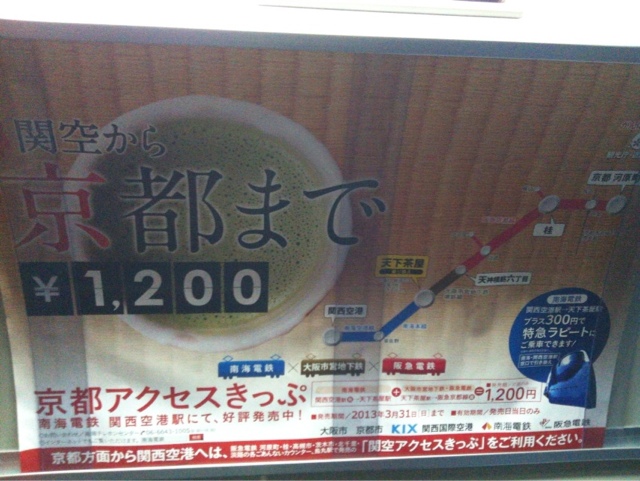
And finally the only other method I have actually taken before now, is the low cost slow train route to the airport. It takes probably more than two hours and you have to transfer like three times, but it is cheap. It costs 1200 yen from Kyoto to the airport, but there are different routes and prices for different areas in the Kansai region, which don't really seem to be well advertised, except for on the bus to and from the second LCC terminal of KIX airport. At least in the Kyoto region, you first start out taking the Hankyu lines heading toward Osaka and alighting at the Awaji station and exiting and transferring to the Nankai lines, from which you will disembark and transfer a final time to board the airport railroad trains.
Due to the amount of transferring this process is not recommended for those who have lots of bags. Pretty much used only by those few backpackers who have no money left from their travels in Japan. And people like me of course.
Also worth a note, it is not really cost efficient to take this method of transportation to the airport and then return home on the bus if your trip will be within two weeks. 1200+2500=just not worth it and go buy a round trip bus ticket 300 yen is just not worth saving if you have to go through that much trouble with your bags.


Ticket package and tickets for Hankyu and Nankai lines

awesome multilingual paper tail that no one reads



other deals for areas in Kansai
Thursday, November 29, 2012
The Lucky Taxi
Taxis in Japan are pretty outrageous. I went 4 kilometers (with luggage) from the station to near my house in a taxi, and it was more than 2000 yen (more than 20usd). Where as in Korea, I think I went something like 30 something kilometers, and it cost 42000 won (less than 40 dollars). That was incredible.
Taxis in Korea will start around 2000 yen for about 2 kilos and will then start ticking up. Pretty much there is no reason not to take one when you are in need. (lowest end was 1800 and highest was 3200 that I have ever seen). In Japan the range is about 500 yen to about 700 or 800 yen for starters. And sure you will just say, 'Then just catch the cheap ones'. It is not as easy as you think, because you have to find one first.
In Kyoto there is a certain branch of taxis called Yasaka, which if you have traveled Kyoto, you would know that is also the name of their famous shrine at the end of the Gion district, the one that Gion Matsuri seems to revolve around. Well this branch of taxi is symbolized by their 3 leaf clove over head of their cars. Japanese peopel seem to really have a thing for clovers. This happens to be one of the largest taxi copanies in Kyoto, I would say there are three big ones (and probably about 15 total) in Kyoto, and I would say that MK, Yasaka, and one more I have yet to learn the name of, seem to be the largest. So you can imagine, there are thousands of taxis. Remember, Japanese people largely rely on public transportation and not everyone owns a car. So taxis can come in handy, especially if you are traveling with large luggage or are traveling after the hours of public transportation (or live like in the inaka!).
Back to the topic, the Yasaka taxi service. So there are thousands of taxis in this one chain all with 3 leave clover little headings, but what the average traveler does not see, is the 4 leave clover taxi. The lucky taxi. There are exactly 3 taxis in this company that have the 4 leaf clover embelem ebmlazoned on their cars. These cars are said to be driven by exceptional drivers. I have no idea what the requirements are to be known as the taxi driver of their car, but I am sure an unblemished record is one of the things. And the cool thing is, is that it cost nothing more to ride in this one as opposed to a 3 leaf taxi. In addition, they will give you a little sticker that you can only get from riding in this car. Cute right?
So what is more awesome than driving in the lucky taxi? There is exactly one taxi that is completely in the S-class (a Japanese thing that means like super or special or something. basically AWESOME) all of its own. It has a pink four leaf clover sigil on its car and heading. I have only seen this car exactly one time, and until then had no idea of its existance.

Taxis in Korea will start around 2000 yen for about 2 kilos and will then start ticking up. Pretty much there is no reason not to take one when you are in need. (lowest end was 1800 and highest was 3200 that I have ever seen). In Japan the range is about 500 yen to about 700 or 800 yen for starters. And sure you will just say, 'Then just catch the cheap ones'. It is not as easy as you think, because you have to find one first.
In Kyoto there is a certain branch of taxis called Yasaka, which if you have traveled Kyoto, you would know that is also the name of their famous shrine at the end of the Gion district, the one that Gion Matsuri seems to revolve around. Well this branch of taxi is symbolized by their 3 leaf clove over head of their cars. Japanese peopel seem to really have a thing for clovers. This happens to be one of the largest taxi copanies in Kyoto, I would say there are three big ones (and probably about 15 total) in Kyoto, and I would say that MK, Yasaka, and one more I have yet to learn the name of, seem to be the largest. So you can imagine, there are thousands of taxis. Remember, Japanese people largely rely on public transportation and not everyone owns a car. So taxis can come in handy, especially if you are traveling with large luggage or are traveling after the hours of public transportation (or live like in the inaka!).
Back to the topic, the Yasaka taxi service. So there are thousands of taxis in this one chain all with 3 leave clover little headings, but what the average traveler does not see, is the 4 leave clover taxi. The lucky taxi. There are exactly 3 taxis in this company that have the 4 leaf clover embelem ebmlazoned on their cars. These cars are said to be driven by exceptional drivers. I have no idea what the requirements are to be known as the taxi driver of their car, but I am sure an unblemished record is one of the things. And the cool thing is, is that it cost nothing more to ride in this one as opposed to a 3 leaf taxi. In addition, they will give you a little sticker that you can only get from riding in this car. Cute right?
So what is more awesome than driving in the lucky taxi? There is exactly one taxi that is completely in the S-class (a Japanese thing that means like super or special or something. basically AWESOME) all of its own. It has a pink four leaf clover sigil on its car and heading. I have only seen this car exactly one time, and until then had no idea of its existance.
Subscribe to:
Posts (Atom)