Showing posts with label Kyoto. Show all posts

Tuesday, April 16, 2013

A Pack of Pickled Peppers

Pickling season.

These barrels are full of cucumbers, radishes, ginger or possibly some other vegetable and are in the process of being pickled. These are called tsukemono. Tsukemono are eaten with any traditional styled meal and are often used as a palate cleanser or a garnish.
Here, they have this rather unique way of preparing the tsukemono involving the stones you see here. They first fill these barrels full of their vegetable and likely vinegar. As time goes on, and the pressure the stones exert on the lids, the barrels compress which is essential for the process. As you can see in the picture, some of the lids and stone levels are different. This particular picture was taken at a Kamigamo shrine in Kyoto.
Symbolically, I suppose the fact that the place they are pickling is a shrine, can relate in western culture with the splashing holy water in the churches. Here, the pickled products are on sacred ground or prayed over such that whomever ingests them will be healthy in the year.
Kind of like, you know, everything Japanese. Do/Eat/Buy this and be pure and healthy and prosperous and fortuitous and magical for an entire year, or you know until the next time we try to gain money from you somehow.
This same temple will pray over pretty much everything. They even have a place to park your car to preform rituals on it so that it may be safe on the roads. It is also large enough for a bus to park should the need arise.

Tuesday, December 25, 2012

Christmas in Japan

You know I think that it really is slowly and surely becoming a bigger and bigger deal in Japan. I feel like I am seeing more lights this year. And they sure as hell play all the Christmas songs, and there are even some in Japanese that they play. I am even pretty sure that some of my students get presents.

Funny story actually, I asked my students when they thought about when they thought about Christmas, and you know I got Santa, and presents and Christmas trees, but probably the fifth thing someone yelled out was KFC. I lost it. I laughed so hard. I told them that we didn't have KFC for Christmas, but maybe they did and that that was a tradition all of their own.
In addition to their own traditions. Strawberries are grow for exorbitant prices out of season just to make their little Christmas cakes. Like 700 yen for a basket. And yet people buy them. Gotta have them some of that Christmas cake. No Christmas is complete without it.

So last Christmastime I went to both Osaka and Arashiyama for seeing the 'Christmas lights' they put up at this time of year. In Arashiyama, this counts as throwing up some green and blue accent lights accenting the bamboo forest, well it also has a few excessive flower arrangements as well. In Osaka it was that amazing light show and their Chirstmas wonderland which was a (kind of sad looking) Christmasy light display on that little island between the two rivers. Osaka also put on one of my Christmas favorites, German Christmastown. A really fantastic set up over at the Umeda Sky Building with mulled wine, a big jolly Santa and lots of imported German goodies: wood workings and carousels and clocks and Christmas ornaments, even the people, they shipped some people from Germany over just for this occasion.
This year I went to Kobe. I got to see the grand luminarie which is really in honor of the earthquake victims from a decades and change back. They put on this really grand illumination every year and it is free. The line is so long to see it, it goes on for kilometers and is heavily patrolled by police with metal blockades  Pretty impressive in that alone. One you arrive to it, it is over actually pretty quickly or it would be if you and everyone else would quit taking pictures. This is no parade of lights you see, it is a much quicker event than that...though perhaps a little more grandiose. This event doesn't actually cost anything, but they would really like you to donate 100 yen. There are places set up all over to accept it. The 100 yen is to cover the cost of electricity for the event, or so it is said. Sadly they come up in the red every year. But Good Guy Kobe continuously puts it on year after year, because it just isn't Christmas in the Kansai area without these symbolic lights.
Another thing I got a chance to see this year was a luminary out in the mountains around Maibara Kyoto (so you have to have a car to get there). It primarily consists of a little stream and a bunch of trees decked out to each and every twig with some white and blue LED lights. There was also a waterfall that they illuminate and a castle like structure they build out of a bunch of blue LEDs. This one also costs money, but instead of a donation, they require you to pay 500 yen. And for what it is, and the fact that you have to drive out to it. That is pretty over priced, but romantic, so it happened anyways.
But by far the best Christmas adventure viewing you can see is free and it is at Kyoto station. They have a wonderful color changing Christmas tree set up on the upper levels of the outdoor terrace, above Cafe du Monde and Mister Doughnut. But it is not just that that is magical. Their enormous staircase, just in front of the tree. All of the stairs are decked out in LEDs and will put on a light display every so often. And apparently a fairly long one as I sat there for 10 minutes and it had yet to loop back around.

Thursday, October 18, 2012

A Pain of a パン

Pan is taken from the French  Portuguese word for bread, pao. It is commonly thought to be taken from the French word pain(NOT to be pronounced like the English word, 'pain'), which is actually takes influence from the Portuguese word. But you see, Japan learned of this delicious sort of food directly from the Portuguese themselves. The Portuguese are the original influence that opened up Japan for international exporting, and also for western influence. Not to be mistaken for the 'black ships' which brought about the end of the Edo period and opened up Japan, the Portuguese landed in Nagasaki in the 15th and 16th centuries and got a modest, but growing trade scene going. They introduced things like Christianity, medicine, and technology, and of course, bread to Japan, all of which took to different sorts of followings. But of course after some time, Japan became a shut in again and persecuted the Christians and closed its borders. However, in Japan you will find many other things that French and English and Portuguese words that have been Japanified, and this is a popular one. Japan seems to have a small habit of taking the foreign words for things for which they have no word, and adopting them into their own culture; in the process, giving the word a bit of a Japanese embellishment, hence things like ramune versus 'lemonade', or toreina for 'trainers' (meaning sweats).

Bread is possibly THE most important snack food in Japan. Especially in Kyoto. There are boulangeries and patisseries everywhere. But more effectively, bread can be found at the 7-11's and convenience stores, which I might add are way more true to their name and actually convenient, than in America. There is a whole series and selection of bread. Sugary, savory, green tea flavored, creamy, rolls, croissants. Just so much bread.


But the bread that is probably most worth a mention, and is something that can perhaps only be found in Japan. It is called メロンパン or melon bread. This bread is typically round is shape with a criss-crossing of markings across the top and is on the slightly large side as far as dollar breads go in Japan. Sometimes it is covered in sugar, and others it has a greenish dried icing look to it, and other still it is filled with custard or cream. I am not so sure about the melon flavoring...perhaps there is a slight hint to it; but lets be serious you would be eating this bread not for its melonyness, but for the most delicious sugar rush you can get for a dollar at a convenience store while still maintaining your dignity.


Another popular and very traditional styled bread is あんパン or anpan. Anpan is red bean bread. Yeah beans. You might be a little turned off from this bread at the moment, but they are sweet. Yeah, I couldn't really imagine sweet beans either before I came here. I kept imagining throwing brown sugar into some beenie weenies. I bet you might be thinking that too. And that face you are making right now? Probably close to the one I made. But it is actually very sweet, and not all that weird, or bean-ie tasting. This bread is bread and normal looking on the outside, with the red bean sweetness on the inside.

It became such a popular sensation, that they named a cartooned super hero after the bread. In the Japanese anime, Anpanman, the hero has the head of an anpan. Which when damaged, or say, eaten, gets baked anew. The anime became so popular it has been on air for more than 3 decades!

Thursday, September 27, 2012

The Tofu Man

I am not sure if this man exists everywhere, or if I am just super lucky.
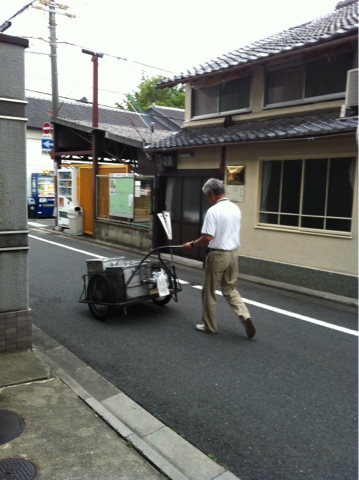
Anyways the tofu man is a man with a large two-wheeled aluminum wheelbarrow and a horn that sounds like a 1920's retired fire engine alarm. WEEEEEEE woooooo, the forceful sucking of air in and its exhausted release back out, like an old man on a respirator. You may or may not get the picture.
This man goes up and down a dozen streets and side streets throughout the day blowing the little horn. As you might have guessed he sells tofu to the denizens of Kyoto. This tofu is very likely homemade by the Man himself or possibly his wife. I cannot actually attest to the quality of the tofu and its tofiness, as I have never actually wanted tofu whenever he came by. He pretty much only comes by during daylight hours, around midday, but he will continue until dusk. And he will sell his tofu rain or shine. I have seen this man all decked out in rain gear with a covering for his wagon as well. I assume snow as well, but as it has yet to really snow and stick in Kyoto...
Honestly the way he walks selling tofu rather quite reminds me of the ice cream man in America. Touring the streets for sweltering children looking for respite, or in this case it is Japanese housewives planning their dinners.

Thursday, August 30, 2012

Rakugo

I don't know if anyone else had the experience of storytellers coming to their elementary schools. But my school had a fair amount of them. The majority of them were native American stories. With puppet shows, and shadow shows or acting it out, or even just vocal performances.

Japan too, has a great many of these kinds of performances. They are called rakugo. They are a story that displays some sort of moral in the end, though not always. They are more known for being amusing. Though it is an odd sort of humor, where it is not really funny as in hilarious, but funny in a pitying sort of way meanwhile, making your life also feel better. I know it is strange to say.
Recently, I had the honor of meeting a rakugo artist and listening to him practice his tale. He was a Japanese man performing in English for an event to be put on at the Kyoto multi-cultural center September 29th. This man's story was one of death, and making deals with death. And of some poor sod who had a terrible life any way you shaped it and so he made a deal with a shinigami(god of death - in Japan there are multiple shinigamis). The man of course got greedy, almost like in Aseops tales, and tricked a poor shinigami. And well I won't ruin the story for you!
But here are a few examples of other rakugos preformed in English.

Tuesday, July 31, 2012

Gion Matsuri

One of the three biggest festivals you can happen to see in Japan.

This one takes place in Kyoto and specifically, if the name hasn't given it away already, the Gion district. 

This is not an event that you run through quickly and get it all done. Rather it strolls right through your city and makes sure you know its there. It is a month long procedure starting at the beginning of July, but the most notable events begin around July 10th. At this time you will often hear the Gion Matsuri music being played in the arcades and along the street and shopping areas. There is a parade welcoming the mikoshi which effectively works as a further build-up (further since this is the second parade for the month in honor of this matsuri). It is this day that the mikoshi are cleansed in the Kamogawa and the commencement of the building of dozens carts called yamahoko. There are special places all over the city with granite blocks inserted into the street where the yamahoko are build upon when the time comes. 
The yamahoko are provided by special communities where they originate from (often called yama something) and if you are a member of one of these communities you have the unfortunate tax of providing for these gargantuan carts. There is a special community tax for their up keep, but in addition there are also sponsors for some lucky carts as a bit of a financial break. The instructions for these crazy carts are passed down from generation to generation without ever being written. Yeah that's right. They build these 10 meter plus structures completely from memory and just watching when they were children. Needless to say the building team is pretty exclusive.
These carts are finished in three days time on the 13, but with some particular carts (like the koi one), some finishing touches are added the day of the large Gion matsuri parade. The night of the 14th is called yoiyoiyoiyama, which pretty much translates to 'The Eve of the Eve of the Eve of Gion Matsuri'. Pretty ridiculous right? Well these people like their festivals. And as you might have guessed, the next night is the ever of the eve and then the 16th is the eve of Gion Matsuri. And you might even say this event is bigger than the actual day of the event due to the turn out of people. Gion Matsuri is held on the 17th of July every year. Rain or shine. Weekday or weekend. 
Hence if the 17th is on a Wednesday, you might expect a lot of people will not take off of work to see the parade around the city, but rather admire the yamahoko and food stalls and thousands of people the night before. It is a very large event that closes down the busiest part of town. People flood in from literally countries away. All of the hotels are sometimes booked a year in advanced for this celebration. There are game and activity stalls in the streets and people selling their merchandise and food. Lots and lots of food. 
On the morning of the 17th around 10am, the yamahoko begin their march around the city. Starting with one specific cart every year with an impressive katana on the top of it. Held on a bamboo pole perhaps 5 meters about the cart itself, this blade is used to cut the ribbon commencing the festival.

The day of the matsuri, the three gods of Yasaka shrine at the end of Shijo street and the Gion district are transported to a new temporary 'home' in the middle of Shijo street via the mikoshi that were earlier cleansed. The reasoning for the carts is that those are used to cleanse the streets in preparation for the gods arrival. The night of the 17th is when the mikoshi action takes place. You see at the shrine there must be complete darkness, no lights, no cameras, cellphones, nothing. Just total darkness for the gods to go into the mikoshi. A ritual is preformed and they are on their way. In 10 days time, on the 24th of July, they are paraded around the city once more via their mikoshi and are sent back to the shrine. This event gathers a lot of watchers, but not as many as before. There is also a significant lack of food stalls ( perhaps 4 or 5 to every hundred of the night of the 17th). 
On the 28th, these mikoshi are again cleansed and packed away for storage. 


Tuesday, June 19, 2012

Geisha

Largely disappeared in the increasingly modern if not advanced world of Japan, one stills seems to have a place in ones memory for the matter of the white-faced geishas.

Recently a friend inquired me if geishas still existed.
The extremely direct answer is that yes they do and I have actually had the luck to see one. But the other answer is that they are not quite like they were from the movie Memoires of a Geisha.

Previously, geishas were more often thought of as high priced whores, also seen in Memoires of a Geisha. But moreover, they got their start as more of an expression of art and entertainment. You see, back in the day, well I suppose it really isn't that far back in the mentalities of most Japanese, but for the purposes of this story you need to go back, back to when men were supreme and women their mere servants and heir bearers (see 50 years ago isn't that far back, but I speak of hundreds). Men of this time were often samurai, as well as butchers, heads of offices, merchants, you name it. The important part is that men were the one with the jobs. This means that men also had positions in the performing arts as well. Well more like every position. Geishas they were. The art of grace and style of beauty actually came from men! Can you believe it?! But the point of all of this was a discussion on the origins of geisha-ism, so with this knowledge you cannot say that the origin of geishas was prostitution (I mean unless there was male geisha prostitution of which I am unlearned).


It was later that women took over the role of being a geisha. Perhaps just for the prostitution aspect? I cannot say. But they would preform for clients with expensive tastes and would often entertain people such as the emperor himself. And men, being the selfish pigs they are, turned these geishas into concubines (one woman is clearly not enough, how dare you speak such heresy). And of course seeing the plethora of job opportunities on the market for entertainment and pleasure acts, geisha brothels did appear. Though I suppose one can argue whether or not these are true geishas at this point. Such was the reaction to these brothels that the city had to institute a number of rules on the whore house perhaps to maintain somewhat of an air of modesty and class to their cities. For example:
  • they limited their existance to specific districts called yukaku 
  • they instituted a rule where no male was allowed to stay there for more than a 24 hour period straight 
  • the employment was not allowed to leave the peremmississ without authority to do so 
  • and the employment was to wear simple died kimonos, to a lesser quality than the finer courtesans

These rules and tight control came upon a time when female geishas were flourishing and daughters were easily given up to a geisha or brothel house. A woman's dowry can be quite expensive you see and women are no cheap things themselves, just compare a woman's and a mans kimono. Please reference the movie again to understand why they were given up and auctioned off...


In today's time, geishas still exist as the exquisite beauties of white face and striking make up. They wear beautiful and elaborate kimonos that must be sweltering with the many layers of fabric. They do still do dance performances as well as tea serving at select tea houses. They are a top dollar commodity, a luxury expense for the wealthy elite. They play instruments, they dance, recite poetry, they sing, write calligraphy, they story-tell, they pour tea; but they are not auctioned off to any bidders with virginity as a price.

Living in the kansai region, a stones throw from Kyoto, I can attest that you can still see many of geisha present there, if you know where to look. By that same factor, I will also be the first to tell you that there is no real geisha scene in Tokyo. I would tell you this because the culture and the traditions as well as the buildings themselves and atmosphere of Kyoto is so well preserved that the modern and technologically advanced Tokyo cannot hold a candle to it. Indeed in Kyoto there are ordinances input to maintain as much historical buildings and areas as possible. Even the atmosphere is important: you know McDonalds red sign with the golden arches? Well because back in the day, they would not have acheived such unnatural colors, they have modified the sign and appearance to be somewhat dulled and the red is a ruddy brown and the golden arches are more or less a bit more golden in appearance.

It is true that many of the 'geishas' you might believe to have met are actually maikos, a younger, less experienced apprentice version of the same thing. At what time a maiko becomes a geisha, I cannot say. It used to be at a certain age, a maiko would graduate into a geisha, but today's skills and requirements tend to vary from ancient times. Others that you might see, especially if they are out and about, are actually tourists, who pay a fee to be dressed up as such and visit the relics of Kyoto.


tourists in dress 


Where to see them? At big events that call for a celebration. I saw them at a recent matsuri (festival) where the pair, a geisha and a maiko put on a beautiful dance.


Tuesday, February 28, 2012

That Delicious Fish Dish that is pure Bliss

A basic how to of your typical sushi restaurant.

Yes, as you can see they have conveyor belts of sushi, but what may surprise you to find out is that they don't really do the "roll" type of sushi that you often find in America. Here, it is your typical fish on rice. There are a few as you can see that are Nori, Rice, and Seafood-substance ( like the Seafood Salad that you see coming up). Another popular one is egg. It can be hard boiled or fried, but mostly people stick to fish.

Rules for eating sushi

  • When eating at a small restaurant where a chef makes it in front of you, do not add too much wasabi. It is considered a bit offensive to the chef. Like how in Chicago some places don't serve ketchup with their hot dogs, they have a unique style and know the best taste for it. 
  • As for the wasabi, it is a common style that I have seen (and by that, I mean the only style) to remove the fish from the rice, add a small amount of wasabi and sometimes a few drops of soy (which you can add after the fish has been replaced if you prefer), and then replace the fish. If you are at a restaurant where the chef styles and makes the sushi in front of you, he may already add the wasabi in what he considers if the perfect balance of spice and fish.
  • Do not add the wasabi to the soy sauce dish.
  • Eat it in one bite. Ok. This is a bit obvious, but really...you just try taking two bites and making it look graceful and unmessy. Yeah, that's what I thought. So take two bites. 
  • Many people will advise you to make a small dish of soy for dipping. However, I have found that it is commonplace and perfectly acceptable (at least in restaurants such as the one below) to pour the soy sauce directly onto the sushi. You only add a few drops and definitely not to much. But this method prevents too much waste of the soy sauce and you wont leave any grains of rice afloat in the soy sauce dish. Another note, is that some will advise you to only dip the fish in the dish of soy sauce and not the entire nigiri, as the rice will soak up too much soy (and also leave rice grains afloat)
  • Speaking of that, don't leave any grains of rice in the soy sauce dish. It is unavoidable for some, but it is not seen as proper etiquette. 
  • Where I have heard it is alright to eat sushi with your hands to eat in some restaurants. I have not seen this. And prefer to always use chopsticks...May Buddha smite you if you use any other utensil.
  • The ginger. There is no advisable amount for this. Often when I go to a restaurant with a Japanese friend we can clear out half a container of this if not more. This is considered as a palate cleanser, and is eaten between bites of different sushi. This is so that you get the full effect and flavor of the new sushi you are sampling so you can enjoy it to its fullest effect without having a cross contamination of flavors.


Tuesday, February 7, 2012

Demon Days


Setsubun, also known a Bean Throwing Day, is celebrated on the 3rd of February.

This day is famously celebrated by throwing beans at a demon, oni, to drive him away. This is called mame maki, mame being the beans ( hence eda-mame); however the beans being thrown on this day are roasted soybeans, called fuku-mame (fuku meaning fortune). Typically one poor soul gets to be the oni and people will throw beans at him. This is often the man of the house or occasionally if there is anyone present who is representative of the coming years zodiac sign. The oni gets to wear a special oni mask that can be pricked up for free at the local grocery store, or nicer ones can be purchased elsewhere. Mame-maki is done while saying "Oni wa soto! Fuku wa uchi!" which means to drive the oni out and welcome in happiness. After driving out the demon, you can eat your fortune ( the beans) on the ground...or happily step on  them, but eating them is considered luckier.

This whole ritual is done just before Risshun, or the beginning of spring. Thus Setsubun is the separation between winter, and spring. Ideally this day would be considered New Years eve in accordance with the lunar calendar; however as with most holidays in today's Japan, this is now a fixed day of the year and does not always coincide with the lunar New Year ( which was January 23rd this year).

Other ways that this holiday is celebrated is through their food culture. Common dishes on this day are a grilled sardine, of which everything is to be eaten, and a large type of sushi roll called, ehomaki, and of course the roasted soy beans. Ehomaki is a funny little tradition. It contains 7 lucky ingredients ( these tend to vary or be eaters choice) and then is eaten in a particular direction. This direction changes every year. This year it was North NorthWest. You then eat this entire engorged sushi roll without chatter or distraction. You are not really supposed to pause, but that does not mean that you are supposed to choke the whole thing down either. Once accomplished, your luck is now certified. Edo-maki, by most accounts, has originated in Osaka. This being the case, it is largely a kansai tradition. The accounts by which edo-maki seems to have originated tend to vary, some involving geishas or farmers and others stills involve samurai, nevertheless the point remains the same at the end of all these tales. They all obtained their luck from eating this roll.

After your meal opener, the main course is served.
Next the sardine is eaten from head to tail, bones and all. Personally, I could not quite achieve this. This is eaten because it is said that the oni cannot stand the smell of it and will forgo devouring you.

Lastly, after eating all this fun food and chasing my demons away, I went to a huge bonfire.

There are many festivities on this day, most located at large temples. Such festivities could include huge bean throwing events, and concerts, and at Yasaka-jinja, near the Gion district in Kyoto, you will have the fabulous opportunity to see geishas and maikos perform a dance for the gods.
Also in Kyoto, Yoshi-da Temple (吉田神社) is a shrine that hold a massive Setsubun event. They compile a huge sacrifice, arrows, wood plates, bamboo, or anything thing that you wish to sacrifice to bring you luck. These items are then strapped to this massive barrel shaped bamboo structure. At exactly eleven, the pile is set fire ( with many fire fighters on guard). It will continue to burn for quite a while and smolder for longer after. This year the flames got so high the firemen had to chase them down a bit. If you wish to see this make sure you are there half an hour in advance, as the security guards stopped entry just after I arrived. Apparently those beans gave me better fortune than I warranted!