A lot of people wonder what we do for Thanksgiving in Japan. Well of course Japanese people do nothing; but by we, I meant the odd gaijin or two.
There are few to none options for turkey dinners here in Japan...UNLESS you know where to look. There happens to be a few specialty stores and a few restaurants who celebrate Thanksgiving with turkey dinners. Or you can visit www.themeatguy.jp who sells turkey and chicken beasts that vary in weight and origin. This guy goes and gets these birds in perhaps early October when you can start purchasing them until mid November when they are either all sold out or is it crunch time to get a bird by the special day.
Here in Japan, this year we had the day off before Thursday. This day is to celebrate hard work ANNNND, get this, the harvest festival. What does this sound like to you!? But of course! Labor Thanksgiving Day!!! Ok so the two are a bit lumped together but the important part is still there, Thanksgiving. The Japanese holiday is called Kinro Kansha no Hi, 勤労感謝の日. This is a day for congratulating people for their hard work and giving thanks. Traditionally on this day the emperor makes the first offering of current years rice harvest to the gods and then partake in the fresh harvest himself. This tradition goes back hundreds of years, though in recent times, since the end of the second world war, it has come to be known as a labor day combination. This holiday is always celebrated on the 23rd of November, unless the 23 falls on a weekend, in which case the kind Japanese government will observe it on the following Monday, which will then be a day of rest.
One of the major festivals for this day occurs in Nagano and unfortunately I was not able to make it there.
What we have here is a sincerely molested chicken, adorned with stuffing. It weighs in at perhaps a kilo or two. A small gravy dish. Mashed sweet potatoes. And green bean casserole...and pan.
And that proves you can do Thanksgiving in Japan
Tuesday, November 29, 2011
Thursday, November 24, 2011
Matsuri! on a Boat!
Only there was no T. Pain on this boat.
In Arashiyama this past weekend there was a special matsuri going on. What makes this matsuri so different is that it takes place on boats! Traditionally, in all of the preceding matsuris I have seen, they have all taken the form of elaborate mikoshi with people carrying them around and making their way to the shrine.
So you might be thinking how on earth does one have a festival on a boat. Well about 13 different shrines from all over Kyoto prefecture sponsor a boat and they put on a performance, such as a dance or tea ceremony in front of the Tokgetsu bridge in Arashiyama. Supposedly there was even a Noh play on one of the boats. The boats move in a circular fashion around the lake to appease their large crowd on both banks.
Clad in elaborate costumes and elegant kimono's the entourage of the boats are as much as of the performance as the dancers. These people sit along the sides and rear of the boat as the performance takes center stage on the boat. Some of these people function as singers, singing traditional songs that are possibly for purification, and are often heard at their respective shrine; others would play various instruments such as the gong seen below. The performers donning the most elaborate costume and often a mask or an object with which they dance (a fan, a hat, these things?...).
The name of this matsuri happens to be Momoji Matsuri. For anyone who does not know, momiji is the term for the beautiful fall foliage that Japan is so known for. Unfortunately, this matsuri was planned a little too early and the leave have yet to fully turn therefore having a very slight but still present mottled effect of green and orange tinged leaves.
In addition to watching the matsuri from the riverside, you can also rent boats and tour around the lake. Even during the matsuri allowing you a very up close opportunity to view the festivities.
Tuesday, November 22, 2011
Aki Matsuri
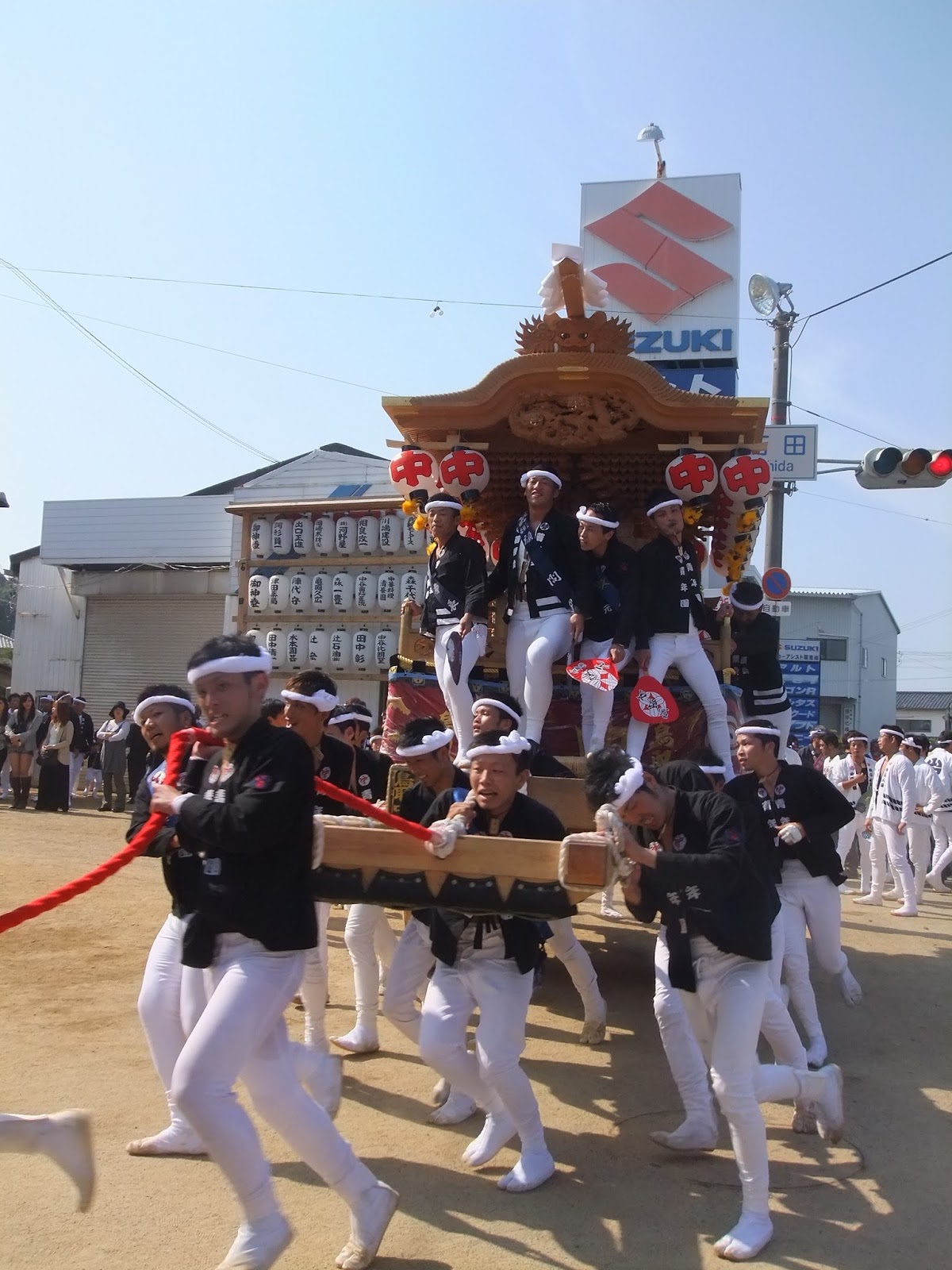
I think one of the most associated aspects of the word matsuri is all the food booths and game areas. But one of the greater more massive features of it, is the giant elaborate wooden carts that weigh 4 tons and are mobilized by the shear force of man. Here at the Wakayaman town of Aki, matsuri that is no different.
These wooden carts are called mikoshi and it is believed that the gods temporarily reside in them while they are transported around a city or to new shrines that will serve as their home. These are often seen as portable shrines and are sacred. Every year lots of money is used to furnish and decorate the mikoshi. Since they are so elaborate and so much time and thousands of dollars goes into making them, they get a lot of use out of them; they are used year to year, for possibly up to 20 years or until they acquire enough money to build a new one. You may wonder what happens to some of the decor that falls off in the stunts that they do, they simply pick up the pieces and glue them right back on for the next years festival.
Here in Wakayama you may notice a few rather similar aspects about the three mikoshi here, They all have a heavy golden rope that weighs a fair amount and costs just as much mantled around the cart, called shimenawa, as well as the folded spirit paper called shide.
During the matsuri these carts are carried by dozens of men and women, who are decked out in the uniform of their team. The leaders sport fans and towels and support the runners, yelling 'Soyra!' as a chant of encouragement. Occasionally seen at these festivals is the hitting of the runners with these fans. At first I thought this was friendly brutality, but later learned it is an act called 'charging'.
At this Wakayama matsuri, the three carts on display at the time run in a small, tight circle dragging the cart to the crowds enjoyment. After an uncertain amount of times or laps they break and ready themselves for the big important event of the festival. They have to drag their 4-5 ton cart up a set of 5 stairs into the shrine center. This is no easy task.They have their long line of runners ready themselves with half of them already up the stairs in order to get the leverage needed to propel the cart up them. It is the task of all three carts to accomplish this. What happens if they fail? Well I don't know!
Once up the slope the carts put on a sort of 'dance' if you will, rocking their cart back and forth with a person in the back pounding a rhythm on the drum. After each finally make it, they go out in a bang, producing their banners, popping streamers, and finally go into a sort of boisterous revelry. They drink sake, Japanese holy water, and proceed to anoint their mikoshi with the sake as well as the crowd. Then they proceed to gift the crowd with mochi, or rice cakes, which are thought to bring good luck in health if obtained.
Other notable areas around the celebration are the stalls. Food stalls. Game stalls. Sweet stalls. Fish stalls. All sorts of things can be found here. And rather go into detail describing them all I will just give you the photos for you to make of it what you will!
These wooden carts are called mikoshi and it is believed that the gods temporarily reside in them while they are transported around a city or to new shrines that will serve as their home. These are often seen as portable shrines and are sacred. Every year lots of money is used to furnish and decorate the mikoshi. Since they are so elaborate and so much time and thousands of dollars goes into making them, they get a lot of use out of them; they are used year to year, for possibly up to 20 years or until they acquire enough money to build a new one. You may wonder what happens to some of the decor that falls off in the stunts that they do, they simply pick up the pieces and glue them right back on for the next years festival.
Here in Wakayama you may notice a few rather similar aspects about the three mikoshi here, They all have a heavy golden rope that weighs a fair amount and costs just as much mantled around the cart, called shimenawa, as well as the folded spirit paper called shide.
| Up on the cart are the leaders yelling encouragements and waving their fans. |
Here are boys and girls decked out in their teams uniform.
White pants, white cloth shoes and a type of (usually) black jacket with their team image.
Girls often do up their hair in cornrows for the event.
At this Wakayama matsuri, the three carts on display at the time run in a small, tight circle dragging the cart to the crowds enjoyment. After an uncertain amount of times or laps they break and ready themselves for the big important event of the festival. They have to drag their 4-5 ton cart up a set of 5 stairs into the shrine center. This is no easy task.They have their long line of runners ready themselves with half of them already up the stairs in order to get the leverage needed to propel the cart up them. It is the task of all three carts to accomplish this. What happens if they fail? Well I don't know!
Here is a picture of the shrine and the sand bags that
they put before the first step to give them leverage on the way up.
Once up the slope the carts put on a sort of 'dance' if you will, rocking their cart back and forth with a person in the back pounding a rhythm on the drum. After each finally make it, they go out in a bang, producing their banners, popping streamers, and finally go into a sort of boisterous revelry. They drink sake, Japanese holy water, and proceed to anoint their mikoshi with the sake as well as the crowd. Then they proceed to gift the crowd with mochi, or rice cakes, which are thought to bring good luck in health if obtained.
Other notable areas around the celebration are the stalls. Food stalls. Game stalls. Sweet stalls. Fish stalls. All sorts of things can be found here. And rather go into detail describing them all I will just give you the photos for you to make of it what you will!
Thursday, November 17, 2011
Got milk?
Chock full of calcium and essential to your everyday diet and can also be found in a vending machine.
So you may be familiar with the Japanese beer, Kirin. This is not a post on that. That being said Kirin also produces a plethora of vending machines in their name. For anyone who does not know what Kirin means in Japan, it means giraffe. And with that being said here is what I tend to imagine every time I see a Kirin vending machine.
How it really is:
The drink machines are typically priced at 100-150 yen per beverage for such things as coffees, teas, juices, colas and energy drinks. But there are special 100 yen machines that sell the off brand or smaller versions of the typical 20 ounce. Just so you know that 100 yen is still over a dollar, but this is seen as reasonably priced in Japan.
In addition to finding them in any place, they vend an extremely large variety of stuff. Now people say that you can find anything in these machines: soda, cigarette, octopus, action figures, women's underwear. Personally I have only ever seen cigarettes and soda come out of most these things, though I have seen an occasional flower or camera film/disposable camera vending machine, ice cream vending machines are easy to find at parks on hot days, and of course the beer ones are common enough. This is not to say that women's panties vending machines do not exist, I would not be surprised to see on the shadier streets of Tokyo ones that vend women's panties.
What I DO find special about these machines is that they vend hot drinks. And sometimes hot and cold drinks, meaning that there is a heating and a cooling system side by side in the same machine. You might be thinking why would I want a hot cola, but don't think along the lines of cola, think more like coffee and hot chocolate. In the winter and your hands are freezing I find these machine invaluable hand warmers as well as a source of delicious beverage.
![]() |
| Told you so |
The drink machines are typically priced at 100-150 yen per beverage for such things as coffees, teas, juices, colas and energy drinks. But there are special 100 yen machines that sell the off brand or smaller versions of the typical 20 ounce. Just so you know that 100 yen is still over a dollar, but this is seen as reasonably priced in Japan.
![]() |
| bank of a bunch of different machines. Looks like mostly beverages and cigs |
You can pretty much find these guys everywhere...and ANYwhere. I hiked up Atagoyama back in May, and yup there one was...at the top. Of course drinks were 200 yen more at the top for those thirsty hikers who finished off their water supplies. It is said that there is one vending machine for every 23 people in Japan. It is my own theory that there are practically no water fountains in Japan in order for the vending companies to gain a bigger profit. Very opposite from Korea, where there is a free water cooler in every building you enter. The reason why there are so many vending machines is that the land owner gets a cut of the profit that the machine produces. How it works is they just call up their favorite vending machine company and have them install a machine on their property and then they pay for the electricity and get a cut of the profits. It is a simple and easy way to get money without working which is why there are so many of them all over Japan.
ANYwhere
What I DO find special about these machines is that they vend hot drinks. And sometimes hot and cold drinks, meaning that there is a heating and a cooling system side by side in the same machine. You might be thinking why would I want a hot cola, but don't think along the lines of cola, think more like coffee and hot chocolate. In the winter and your hands are freezing I find these machine invaluable hand warmers as well as a source of delicious beverage.
![]() |
| the top row is the hot beverages in red everything in blue is cold |
![]() |
| one more for you |
Tuesday, November 15, 2011
七五三 Shichi-Go-San
or seven-five-three for anyone not currently up on their Japanese. These numbers do not relates to waist sizes for a particular store of jeans, but rather a Japanese holiday held every year on today, November 15th. However, since it is not a national holiday and children must still go to school, it is typically celebrated on the preceding weekend.
It is the day when all of the girls of ages 3 or 7 and boys of ages 3 or 5 make their way to a shrine. Why 7-5-3? That is because in Asian culture odd numbers are often seen as lucky. This is a celebration of the passage into middle childhood as well as a celebration for a long and healthy life. On this day children get elaborately dressed up, little girls dress up in fine kimonos, and boys will often wear haori and hakama. Often times going to photo studios for memorable portraits of the day. In present days, more and more children often wear fancy western styled clothes to visit the shrines.
In earlier years (the Edo period) this passage into middle childhood meant that they no longer had to shave their heads as of age 3. And then boys of age 5 were allowed to hakama for the first time. At age 7 girls graduate to being allowed to wear an obi instead of cords to tie their kimono.
Following the purification ritual, parents will sometimes by chitose-ame for their children. Which is translated to thousand year candy. This is a long candy-cane like candy with its red and white stripes. This candy, typically presented by a turtle and a crane upon the package, represents longevity, so that their children may have a long healthy life and happiness.
It is the day when all of the girls of ages 3 or 7 and boys of ages 3 or 5 make their way to a shrine. Why 7-5-3? That is because in Asian culture odd numbers are often seen as lucky. This is a celebration of the passage into middle childhood as well as a celebration for a long and healthy life. On this day children get elaborately dressed up, little girls dress up in fine kimonos, and boys will often wear haori and hakama. Often times going to photo studios for memorable portraits of the day. In present days, more and more children often wear fancy western styled clothes to visit the shrines.
In earlier years (the Edo period) this passage into middle childhood meant that they no longer had to shave their heads as of age 3. And then boys of age 5 were allowed to hakama for the first time. At age 7 girls graduate to being allowed to wear an obi instead of cords to tie their kimono.
![]() |
| haori are the over coats they are wearing. hakama are the pants that are belted above the waist. |
![]() |
| you can see the bow from her obi in the back |
Following the purification ritual, parents will sometimes by chitose-ame for their children. Which is translated to thousand year candy. This is a long candy-cane like candy with its red and white stripes. This candy, typically presented by a turtle and a crane upon the package, represents longevity, so that their children may have a long healthy life and happiness.
Subscribe to:
Posts (Atom)