Tuesday, July 17, 2012

Suicide by Force

This is determinedly a very unhappy post, but it does show you a lot of insight into some really harsh Japanese culture.

A seemingly mundane event for Japan happened last October in Otsu (pretty near Kyoto), that was just a minor ripple in the pond until recently when investigations uncovered the schoolyard brutality that began making much larger waves.

A junior high school student, a boy of 13 years, committed suicide last year by jumping off a 14 story tall building. Seeing as suicides happen in Japan every day, by train, by hanging, by jumping, cutting, pills etc. It didn't seem too incredibly out of the ordinary. Sadly. It took almost an entire year for them to really dig their claws in and turn this evidence to light, that it was really no normal event. 
I am not talking about murder, no, I am talking about such forceful bullying that suicide seems to be the only logical conclusion for young teens. This story touches a bit close to home for me, seeing as it really happened so close to my own home and I, myself, teach a bunch of junior high schools students, everyone of  which I care about. 
In this particular incident, a group of 4 boys mercilessly bullied this poor student into submission. You might be thinking oh he should just suck it up, we all got punched a few times, it is part of growing up. That may be...but did you have to eat dead animals? Were you forced to practice suicide so that your peers might find you absent from school in the following days in hopes that you finally did off yourself? The group of boys forced the poor lad to do numerous things for them starting with the beatings, the mild money extortion (they actually weaseled out his PIN information and would withdraw money from his account) and shoplifting and escalating to public humiliation of derobing him and scribbling on his face, and finally forcing him to eat dead bees, frogs, and birds and practice his own finale. They made him practice jumping so that he would not be so scared as to do it if that was the way he chose, as well as to tie his own noose and see how it felt with his head snug inside it. Additionally, and perhaps the most psychologically tormenting, was the mock funeral that they held for him, making him play a part. 
Nearly everybody knew about it. Only who wants to stand away from the laughing group? Who wants to be the outsider that lets know it is going too far? Such heard mentality. 
Just before he died, he messaged his tormentors proclaiming his act and they replied with encouragements.

And the worst part?

I know you are thinking how could this possibly get any worse. 
EVERYONE tried to sweep it under the carpet.
The police received advanced complaints MULTIPLE times about the bullying. But each and every time, they turned away the father of the child saying that their hands were tied and there was no proof and it was hard to claim. It was reported to the teachers as well as the school who did no more than say 'Keep it to a minimum'. The boy went to them even for advice. For help. For mentoring. For avoidance. But they turned a blind eye. They did nothing. They did not watch over him as a teacher should. As he was forced to do these acts during lunch break, where I can attest, a teacher has to be in the classrooms at all times. 
And then after the fact?
The school tried to cover it up. At first they claimed there was no bullying what so ever. And then after an initial investigation they claimed that it was only mild instigations.  The school removed all the reports of the bullying and any new evidence reported went unclaimed to the board of education. They actually went as far as to claim that 'no new reports of bullying had been submitted.' They were trying to keep the incident in the family and trying to make it seem less worse than it really was. The reason? Money. Why else? If they school goes public with information, no one will want to go there. The teachers will be out of work, and not only that, they will find it difficult to find new jobs once they are known as the 'Teachers who Stood-by', new schools don't want mentors for their students if they are no mentors at all. A group collective decided to ignore these reports and now a renewed police investigations are looking into the school and case. 
What took the police so long? Why did they ignore the fathers claims of bullying?
One of the boys' grandfathers was a policeman. Not just any policeman, but a well respected one with influential power in a top position. Even retired he still had a bit of power and if it came out that his grandson was involved and how wretched of a person he must be to overlook the actions and mentoring of his own family to end up in such a situation, well it would just not look good. It is suspected that he used a lot of his remaining power to forestall investigations and make them seem less serious. 

Currently the mayor of Otsu has proclaimed that another investigation was going to be set underway promptly as the case has come more and more into light and after being bombarded with many angry parents and emails in regards to the bullying. 
The parents of the boy are suing the involved students and their families for incredibly large sums of money, but in my opinion not large enough. 
Two of the four families have already moved to Kyoto, trying to avoid the spot light that Otsu has become. 

And the worse worst part?
Just when you think it cant get any worse right. There will be no retribution. 
The boys?
Nothing will happen to them. There will be no jail time. There will be no trials. They might have to go to a detention facility and come back all freshly reprimanded but that will be it. Here there is a law that protect kids of the ages 14 and under. I would totally recommend the Japanese movie Confessions, which really shows you how the Japanese mentality regarding this law in respect to the students functions. It also is a movie that gives you some insight to the bullying that takes place in Junior High Schools in Japan(additionally it is a pretty good psychological suspense movie). 

Thursday, July 12, 2012

A night of Fireflies and Romance

Japanese people seem to have a penchant for fleeting ethereal beauty.


Fireflies have a special significance in Japan. Their their fleeting lives and their illuminating presence light up the night in a spectacle for all to see. Indeed, in Japan there are firefly evens where a thousand fireflies are released and rise up into the night like hundreds of blinking stars. Of course there are natural fireflies too, but there just simply aren't enough of them for hundreds of people to enjoy at once.
Fireflies are special for a reason that I was entirely clueless to before moving to Japan. Fireflies will only inhabit clean water. Well I suppose the first fact I was clueless to was the fact that fireflies like water. I have always lived around water and have always seen fireflies in the spring and therefore took it for granted that fireflies are not in fact everywhere. But secondly and more importantly, fireflies will only populate areas with sources of clean, unpolluted water. It is essential for their continuation, as their larvae need it to survive.
Fireflies are more prone to warm and humid climates and therefore are more dominant in the south of Japan. Here we will have minor festivals in Osaka and Kyoto where fireflies will be released for the enjoyment of hundreds of visitors, which also serves to help repopulate the fireflies in these select areas. I must say that this feat is a bit better suited for Kyoto as there are a number of clean water sources present there. I think the best of all is the Philosophers Path with a steady steam coming in from Lake Biwa. There is...not exactly an abundance, but a good amount of natural fireflies to be seen here. Other places are the Shimogamo and Kamigamo shrines. The Shimogamo shrine, in particular, is one such place that releases the fireflies to all to see. Another such area is in Osaka at the Sky Building, at the floating garden. I have to think, though I have no witnessed, that Harie must be the very best place to see fireflies, with their special underground cistern from which the cleanest and clearest water from all of Japan flows. So if you are looking for a site you should visit one of these select places on a warm night when mosquitoes are bound to be buzzing about!

Tuesday, July 10, 2012

Lucky 7

There are many occasions for celebrations through out Japan, like Hina Matsuri, or Girls Day which occurs on March 3rd, or Boys Day which occurs on May 5th, and also Tanabata, which occurs on
July 7th.
Seeing a pattern? 3/3, 5/5, 7/7 (and of course 1/1 is new years). So upon finding this out, I immediately as if there was a 9/9 or an 11/11 event. And my students pondered really hard for a moment, seeing as it almost made sense for there to be such events. But no such luck, or not that they could come up with.

July 7th, Tanabata, was originally one of those customs that pertained to the Chinese calender and would occur on the 7th day of the 7th lunar month. Due to the predominance of the Georgian calender in Japan, the holiday would follow the natural course of its brothers and sisters and would take the same literal meaning and apply it to the Georgian calender, and take the date of July 7th.

And as all things go in Japan, there is, of course, an old story that goes with it. It is a story of falling in love between the daughter of the Universe, Orihime, and a lowly cow herder, Hikoboshi. Let me preface this story by saying that these two are constellations and live in the sky above. The daughter of the universe was clearly a princess who was gifted at weaving, and would often do so for her father, who was pleased. The daughter wanted more than anything to fall in love. She eventually came to meet this cow herder upon the banks of the river (the Milky Way) where she would weave. The two fell in love at first sight and were wed. And as with all couples, that is where the trouble began. The two became so involved with one another, that they took leave of their duties. Cows wandered the heavens and the Universe no longer received gifts of the bolts of weaved fabric from his daughter. Seeing their negligence, the Universe took away his daughter to maintain order in the heavens, and moved her across the Milky Way forever separating them. But all fathers bend at their tears of their daughters and agreed to allow them to meet once a year, on Tanabata. To allow her to cross the Milky Way river, a flock of magpies ( a black bird) formed a bridge so that she could meet her beloved on the other side. But if the day is rainy, it is said to be her tears at the inability to see through the clouds and make it to the other side to her Hikoboshi. Therefore they can only meet on clear evening when the sky is starry.
Outside of the legend, two stars, Altair and Vega, are separated by the Milky Way and on this day (in the lunar calendar) they can meet. Of course you can't see it if it is cloudy.

To celebrate this day, modern Japanese people will write wishes and poetry upon colorful origami paper, called tanzaku, and attach it to a bamboo limb. These colorful decorations are either burned (the ashes ascending to the heavens) or floated down a river (symbolic of the Milky Way river in the story) so that their prayers and wishes will reach the heavens and come true.
Additionally there will be more festivals held in August when the stars are in accordance with the lunar calendar. In Kyoto, there will be more tanzuka bamboo structures, lanterns floating down river (Horikawa), and bamboo artworked exhibitions, as well as an illuminated walkway representing the Milky Way. Basically a nice little romantic evening for couples.

Thursday, July 5, 2012

Japan Fashion: Accessories

In the winter most of us are prone to wearing hats, gloves, scarves and accessories to keep us warm. Sure most Japanese people will wear scarves, almost men more so than women. But to see then wearing hats is another thing entirely. Especially in winter. Men will wear hats typically, but I feel like it is definitely not as many that would wear them in the states. The beanies, toboggans, berets are all amiss over here. Women in particular are very against wearing hats. It comes and goes with the fashion of popstars, but the recent consensus is that wearing hats, especially winter hats ( in other words NOT sun hats) makes girls faces look large.
Weird right? I don't think I have ever been concerned about my face shape in America. But I suppose it is a bit like saying 'Does this dress make my butt look big?' only instead it is 'Does this hat make my face look fat?' An excessively large number of Japanese women are concerned over the width of her face, and it is often one of the first things they will notice about a new person. I remarked upon how I thought a woman across the street was very comely and the Japanese woman next to me said her face was too big. I am sure I made something similar to one of these faces (o.O). It is super weird to hear Japanese people say anything is fat seeing as they are all so skinny and practically under the degree to which their body mass indexes are recorded for average. It is also weird for my students to tell me I have a small face. Personally, every time I hear that I am thinking about the shrunken heads from the Night Bus of Harry Potter, and get a bit concerned.
But I digress. The point is due to the attention that hats will draw to ones head, many Japanese women will avoid wearing them. Additionally hats will push their hair and any volumizing elements that wear added to it, down flat, mussing their carefully maintained hair styles, and lets be honest, to carry around all those cosmetics just to have a wear head with a hat is just a pain!
But what they might wear is a scarf. Especially if it does not mess up their locks. It is outfit accentuating and very fashionable. Summer scarves likewise seem to be a good accessory for most women. A light breezy one, or even the stewardess ones that tie around the neck. As for the hipster scarf, I swear Japanese people must have mastered the look before it reach America, with the ease that they wear them. And it is just unearthly how perfect their scarf placement looks at all time. As far as I go with scarves it looks like It found fabric and rolled in it and they assume it as a pitiable attempt at clothing oneself.
Gloves are fashionable for winter and for the gothic lolita sort, and primarily consist of a thin material, often a knit or a wool and the primary function is fashionability and not so much warmth. Mens gloves have a greater degree of variance and will be thin or think in mostly darker colors.
Also in winter, I would swear up and down that those face masks are popular, because I see no other point in donning one of those ridiculous and irritating things on. Well I suppose there is no point if you are a mouth coverer whenever you cough, but like I mentioned earlier, it seems that is against most Japanese peoples policies. Though it is really not just a winter fashion. People wear it for pollen too. It just gets to its peak of fashion popularity in the winter.

Jewelry, ah jewelry. What most people automatically jump to whenever accessories are mentioned. Jewelry here is certainly worn. And I would ever fractionally hesitate to say that it is worn more here than in America. The largest difference is rings. Japanese girls and boys do not really wear rings. If you wear them people automatically seem to think that your significant other gave it to you. No matter how it looks or on what finger you are wearing it. It seems to me that they really don't know too much about the significance of rings like Korean do; who will get couple rings to all of their long term fancies and pretend they have lasting significance as promises of marriage to one another. Japanese people do wear wedding rings, but it is more of a recent fashion and I would certainly wonder as to the percentage of married people that choose wear them. It seems to be a younger thing to do for sure. Additionally, they don't really wear them like the married couples of America. I saw a family on the train this morning where the mother was not wearing her ring and it didn't look like she had in a while and the father was definitely wearing his. But she didn't look like the type to be promiscuous or anything for those who were about to suggest...(too homely). So it seems to me that rings, even wedding rings, are an accessory that are seldom worn and not worn with the regularity and meaning that I grew up with.
Necklaces and bracelets are of course worn in plenty. And the shinier the better, or so it seems. Those hipster things with feathers or made of cloth, are not too popular in this part of the world ( though I was told that feathers were in several years back). For men, necklaces are again not too uncommon, but are much more simple. There is a significant abundance of bracelets that seem to adorn the womens (and sometimes a simple thing for interested men) arms here, but a noticeable lack of watches. Even in the men, I find that watches are noticeably less. Though not as significantly absent as with the women.
Belts are worn, but nothing too noticeably different there save for that my students seem to prefer a punkish looking belts and the girls will often get some pretty often shiny or sparkly affair. Not that they need belts. They use them to hike up their skirts.

But the major Japanese accessory, is a pocket towel. Or a handkerchief. Men will often carry them about in their back pockets, and women their purses. These guys serve for multiple purposes. Such as wiping your face from sweat on a hot summers day. I see many a man doing this all the time. I think ladies must go to the bathroom and dab at their sweatiness so as not to rub their make up all around. In the winter, when you have a cold and are in complete absence of tissues, is serves as a super secret nose wipe. Now please note, it is not really polite to do this, but I have seen them do it and know they do it. The thing is, blowing your nose is disgusting to them. They would rather see you sniveling throughout an entire day than clearing your air passages in public. It is considered gross not only to blow your nose, but also to blow it into your handkerchief, but significantly better than wiping your nose, say, on your sleeve for instance. But sometimes, things get a little desperate. So the trick is to do it unseen. Going to the bathroom (which will not always have toilet paper. Especially in public ones) or any separate, vacant room, and hiding from view in one way or another is perfectly acceptable solution to this kind of situation. And lastly, and probably most important, they use them as hand wipes. Not to wipe your dirty icky hands on. More so to use after you have washed your hands afresh and need to rid yourself of the water rivulets running down them. You got it. There is no paper towels or hand dryers in a very large amount of the bathrooms in Japan. In this manner, they can save, money on electricity, trees, and maintenance as well. And, especially at the present, Japan is all about saving some electricity.

Tuesday, July 3, 2012

Onsen: A guide to the Japanese Hot Springs

In Japan hot springs are referred to as onsens and are extremely different from the jimjilbangs I once wrote about in Korea.
Onsens are naturally occurring springs of boiling water throughout Japan. And what better to do in these naturally occurring hot pockets but bathe!

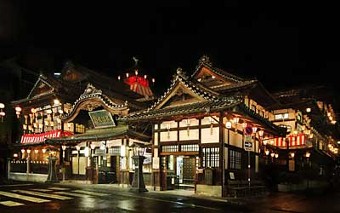
I always found onsens intriguing ever since I saw Spirited Away, the Miyazaki film set at an onsen (which in real life took inspiration from the pictures below, Dogo Onsen, out in Matsueyama - for anyone looking for some travels!)


These hot springs are formed largely from the effect of Japans volcanic activity. Japan has many great features about it, such as there are a surprising number of freshwater rivers and pools throughout the island, as well as fresh water that pools beneath Japan, it has lots of seismic activity dude to the flirtations of those tectonic plates, and of course it is a volcanic island. It is due to this volcanic activity and the underground pools that enable these hot springs to form. That being said, they are not everywhere, but certainly more than I can count in a fair number of places. But seemingly larger cities like Kyoto and Osaka their number seem to dwindle ( I think I only know of one between the two, and it couldn't attest to its magnificence). Rather you had best go to a hot spring town that is known for the onsens. Occasionally, it is even in the name like Kinosaki Onsen.
Personally, I would say I have been to a fair number of onsens, but I would also tell you not enough. But from what I have been to I can tell you these there is a very typical sense to them. Often a few pools and showers of course. And if you are lucky there are also an outdoor set of pools as well. The water temperature typically varies between bath to bath, such that the people who just cannot take the heat, can simply switch to a cooler bath. When I say cooler, in reality I don't believe many baths are ever below 40 Celsius. The baths come in many different styles; some with stone basins or wooden ones, ones where you sit or lie down and let the water run over you, ones with jets to massage you and ones to simple relax in, there are simple foot baths and saunas that use the onsen water for the air vapor. So you know...many. I am a big fan of outdoor baths. Ones where you can feel the wind on your skin to cool you down from the headiness that comes over you are you soak. There is no need to worry about the outdoors part. You are in an enclosed area at all times with walls a few meters high so no peering eyes can find you. Occasionally, the more well done ones will have scenery, a direct and steep mountain side from which the water flows down and into the pool, or even an ocean that is seen through bamboo blinds.
The water of many onsens is especially high in minerals and thought to be good for health and skin. Once at an onsen out in Nagano, the mineral content was just right to tarnish my silver ring in seconds. Where as another out on Iojima island, I swear polished it to a shine such as I have never before seen. Onsens will often boast of their unique mineral content saying how it is good for one thing or another and how you will get less colds and your skin will glow.
Onsens have often been seen as a place to relax and often a place to take a company relaxation trip in Japan. Onsens help to break down the barriers around people (pretty litterally here) and help in communications. It is like a get to know you or a get to know you better, if you will and tends to bring people closer together creating the bonds that companies and clients desire in one another before doing business. Of course it is not just for companies, but perhaps new friends will go together or a mother and her soon to be daughter in law. Or any number of people.
But one cannot just hop into the bath!
First thing is first, you have to get naked. So shuck off those embarrassments and reserves you have about your body and get going. I remember one friend once asking me if you can wear a swim suit, and no, you really can't. There is actually a reason for that. You see, people with tattoos are not allowed inside public baths and onsens. The reason for this? It is because of the yakuza. You see, they cannot outright ban yakuza members from entering, they will just deny being yakuza. So they ban anyone with a tattoo, and as a large number of yakuza have tattoos, they cannot enter. However this method prevents everyone with a tattoo from entering so as to be unbiased and fair. And that ladies and gentlemen, is why you cannot wear swim suits. Though in mixed baths and larger public baths it is entirely acceptable and likely enforced, especially with mixed genders. But those are fairly uncommon. In Korea, I once saw a gal with a swimsuit on and she got a bit of the awkward indirect stare down. I suppose she just felt awkward either being the only one in a swim suit, while old fat wrinkly ajoomas walked around freely or she got the full heat of the silent judging glances. Either way she removed her swim suit in the middle of her shower joining the rest of us in nakedness. And now, with that out of the way...
You have to bathe first! Weird right? You have to bath before getting into a bath. You see, they do not want your body juices floating around the pool and your sweat mucking up everything and getting other people dirty. It will also possibly set the water concentration off a bit. And due to that, and the fact that it is just gross, you take a shower first. There are always showers in every onsen, the vast majority of which also provide shampoo and soap and even 'rinse' if you are lucky (how Japanese call conditioner, but I will swear up and down that it is entirely different from American conditioner). Traditionally, they would fill bowls of water and wash them selves with it and pour water on themselves from it when needed and refilling it as necessary. Now there is generally a shower head and a faucet with bowls so as you can choose whichever you desire. And of course you sit on one of their stools during the process. This is not typically a standing process unless the place is extremely modern. As far as washing goes, you must take note to wash extra thoroughly. No one will be watching you, oh but they will! No one will look at you or pay much attention to you, the whole Japanese eye aversion thing, but they will know for how long you rinsed and how thorough you were. And be certain to wash all of the soap from you body before entering the pools. It is quite uncouth to do otherwise.
You may now enter the pools.
Huzzah! As far as the pools go, you can switch between them as you please, but I wouldn't stay in one too long! These is a lot of dizziness to account for upon standing up, especially from the hotter pools. As far as the length of time for which to stay in each pool, I suppose that is pretty much up to you. I think people will notice if you butterfly about and go from pool to pool minute to minute. This is a relaxing thing. Take your time. And make sure you plan time in your schedule for it to be relaxing. I am not saying don't try each pool, just to enjoy them before you leave them. But by all means if it is not the right fit and you are uncomfortable, no one can hardly blame you for that! I know just recently I went into a 90 Celsius sauna at the hot spring and stayed 3-4 minutes and that was quite enough! It is also important to have some cold water now and again. Sometimes they offer a cold water pool or basin in where you can either dip yourself or splash water on yourself to cool you down; or, most of these places will offer a cold water fountain just outside and disposable cups to drink from.

This is brought on by my recent trip to Nagasaki and my subsequent search for an onsen. I found one. Out at Iojima. And for any curious eyes who want to see it before they try it, I stole a few pictures of inside the onsen. No, no one is in them silly!


The most awesome onsen I went to? There is a mud onsen to the north of Nagano which was extraordinarily awesome. The mud is not thick like you might think, more that the hot spring formed in well and muddied land turning the water a orangey-red and making visibility next to nil beyond a few centimeters.