Thursday, November 8, 2012

Salt: A Gateway Mineral

Which is exactly as it seems. A doorway offering. 


I have constantly asked what this was time and again over my nearly year and a half here and have gotten various answers.
"It is a salt lick for horses back when we used them and people still keep it out in remembrance"
"It is actually their table salt. You have to come out here to use it"
"When you work out, you use both your and the airs' electrolytes and we put this out here to replenish the airs' electrolytes. We don't want the air to taste bad for other people."
"It is for you, so you can replenish your electrolytes after running. We are very nice people"

Perhaps I should just know better than to continuously asking the same person. The same person who told me that  the decorative sample meals or fruits and vegetables outside of restaurants are actually free and that they were for the homeless or for us to take home. Because you see, their restaurant had such superior quality produce, they wanted us to try it and see how amazing it was and come back and eat at their restaurant because of their exemplar quality of foods.
So, don't believe that one either.

Salt has an important significance in Japan, it is an offering of sorts to gods and people and has a meaning of purification and cleanliness, as well as to keep away ill luck. You know things like witches and zombies and stuff. Place yourself in a doorway guarded by salt and the oni cannot enter. Ok, but seriously, these salt piles are called morishio, 盛り塩, meaning pile of salt in a very literal sense. Back in the day, salt was an important commodity; it was a well cherished import noted for its importance in keeping fish and meats from rotting and also valued in a spiritual manner as well. It was so pure and white and pretty, it began to be used for religious purposes as well. Probably the most notable today is the use of it at funerals where you will sprinkle it on you before the funeral and throw it at the door as you leave in order to purify yourself from death. A bit resembling the way one would throw beans at the oni during Setsubon.
But even more commonly, you will find it outside of doorways and in gardens and other unusual places. When placed outside of doorways, it is typically in two little dishes on either side of the door, in what are often described as little cone shaped mounds. But the reality of that statement is that there is just salt in a dish, typically in a semblance of a mound. The cones are reserved for the more influential of restaurants and are smashed once a customer has entered the establishment to signify to others that the business is prosperous at that time. In most cases though, these mounds are hand formed by the shop owners and are placed on the outside for a symbol of purification and that their shop is clean. It is an old business model that is still used almost as a token of good luck in attracting customers. It also symbolizes that the restaurant is traditional and is in keeping with some of the more customary Japanese practices. In fact, before placing salt outside of their doorway, most companies and businesses will wash the road and sidewalk in their vicinity with water and salt, or at least water. I actually see this practice every morning, a little old woman with a bent back is up at the crack of dawn watering her street corner as I ride my bike to the station. My Japanese friends have told me that is what they do when they first get to work to open their business as well. They say that it is to 'clean up', so I am mot really sure if the welcoming good business aspect of it applies to that or not, but I assume if you are 'cleaning up' to look respectable for potential customers, that clause is also grandfathered in.
In other practices, for anyone who might ever see a sumo match, the wrestlers will throw salt in the ring to purify the ring and keep evil out. I am not really sure why that is. I am not sure if sumo is a holy sport or if they feel vulnerable without their salt, but it is now a tradition and no match it complete without it.

Tuesday, November 6, 2012

Boxcar

This is just something I have happened to notice about Japan.

Cars are a lot more boxy over here. I remember when the Cube just came out in America and everyone made fun of it a bit. I think there was even a commercial with people driving refrigerator boxes when another car would be well and clearly on display amidst all the cardboard.  And then people noticed how these boxes kinda, just kinda, looked like the Cube.

Well anyways, here, boxy things like the Cube are the norm and people love their little box cars. Many of them happen to be Kei cars, which are a type of compact car that is narrower than many of the compact American cars. In America compact might mean like a lower roof kind of car, like driving a Corolla versus a Suburban. So it was odd coming to Japan and seeing these tall but extremely narrow types of car. Though that interestingly does not mean it is any less comfortable in the car; though in the back, you might be sitting two instead of three, though again some cars still have that three-seater option. But then again the Japanese three-seater would not have to be as large as an American three seater as they are a definitely thinner population here. OK that is not the case really, they are not thinner per say, but more averagely proportioned with well balanced diets. Take from that what you will...no OK, I am calling Americans fat. Yes, I am, it's true.

These Kei cars are extremely popular to drive since they cost a lot less, your insurance is a lot less, and most people don't have that big of family to pack into a car. Also, they really rely on their public transportation a lot more than most other countries, and therefore find less reasons to drive. Gas is extremely expensive and cars are just too small to entertain kids for extended periods of times. And trains are just so cheap and convenient in comparison, so why not visit grandma via the JR lines? Precisely the Japanese mindset.  But the few that do have cars seems to vastly prefer these Kei cars. And for those who have a little more money, they will get a larger version of these Kei cars, which are at that point no longer considered 'kei', or gasp something like a Prius. An interesting fact between the two car-types, is that you can differentiate them by their license plates; kei cars will have yellowy-orange plates, where are a normal vehicle will have white plates.Toyota does seems to be one of the more popular choices of normal car here in Japan, well at least as far as normal sized Japanese cars are concerned (Suzuki Wagon R seems to be the most popular kei car that I can seem to determine). At least they hold their Toyota's in high regard, with things like the Nagoya Toyota car museum and their well esteemed eco-friendsly cars.  But again, you would have to pay more money for the car and the insurance and probably the plates as well. I almost wonder if you have to pay more just to use the toll roads when you are driving a normal sized vehicle. They really seem to like to punish you for driving one. haha.
And for people who really have money to throw around, they will get the foreign imports, but not just ANY foreign import, they would get the ones with the driver still one the right side of the car. And when going through toll roads, they have special booths set up to specifically accommodate these people.
Yellow plate. 
Also...crazy decor 
Check out the boxyness.
That silver one is a Suzuki Wagon R

Thursday, November 1, 2012

Halloween Special

I feel like Halloween is even a bigger deal this year than last. I feel like Japanese netizens are finally finding the spirit of it. I feel like bakers make a better attempt than most with all their Halloween decorations and fall and pumpkin themed treats and breads. Of course it would kind of make sense for them to try new promotional items with the changing of seasons and holidays are just the thing to welcome that. Otherwise, stores also advertised with more decor, the costumes and holiday accessories were front and center and in larger supply. And perhaps most impressively, was that a few stores even ran Halloween commercials, though limited. 

With every intention of going to USJ again this year for Halloween, that alas did not happen. This year, the Universal Studios Japan Halloween Event has actually been extended into November (I think by two weekends even), though by and large, the majority surely appeared the 27th. What is so special, is that this year, Capcom is sponsoring the Halloween event probably in large part due to their release of a new addition to the resident evil series. So everything is again Zombified, but now more money is being thrown at it to make it better. Such a shame I missed it (ok, technically I haven't, but for me Halloween ends Nov. 1st).


Instead, this year I went to the Kitayama Halloween event in Kyoto. They held it both on Saturday and Sunday. Early in the day, they had pumpkin and small gourd carving. For the most part, they are not pumpkins as the great orange squash we all know and love, they are the pebbled green tinted and occasionally orange coloration leaks in squashes that are oddly shaped. Well it mattered not to the patrons. They still had a grand time carving them well into the night. Some were carving little gourds that could be no bigger than an apple! Among the carved, my favorites were a Tottoro and a Mario and a pumpkin within  pumpkin. The pumpkins there that they were selling were incredibly expensive at 300 yen a kilogram and a good sized pumpkin would be about 18 kilograms. I bought my pumpkins for 500 and 600 yen at Costco and a flea market. The Flying Pig is a pretty grand place to find decently priced things from Costco without having the membership. At my school in my handcrafts club, we ordered a few of the smaller ones and carved them up. It was all their first time and I think they did a wonderful job. Pumpkin pies and roasted and spicy seeds to come later!
Throughout the day, there were handcraft stalls and Halloween themed treat stalls at a few places around the venue. Things like artfully designed spooky plants or apple and pumpkin flavored cookies. Metal workers and live glass blowing. Jewelry makers and wood workers. All in all, I probably make it sound like there were more than there actually was; there probably was somewhere around 10 total. And on the lowest level of the outdoor venue was a night time party, complete with hired DJ for the event. That was where the costume even took place. Only the deal was, you had to pay 1000yen to enter. Then you were given a set of stickers and would give your sticker to whomever you thought was best dressed for the evening. And the one with the largest number of the night would win. Last year they announced that their winner wore a Lady Gaga themed costume. I really wonder which one....Anyways, downstairs at the party, is where most of the action happens and it is also where all the food is, albeit not free. 
At the end all, there would be an announced winner to both the carving and costume contests who would then receive prizes, though I would not be able to tell you what exactly they were.
Also I have to hand it to the party goers, there were so many many people who were dressed up and coming to the event and just walking around. It  was almost like a little piece of home. I think the funnier thing about this all, was all the ladies coming wearing kimonos. You know in America, that would be an actual costume, but here in Japan it is more like formal wear. I suspect they were wearing them to be in the spirit of dressing up, though an added bonus is that it would give them an excuse to wear something elaborate, that, let's face it, sees very little time outside the wardrobe. 

Also as Halloween was in fact yesterday, and I was in Osaka, I did not see any loop line goers, though plenty enough of folks dressed up. So possibly the train station staff and police did a better job of shutting down the event this year?

Tuesday, October 30, 2012

Moe Moe Maid Cafe

Why I haven't done this before I could not even tell you...

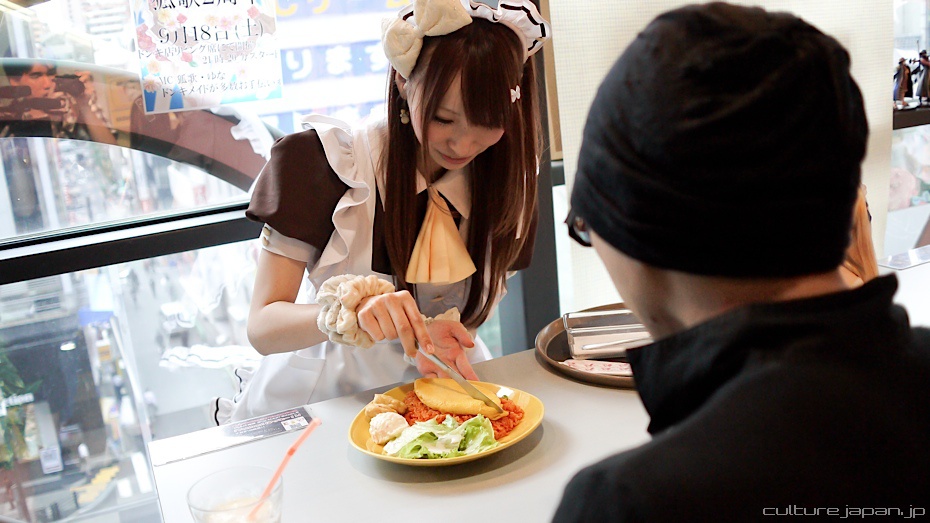
So anyways back when I stilled lived in Korea and was in Japan on vacation, I visited Tokyo. And I did the thing that all people who come to Japan always talk about, especially where Akihabara is concerned, and I went to a maid cafe. It was called At Home Cafe, At Home Maid Cafe, @ Cafe or something along those lines. I remember they made a big-ish deal about using an at-mark, @. Possibly there was another similarly named one, or they thought themselves extra hip for doing that.
ahhh that's the one.
Anyway, it was nice and fun and a good time. I went with a Japanese person who was also visiting Tokyo for a job interview, but had never been to one of these places before because they are seen as only places that otakus, perverted businessmen with too much time and money, and also gaijins would ever go to. And so, with myself as his loop hole to the otaku rule, he was able to allow himself to go in as he was accompanied by a gaijin.
The place had possibly like 4 floors, each with a different theme, and I suspect a staff that rotated between them frequently (like every 2 hours). The reason for that is you don't want a creeper to get too attached to you, and therefore they is like a kind of safeguard against that. Of course, they can follow you to another floor, but then they would have to pay for everything all over again.
We chose a floor with their maids dressed as maids with added ears and tails for animal effects. Our server was a squirrel, but I kept calling her a fox. You had your dogs, cats, bunnies, tigers, and I remember there being a turtle too (sexy maid turtle...weird I know), I am sure there may have been others, just none that really stuck out. The place was pretty dimly light with a pretty modern design and use of colors. It was also very girly. In the front and center was a stage.
At first they explained to us that there was an entrance fee that would be added to our bill for going there. Like a club or a pet cafe or such. Our fee was 500 yen. Not too bad. They also explained that it was a timed affair. I am pretty sure we only had an hour for everything, but I would tend to think that it might also be standard to have 90 minute affairs as well (I say this because nearly everything here in Osaka has a 90 minute timer on things - buffets, all you can eat Brazilian BBQ, all you can drink things etc). After an hour is up, I expect you are expected to pay up or to likely pay again for another hour. So first they sat us down and then they came and gave me a welcome to Japan party baggie (it had a few stickers, a piece of candy and disposable chopsticks in it...). That was weird. They actually did have an English menu, which is proving his theory of gaijins frequenting maid cafes to be pretty accurate. We both ordered a parfait, which in Japan is a bowl of artful ice cream and fruit madness. They were huge. There were other things on the menu like coffee and om-rice and a few more pretty standard easy to make, no-effort kind of things as well (sandwiches and the like). And they do expect you to order something. You can't just go there and creepily stare at the girls for an hour. At least drink some coffee with that creepiness, man.

I am not really sure how often they do this, it could be every hour, or we could have just been lucky, but the stage got put to goo use. We had a Janken tournament (rock-paper-scissors). Sounds weird because it is. Basically, one of the ladies gets up on stage and does rock paper scissors with everyone. If you beat her, you can stay standing. If you lose, you sit yourself back down and enjoy that parfait. So as it happens, I was among the top 3 people. I also had no idea what I was doing, and my companion thought it was more amusing to watch me flounder a bit. So the maid gals came and got me and ushered me on stage and set me up with some tiger ears. The other two contestants were also there in some bunny and cat ears. They were male. And businessmen. Theory more and more correct. We three janken with the hostess and then I try to walk away. But no, apparently I won that round as well. I can't remember if I did or did, but I think they almost kept me up there for laugh value. Also for people to stare at something besides the men up there doing 'kawaii-kawaii-janken'. Oh and also worth a mention there was a chant and accompanying...motions... for this that they made me do as well. Faces can not turn redder.
I lost in the final round. The prize was to pick two girls to be taken in a Polaroid picture together with you. Actually, when we ordered, we ordered a set which was the parfait, possibly a drink?, and also a picture with a hostess. I think we could even pick which one if we wanted to because I remember them asking. I think the whole set cost perhaps 1500 yen? maybe it was 900? Either way, I remember it being more expensive then a cafe, but not super ridiculously priced. But apparently, you need to be careful with some places and over charging, and their sketchiness factor. 


Right...the chant.... the chant went a little like this:

At home (but they are japanese and have to end  things in vowels so it sounded more like ato homu)
*make right hand into a fist/circular fingers and the left hand just barely cover it...like an at-mark @*
Nya Nya
*a cat sound and you ball up your fists and hold them near your cheeks and rock them back and forward slightly when you say nya nya*
Joki Joki 
*Joki is...I am not sure...but it symbolizes scissors, and you move your hands up to your ears and the same motions but with your fore and middle fingers make peace like scissors signs*
Wan Wan
* I am actually not 100% this is what they said, but it sounded like it and it was also what I chose to say(>.>). It would also make sense, seeing as if the first was a cat, the second is kind of similar to a rabbit, and this one would be a dog, as wan wan is the sound a dog makes in Japan. It was after all an animal themed maid cafe. So anyways, Wan Wan is for paper and you keep your hands by your ears and open your hands with fingers together and do the little up-down motion with them as you say it*

It all happens pretty quickly. So practice it so you are not unprepared.

flyer girl advertising maid cafes on the street.

Also worth a mention. You are not really allowed to take photos once inside the place. You might not even be allowed to take their photos on the street, but it is harder to stop you. The only picture I have of it, is the polaroid of the maid and myself. Also they take the time to draw all over the picture for you (hearts and things like 'love', 'kiss' and moe moe...whatever they things might be cute and pleasing to their customers). I will try to find and post the picture.

Thursday, October 25, 2012

Rice Cleansing

Here is a new experience for me, cleaning rice. Now I don't mean when you stick a bunch of rice in a pot and swirl it around a bunch of time until the water you pour off it is clear (and no longer white). This is more like a de-shelling process.

Right now is in towards the end of the rice harvesting season in Japan. Their rice patties have turned a golden color (or as one of my students pointed out, the color of my hair - and yes for a shocking second I thought he was saying I had rice-colored/white hair) and are being cut down.
Once you have all those delicious grains of rice all harvested however, you can't just pop those things into your rice cooker...you must de-shell them first. Harvested rice has a golden tint to it and once de-shelled, it loses that tint and becomes the white little grains we know and love.
In order to de-shell the rice, you must either have the proper equipment  or find yourself at one of the odd little stations located in crazy unsuspecting places not near anything else all around the inaka (out-there, the boonies, no-where-ville, the grasslands, farmland, you know). Why the inaka? Because where else are you going to farm rice? You cannot farm it in the city, and as such it makes sense to have these machines located in proximity to the rice patties. Though of course anyone who sells rice would probably own the equipment for themselves. But for those of us who do not have that fortune, there are the machines.
Basically you dump your golden, shelled rice into the indicated area which is then filtered through and you can witness the powder of the shells coming off and the freshly de-shelled white rice pouring out into your container. Here you can see us doing just that, and as you might be able to figure out, it costs 100 yen for 10 kilos of rice (22 pounds people)  and if you have more, you just insert another coin.