Thursday, January 17, 2013

Special Bread

I have no idea if this is a wide spread thing throughout Japan or not, but it is something that I think is fantastic through and through.

There is a little place called Toyama, I can't personally say that I have been there myself just yet, but I do have many a friend there. And one tells me of a certain program for adult citizens of a special mind. In other words, the ones who cannot function well in normal society. Those who cannot have normal jobs and need help with their daily activities often. I feel like there are a good many of these kinds of people in Japan. Perhaps it is because in America we find a way to lock them in some care institution or hide them from the public eye, and therefore I was never formally aware of their presence, or perhaps it is just because I am more adult now and get to notice these types of things.
Either way, in Toyama these people have a unique way of fitting into society. They are breadmakers. In the traditional sense of the word where they are those who make bread, not the head male of the household in 1950's suburbia. Their job is to make bread and have it delivered to certain places throughout Toyama, one of which being the school of a dear friend of mine. Pretty awesome program right?


Tuesday, January 15, 2013

いらしゃいませ

which is pretty much the standard greeting upon entering any store.

These beauties are out in front of the new  (LCC) Terminal 2 of the Kansai airport. 
However they will greet you especially enthusiastically if you see several pots of these outside. You see these beauties right here signify new stores. And typically I believe they are supposed to be given but more than likely the owner just buys a bunch of them and pretends people love him and really want him to open his enormous ass pachinko parlor right there. They don't. Oh well that is only one scenario. They can actually be in the fore front of any store upon its openings. It just seems that they are exceeding standard and super standard quota when it comes to casinos.

So for those who do no know, these are orchids. They are typically a white variety with an exceedingly large flower and flowering stem. And worse, they pick the most exceedingly common, not even interesting one to display everywhere: a phalaenopsis. Orchids in Japan seems to be a pretty common sort of gift when it comes to flowers. Winning a game? Pretty sure you will have orchids on your doorstep when you come home. Sick in the hospital? Something of the same variety might appear. And for some reason...ok I write that like no one can guess it. I am pretty sure we can all guess by this point why they choose a large white flower to give...purity, good fortune, longevity, take your pick. I am sure that it will mean something of that variety. 
To me orchids are kind of a silly gift. An extremely impractical flower. First of all orchids need a tropical climate to survive. So no, they are no an outdoor plant. Maybe in Okinawa. Also they need a pretty warm environment  so that means a sunroom and maybe constantly running a heater in the winter. And most importantly, those big beautiful stems full of flowers? Yeah, those will wilt and die. Not even the stem remains. You will be left with just the leaves. It looks like this.
jesus my house is full of these...
I know all this because my parents have a nice big sunroom full of orchids that they like to grow as a hobby. And whats more? Orchids need pretty specific conditions to bloom. I mean it is not like I had a house full of flowers as a kid. I didn't. They take a long time and lots of car to grow a whole new stem to bud and bloom. And that process can take years. No really. Some of the orchids in my house I have never seen bloom. Once I saw this really beautiful peach one bloom for about a week. I have no idea which one it is now. 

Now what would be a really fantastic business in Japan, is for someone who really has a green thumb, really good at growing and nurturing orchids (in other words not my parents by the number that I have seen come to flower in my childhood), to rent these out to the sad people who try to inflate themselves by buying them in secret for their own businesses. But renting, not buying, this way, when the stems die and the leaves remain, you can just send back the plant for them to bloom again for some other store front. It is a really  was to gain and regain profits from the same plants. Brilliant if you ask me...I have changed my mind. quite reading this blog. Don't come to Japan. This is my idea!...ok, or at least name your store after me? 

Thursday, January 10, 2013

Leaving on a Jet Plane

No.

I'm not.

As much as my parents wish it were true. It isn't.

This one is more about how to get to the airport.
You see there are several exceptionally cheap methods to get to the airport that people ought to be informed about. Or at least people in Kansai.

So the first and my current favorite option is the bus. The regular pay for taking the airport bus on over to Kansai International Airport, from hereon being referred to as KIX, is 2500 yen. This is a one way trip. However, the trip is a little less than an hour and a half and you don't have to worry about your baggage at all and the bus's seats will recline and there is a toilet. So when you are going home or traveling to some place with a long stay and extra baggage, probably the better option for you so you don't have to worry about transporting your baggage as much. The discount deal for this transportation method, is that if you are coming back to Kyoto (note, that price is specific to Kyoto - it is 1500 for Osaka I think and 2000 for Ibarakishi) is that the ticket will be 4000 yen. Yeah, a pretty steep price, but it is 1000 yen off. The deal is only valid for 14 days, so if your travels are more than 2 weeks, it is sort of not worth it, because you will just waste more money and have to buy a new one. Though on the other hand, the guy accepting tickets might not check the date if you are lucky...
The bus schedule and prices for anyone who is interested.


Another way to get to the airport, which I cannot actually boast to have taken though it is my vow for next time, is via train. Which will vary from 1150 to 1830 to 2390 depending on your preference. Pretty much an unreserved seat will cost you 1150 yen, which I am certain that you will be able to find, unless there is a massive hoard of people setting out on an adventure that day. The regular fare of 1830 will guarantee your seat on the train and probably even assign it to you, so when some aimless shmuck without a seat reservation sporting an unreserved seating ticket is sitting in your seat, you can have all that glory of thrusting your little numbered ticket in his unassuming face telling him to high tail it out of there and that the town aint big enough for the both of yous. Ok maybe not all that, but that can be how it might feel. And lastly, the expensive ticket is pretty much the nice car. I have no idea what makes it nicer. Perhaps cushier seats or maybe they have the capacity to lean back, or maybe they come with butlers to take your drink orders for little fruity umbrellaed drinks, nothing like a little pre-vacation wishing before your vacation eh? In any case, those tickets are said to be for green seats, which probably is meant for an entire car of green colored seats, as opposed to green and other variously colored seats intermixed throughout all cars of the train. Though personally, I am a bit lost with this payment system...I am one of those fine upstanding citizens that have the little train/metro money card where, as in most places that have excellent public transportation, I just scan it and walk on through the gates to the proper train. And then it charges me for my journey after I swipe it upon exiting the gates at my destination. However I am under the impression that this special airport train will have an attendant who will come by and make you pay for your ticket once you are seated. So my question would be do you pay twice if you are using my little transport card in addition to paying the money grubbing wench on the train? Well I suppose I shall see on my next venture. In either case, and probably the better of scenarios, you can always buy a ticket at the train station office, at least there, you can buy a unreserved seat if you so desired where I am sure the train wench would charge you for whatever seat you happened to be cushioned in.
This train takes you all of an hour and fifteen minutes to get to the airport, however I would like to point out that it will likely arrive sub-terrain with possibly a bit of walking to the departures and check-ins floors as opposed to the bus which dumps you off right in front of the check in counters. I will edit more of course after my next vacation. 
The only down side to the train is carting that luggage to the actual check in counters, oh and the fact that it only runs once an hour. The bus will run several times an hour and therefore there is always safety in numbers. But then of course, if you miss your train, you can always take the bus as a back up. After all they are located at the same place. 
Also worth a note, a double train fare is cheaper than the special deal for the round trip bus (which is probably why I am curious-and by that I mean confused- about the payment methods and transactions when using the train).
EDIT!
Ok an edit to this one. I found out last weekend it is 2990 to go to the airport from Kyoto via train if you do not change from the Haruka Express. It is only 1830 if you change trains in Osaka, which is also a lot slower I think...

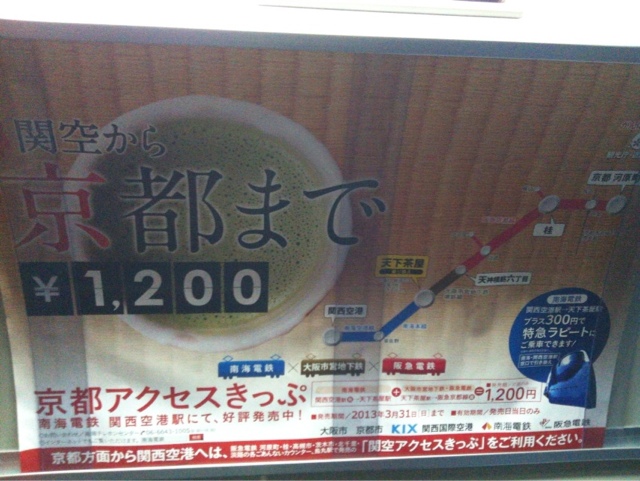
And finally the only other method I have actually taken before now, is the low cost slow train route to the airport. It takes probably more than two hours and you have to transfer like three times, but it is cheap. It costs 1200 yen from Kyoto to the airport, but there are different routes and prices for different areas in the Kansai region, which don't really seem to be well advertised, except for on the bus to and from the second LCC terminal of KIX airport. At least in the Kyoto region, you first start out taking the Hankyu lines heading toward Osaka and alighting at the Awaji station and exiting and transferring to the Nankai lines, from which you will disembark and transfer a final time to board the airport railroad trains. 
Due to the amount of transferring  this process is not recommended for those who have lots of bags. Pretty much used only by those few backpackers who have no money left from their travels in Japan. And people like me of course. 
Also worth a note, it is not really cost efficient to take this method of transportation to the airport and then return home on the bus if your trip will be within two weeks. 1200+2500=just not worth it and go buy a round trip bus ticket 300 yen is just not worth saving if you have to go through that much trouble with your bags. 
Ticket package and tickets for Hankyu and Nankai lines
awesome multilingual paper tail that no one reads


other deals for areas in Kansai

Tuesday, January 8, 2013

Less a Home

Homeless in Japan.

Not me of course.

Many people in Japan do not have a home, by choice or by other circumstances that are known only to them. Actually a pretty good book called the Devotion of Suspect X, highlights Japan's homeless in pretty good detail and gives a potential grim outcast. I won't go in o further details in case of spoilers. It is a good book and a pretty quick read, you should look into it. 
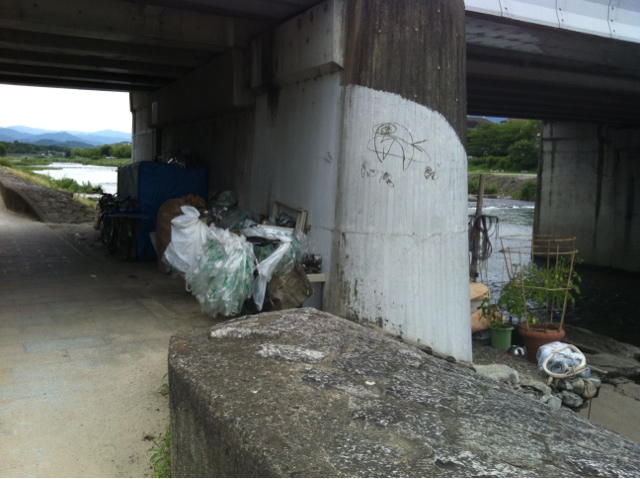
Anyways, one of the popular spots for the homeless to live is by the river. Any river. I am not really sure why this is, if it helps to carry away their bodily wastes, or if it functions to help bathe themselves and their clothes, or for drinking, or maybe all of the above. In any case, they are usually there. They actually remind me of the hoarder I posted about a bit ago. They have a large accumulation of stuff near their locations, often covered with a large blue tarp. Others who live in a more permanent locality, will even set up their own little hand built shack made of wood or cardboard or scraps of metal. Those people will usually be a bit away from the bustling of a city where people or officials would be less likely to hassle them and tell them to remove their structures as they are not really in the way of any one or thing. They set up their camps along the under sides of bridges which can't help but remind me of the trolls in Billy Goats Gruff. But they do it not to frighten poor little goats, but for the over head streets to act as a shelter from the rain. They will then camp themselves on the inside of the pillars that hold up the bridge so as not to be seen or stared at by too many passersby. You know privacy, but also I suspect it is also part due to the Japanese sentiment of not being in other peoples way. 
can collector
So what do these people do to get by? They do not busk. They do not beg or hassle you for money. Many of them collect cans. They ride their bikes around and go through garbage bins and those recycle spots right next to vending machines in order to draw out the aluminum cans to collect and turn in for mere pennies a piece. Others will go in search of daily employment. There are facilities that hire people based on a day to day basis. A lot of these places are places like construction sites, and they will pay you by the day for your work. This helps to keep mouths fed and people from begging. However, there is also a bit of a shady aspect to them. A few known killers have flown under the radar for months and years working for daily job sites like this before being apprehended. That is because these places don't require too much information about you and it is easy to get employed with very little effort. It is a double edged sword allowing the homeless to work by not requiring too much information like addresses and such, but also potentially letting not so good men into your presence; however I think this system does more good than harm. 


among the places you will not see on house hunters


Thursday, January 3, 2013

Spring Cleaning

Does not actually happen in the springtime for Japanese people.

It is something that everybody actually does before the new year, right around Christmastime, or soon afrer. The big osoji (cleaning). Everything must be cleaned. It is pretty much a ritual habit or culture aspect of Japan. Houses, work places, gardens. Everything. And not just your weekly cleaning. I am talking about spring cleaning clean, but almost over and beyond. At least over and beyond any spring cleaning I have ever done. Take everything out and individually clean it and clean the room. Ceilings too. Before you put anything back inside.
I even cleaned under my built-in bathtub with fungal cleaner.
They do this to welcome the new year with a nice and fresh house. The more and more I study about Japan and its culture it is so interesting how repetitive they are with all of their customs and reasons, it seems they are oddly superstitious. They always try to start everything, houses, relations, semesters  workplaces, anew as a way to purify it and to bring in good luck, longevity, and prosperity. To push out the demons of yesteryear and invite in the good spirits and freshness for the new year.
After everything has been cleaned, the decorations are put up, which often consist of mochi and oranges, as well as whatever the year's zodiac happens to be. Likely you will find those large bamboo pine decorations called kadomatsu in front of especially prestigious shops, hotels and other locations soon after as well. In homes, a bit more modest decorations are in place, in addition to their mochi and oranges, they also will typically have  twists of straw rope they are a bit famous for, as well as their paper decorations. All of these things will again reinforce the themes of purity and prosperity in their homes and workplaces.